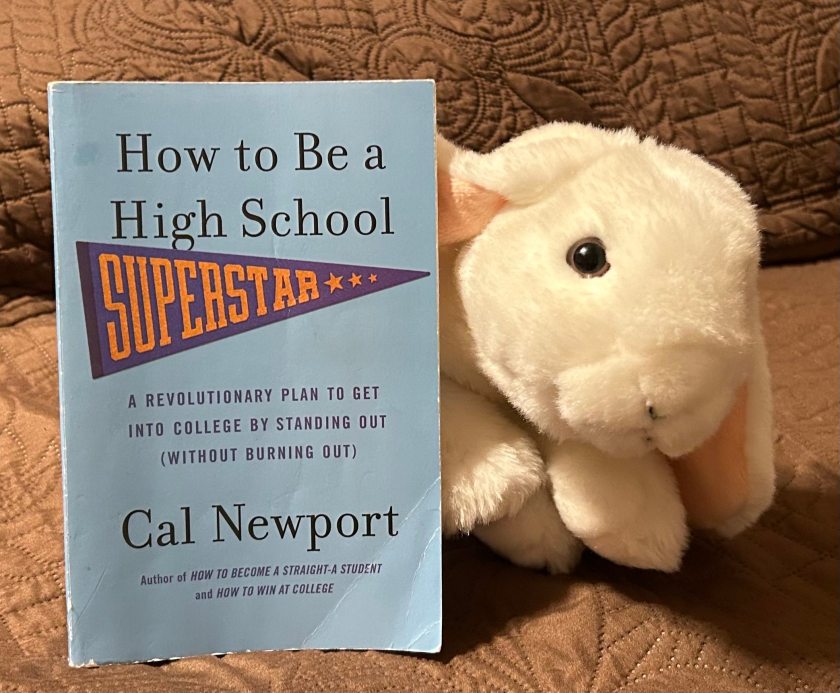
Last year Marshmallow reviewed two advice books by cal Newport directed towards students: How to Become a Straight-A Student and How to Be a High School Superstar. This week she got into Newport’s most recent book Slow Productivity, published in March 2024. Sprinkles enjoyed reading this book immensely, so she wanted to join Marshmallow in this review.

Sprinkles: So Marshmallow, this is your third book by Cal Newport, isn’t it?
Marshmallow: Yes. I find him to present very thought-provoking ideas.
S: I find his books interesting as well. So we both read this one. It is titled Slow Productivity. I think he was inspired by the slow food movement, where you emphasize slowness and quality and community and local ingredients instead of mass-produced generic fast food. I also read a book a while back about slow teaching; it was also cool. So can you tell us briefly what Newport means by slow productivity?
M: Slow productivity is the idea of decreasing your workload so you can increase the quality of your work to reach certain, specific goals all the while making sure you are living a sustainable life.
S: That sounds like a very appealing goal. Tell us more.
M: So his method, Newport promises, will decrease the familiar overwhelming anxiety and stress the modern knowledge worker experiences.
S: Wait, what is a knowledge worker?
M: According to IBM, a knowledge worker is “a professional who generates value for the organization with their expertise, critical thinking and interpersonal skills.” So someone who uses computers for accounting, writes code to solve specific business problems, works as a professor, or is a freelance writer, or stuff like that. So unlike the previous Cal Newport books I’ve reviewed (which were intended to help students), Slow Productivity is aimed at adults who have already begun their careers.
S: Yes, I think so too. So I was surprised when you picked it up. But you seem to have enjoyed it, seeing how you have finished it already.
M: Yes! I started reading it so that I could be prepared for when I grow up and have my own career. I think adults are always too stressed. I wanted to go into my career with ideas on how to be productive in a healthy manner that yields professional success. I also thought this book might still have principles and methods that could be helpful to me as a student.
S: That second part makes total sense, but the first part is really interesting and would probably be surprising for most folks. Especially if they do not know you well… I am sure you are one of only a few little bunnies your age who are thinking of reading about how to be a productive well-balanced adult! Okay so tell us a bit more about the book. How do we do this slow productivity thing?
M: Well, there are three principal ideas of slow productivity. And these are: do fewer things, work at a natural pace, and obsess over quality. The book utilizes a plethora of “case studies” (as Newport calls them) to prove the author’s suggestions and theories. From each of these examples, he synthesizes (or reiterates) the related slow productivity lesson.
S: I think these are good principles for almost anyone. I mean, they are definitely meaningful for me as a working adult and parent, but also for you. You are now a busy kid going to school and doing a lot of extracurricular activities. And these principles seem to agree with the advice he gives students. Do not cram too many activities just to impress. Do fewer things but do those at such a high level that you will be impressive that way.
M: Yes, I’ve recently seen this idea of his show up in the Atlantic under the name of a spike applicant (one who is exceptionally good at one thing.
S: I remember a colleague who said, “Everyone talks about well-rounded students; what is wrong with a sharp knife?” I loved his analogy. I think this spike idea is similar. I mean not everyone is or needs to be a sharp knife, but we do need sharp knives, and they often find their niche. But I also think it makes sense for young bunnies to explore different types of activities to see what they enjoy and what they are good at. Those explorations provide a lot of insight and you can be surprised by what you end up liking and being good at.
M: Yes. In this book though, Cal Newport focuses on maintaining a low, easy workload so you can finish larger goals over long periods of time and build your expertise in your field.
S: That is a different life stage than the exploration stage I was talking about. Of course, his student advice is also about being selective with extracurricular activities, but one needs to figure out what they like and what they want to productively focus on. There is serendipity, some portion will always be about chance, but one also needs time to try out new things. At least that is what I think. But what do I know? I have not written any productivity books!
M: Well that’s okay! Cal Newport gives you the tips so you can focus on other things you like to do and how you can become a fuller person as a whole by managing your workload. In his book for high school students, he focuses on becoming a more interesting person for the sake of college applications (personal growth too I suppose, but primarily applications). In this book, he focuses more on the idea of growing yourself to be a more complete, content individual. I found his idea of pseudo-productivity being unnatural to be quite stimulating. Cal Newport’s books all have this underlying idea that the general consensus (whether in college apps or in careers) is bad because it has been unnaturally perverted towards pseudo-productivity, or doing things just to seem like you’re productive. His main mission is to convince you that this is not the correct way of things and that the situation can be improved by acting in a more natural, original way.
S: Yes, I think that is a good way to put his message in these three books together. I too find his books always give me good ideas. And I am glad you appreciated this book too.
M: Yes! I found his ideas to be very useful, even as a child bunny.
S: This is already quite a long post. Shall we wrap it up?
M: Sure! In summary, I would really recommend this book for all adults who work in the knowledge sector. Even as a bunny in school, I can see that the current work system is set up in a way that is not sustainable for individuals and society as a whole. I hope the situation improves before I join the workforce for my sake. But for the sake of others, I hope this book is more widely read so more people can enjoy full lives with more success.
S: That is a nice sentiment! So how would you rate this book?
M: I would rate this book at 100%. I really liked it and I found it to be very helpful. Cal Newport’s methods are quite logical.
S: That sounds just about right! Okay, what do you want to tell our readers as we wrap this up?
M: Stay tuned for more amazing reviews from the book bunnies!


 BookBunnies