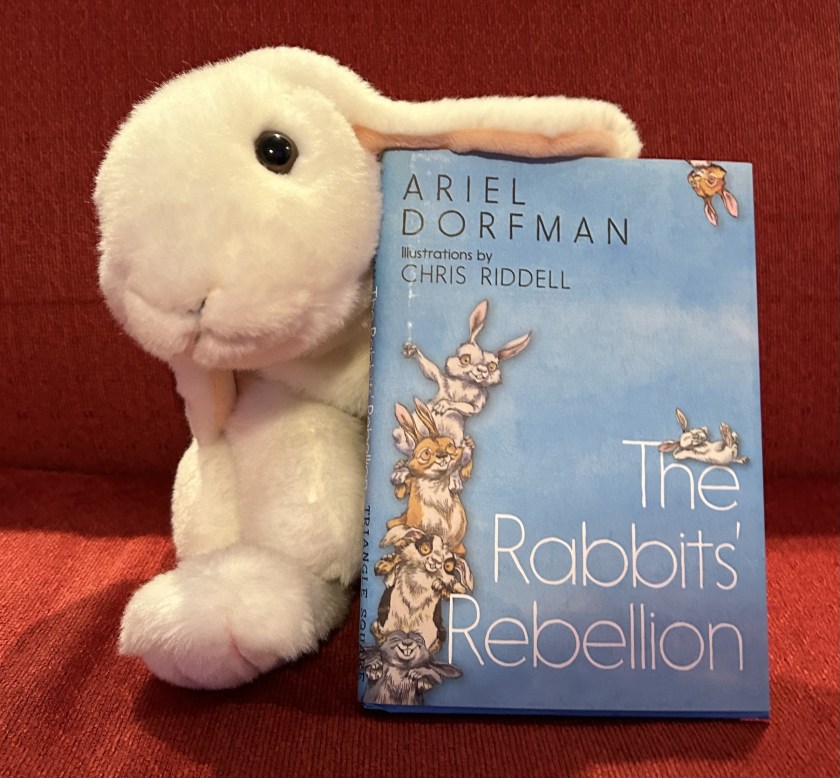
Today Marshmallow reviews a little book with a big message, first published in 2020: The Rabbits’ Rebellion, written by Ariel Dorfman and illustrated by Chris Riddell.
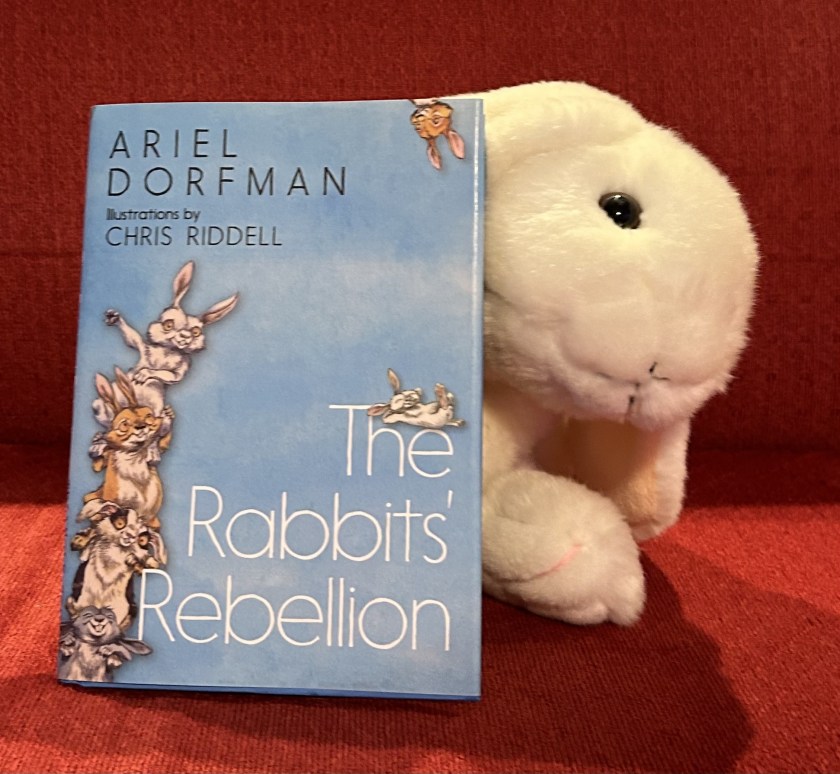
Marshmallow’s Quick Take: If you like children’s books about animals and clever political commentary, then this is the book for you!
Marshmallow’s Summary (with Spoilers): When the wolves invade the land of the rabbits, the Wolf of all Wolves crowns himself king and begins to make some wild claims. First of all, he—feeling quite omnipotent that day—declares that rabbits don’t exist. He bans any reference to them in books (by personally crossing them all out) or in conversation. Unfortunately, birds can fly and report seeing some, which spread rumors that perhaps rabbits do exist.
The king then decides then, if (as his fox advisor says) “seeing is believing,” he’ll make his subjects see exactly what type of a ruler he is. So he commands an old monkey to take regal photos of him to be put up in every town square, every neighborhood, and in every house. He forces the birds to carry these posters, tying their feet to an “endless” cord to make sure they can’t escape. Naturally, the old monkey is terrified of the king and bends to his every whim and want. In other words, he says, too, that rabbits don’t exist. On the other hand (or paw!), the monkey’s daughter—with the fearlessness of innocence—knows that rabbits do exist even though her parents make sure to censor her whenever it becomes necessary.
But that’s just the beginning of the old monkey’s struggles. Every time he takes a photo of the wolf king, there is some hint of a rabbit in the background. When the king shatters the beavers’ dam (which took them three years to build), there are two rabbits sitting on the grass in front of the camera. When the king snarls in the most ‘majestic’ manner, a long, fuzzy ear shows up in the corner. This is most problematic because the monkey can’t show the king photos that go against his rule that rabbits don’t exist. So he doctors his photos after they develop, erasing any and every trace of rabbit hair, ears, or tails.
As the king becomes increasingly more controlling, more egotistical, and more tyrannical, the monkey must keep taking photos and editing them. Despite the king’s advisor tightening security around the photo shoots (he doesn’t want the king to know about the rabbits either—it would look bad on him), the rabbits persistently keep up their rebellious photo-bombing. But how could they, when they don’t exist?
Marshmallow’s Review: The Rabbits’ Rebellion is a really good book! It is written as a book for little children, and it reminds me of some Roald Dahl books I read earlier. Roald Dahl was unique in a way because his books could be read as childish tales, but they also touched on deeper topics. Likewise, the meaning of Dorfman’s book might not be understood by very young readers even though they would still enjoy reading about these mischievous rabbits who insist on existing! (Go, bunnies! Of course I cannot be too impartial here.)
At its core, The Rabbits’ Rebellion is about authoritarianism and dictatorship. The king’s suppression of truth, especially a truth that is so obvious, is in a way an almost comically extreme example of an Orwellian dystopia. In a way, this book is like Animal Farm or Nineteen Eighty-Four for young children. Except—spoiler alert—this one ends better than both of those books.
The Rabbits’ Rebellion is entertaining even if you don’t catch this theme. It is kind of like how one might enjoy reading parts of Animal Farm even without digging into the allegory. But Animal Farm ends at a quite depressing place for young bunnies to really enjoy it all the way to the end. Similarly, I learned that some parents have complained that the ending of The Rabbits’ Rebellion is too graphic to make it appropriate for a calm bedtime. So readers beware!
I found it interesting that the world of this book is so different yet also very similar to ours. There is no magic, but they do have cameras and books. Remember how in Maus the whole story only involved mice and a few other types of animals, but we could see our own world in it? Just in the same way, the differences and the similarities despite those differences help convey Dorfman’s message very clearly.
All in all, The Rabbits’ Rebellion has a really poignant yet simple plot and is a very thought-provoking book even though it is extremely short (only 63 pages). Written in large font and with really beautiful illustrations that evoke a serious, fairy-tale feel, it is quite easy to read, too. I think it could be a great way to introduce children to political thought and discussion. (I might reread Nineteen Eighty-Four as a result of reading The Rabbits’ Rebellion, because this book really reminded me of it.) Overall, I would definitely recommend this book to bunnies young and old, who both will find it entertaining (perhaps intellectually) and thought provoking.
Marshmallow’s Rating: 100%.
 BookBunnies