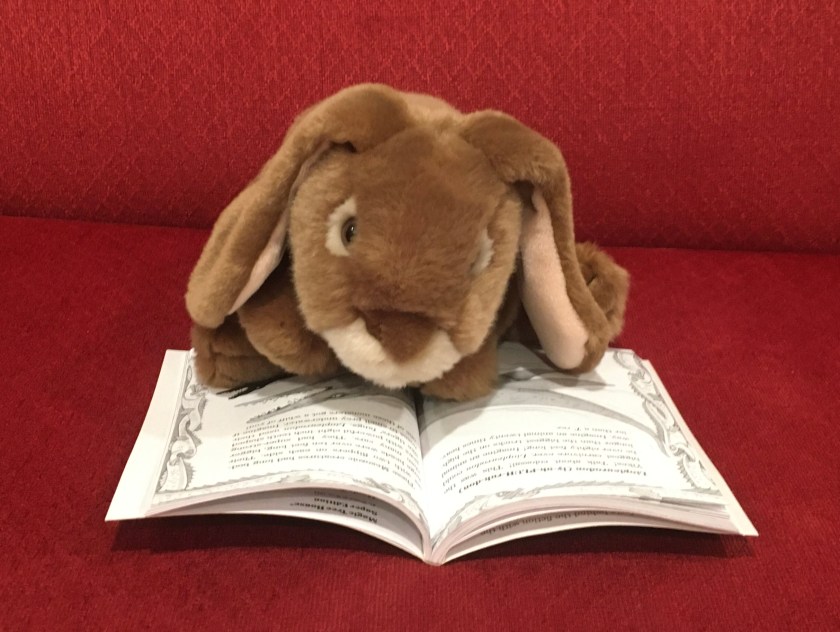
Caramel reviews Sea Monsters (Magic Tree House Fact Tracker #17) by Mary Pope Osborne and Natalie Pope Boyce

Caramel has reviewed several Magic Tree House books already: Night of the Ninjas (Magic Tree House #5), Afternoon on the Amazon (Magic Tree House #6), Knights and Castles (Magic Tree House Fact Tracker #2), Sunset of the Sabertooth (Magic Tree House #7), Midnight on the Moon (Magic Tree House #8), and  Dolphins at Daybreak (Magic Tree House #9). This week he wanted to talk about another fact tracker book: Sea Monsters. As usual, Sprinkles is taking notes and asking questions.

Caramel reviews Sea Monsters (Magic Tree House Fact Tracker #17) by Mary Pope Osborne and Natalie Pope Boyce.

Sprinkles: So Caramel, you found another book about real things, I see.

Caramel: Yes. This is a book about ocean “monsters”.

S: So who are these monsters? Can you tell me a few of them?

C: There is the angler fish, the giant squid, the goblin shark, the cookie cutter shark, the hairy angler fish, the vampire squid, the dragon fish, oar fish, …

S: Okay, I get the point.

C: … giant tube worms. There is also this dunkleosteus–

S: Hmm, I have never heard of most of these. But this last one does not sound familiar at all. What is a dunkleosteus?

C: It is a giant armored fish, I think it is about forty feet long. Its teeth are actually bone.

S: And it is extinct, right?

C: Yes. And there are other extinct species too. There is the liopleurodon, and the megalodon–

S: So I understand. The book talks about large sea creatures, then. Right?

C: Yes. And my favorite is the liopleurodon.

S: Why?

C: Because it is not armored but it has a giant head. I think it looks really interesting!

S: I’m not sure I’d like to face one under water any time soon!

C: You don’t have to worry about that. They are already extinct!

S: That’s good.

C: Not for them.

S: That is right Caramel. This does seem like an interesting book, with many different types of facts in it. So tell me how it is organized.

C: Chapter titles! Here you go: The first chapter is called Sea Monsters. Then the second is Exploring the Oceans. The third is Squids, Octopuses and Other Creatures. Then there is a chapter called Creatures of the Deep.

S: That’s where we learn about the angler fish!

C: Yes. then there is Prehistoric Seas. And there we learn about the liopleurodon, the megalodon and similar creatures. And then the last chapter is called Sea Monster Tales.

S: Which chapter was most interesting for you?

C: I think I liked the Prehistoric Seas chapter most.

S: I know you like prehistoric animals. You have reviewed a Magic Tree House book about the saber tooth before. And another book on dinosaurs. No wonder you chose the liopleurodon as your favorite sea monster.

Caramel is reading about the liopleurodon in Sea Monsters (Magic Tree House Fact Tracker #17) by Mary Pope Osborne and Natalie Pope Boyce.

S: So what else do you want to tell us about this book?

C: It has a lot of pictures and tons of facts! Jack and Annie from the Magic Tree House books tell us all sorts of things. There is also some facts about Steve Irwin and about Jacques Cousteau.

S: We watched a lot of episodes of Steve Irwin’s show together, right? It is sad he died of a sting ray sting. And Cousteau was a famous explorer who was one of the first to go deep into the oceans and to explore. That is great that you read a bit about both. So tell me the most interesting fact you learned from this book.

C: It’s about the largest jellyfish. So let me find it… Okay, here I will read it to you: “The longest animal in the world is not a whale. It is a special jellyfish called a siphonophore. Its tentacles can reach 131 feet long!”

S: Wow, that is long! Wikipedia tells us that “a siphonophore may appear to be an individual organism, each specimen is in fact a colonial organism composed of medusoid and polypoid zooids that are morphologically and functionally specialized.” That is really interesting! I had never heard of them before.

C: Me neither!

S: Okay Caramel, it is probably a good time to wrap up this review. Would you like to tell our readers your three words on this book?

C: Factful, curious because these are really curious animals, and black-and-white because all the illustrations are black and white.

S: Maybe instead of factful we can say “informative”?

C: Yes, that works too!

S: Great! I think then it is finally time for you to say your closing words!

C: Stay tuned for more book bunny reviews!

Caramel recommends Sea Monsters (Magic Tree House Fact Tracker #17) by Mary Pope Osborne and Natalie Pope Boyce, to all curious little bunnies who want to know more about ocean life.

Marshmallow reviews Tyrannosaurus Wrecks by Stuart Gibbs

Marshmallow has already reviewed the first five books from Stuart Gibbs’ FunJungle series: you can check out her review of the first book, Belly Uphere, while her review of the second book, Poached, is here. Her review of the third book Big Game is here, her review of the fourth book, Panda-monium, is available here, and her review of the fifth book in the series, Lion Down, is here. Today she shares with us her thoughts on the sixth and most recent book on the adventures of Teddy Fitzroy: Tyrannosaurus Wrecks.

Marshmallow reviews Tyrannosaurus Wrecks by Stuart Gibbs, the sixth book in Gibbs's FunJungle series..
Marshmallow reviews Tyrannosaurus Wrecks by Stuart Gibbs, the sixth book in Gibbs’s FunJungle series..

Marshmallow’s Quick Take: If you like animals or if you have enjoyed some of Stuart Gibbs’s other books, then this might be the book for you. 

Marshmallow’s Summary (with spoilers): Teddy Fitzroy lives in FunJungle, a mix of a zoo and a theme park. He has just apprehended the Zebra Spanker when his friend, Sage Bonotto, asks him to investigate the disappearance of his tyrannosaurus rex. Apparently, while the skeleton of a T-rex was being excavated on his family’s ranch, someone stole her skull.

The case seems impossible. The skull of Minerva (which is what they named the T-rex) was five hundred pounds and the burglary happened in the middle of a really bad storm. The thieves should have left some trace but it seems like they haven’t. Even worse, the local police thinks that it’s a hoax. So Sage asks Teddy to investigate. (Teddy solved some other cases before.)

While Teddy is at the scene of the crime, the twin school bullies Tim and Jim Barksdale call him. Jim asks Teddy whether he can use the Heimlich maneuver on a snake that has eaten a cat.  It turns out that Tim and Jim illegally purchased an anaconda that ate their cat Griselda. As he investigates, Teddy finds that the twins bought it from Snakes Alive, a new zoo that is nearby and is trying to take business from FunJungle. (Their signs say stuff like “MORE FUN THAN FUNJUNGLE—AND A WHOLE LOT CHEAPER!”)

As Teddy learns more about the two cases, things get more and more complicated. You will just have to read the book to find out more!

Marshmallow is reading Tyrannosaurus Wrecks by Stuart Gibbs, the sixth book in Gibbs's FunJungle series..
Marshmallow is reading Tyrannosaurus Wrecks by Stuart Gibbs, the sixth book in Gibbs’s FunJungle series..

Marshmallow’s Review: This is a really good book for people who like to read about animals and mysteries. The characters are very well written. The plot involves a very interesting mystery. There are a lot of people that you could suspect, and the thief is someone I would not have suspected. Without all of the evidence, it would be impossible to solve the case.

At the end of the book, the author, Stuart Gibbs, has some notes about one of the main topics in the book: animal trafficking. This is something Gibbs does in all the FunJungle books, and helps the reader connect the book to real life.

Tyrannosaurus Wrecks is probably best for ages nine and up. This is because the plot is very intricate and it could be very confusing if the reader doesn’t catch all of the evidence. Also it could be scary for readers who do not like snakes. Another reason is because its “language is not very delicate” (as Roald Dahl wrote about Matilda‘s father). But all that aside, this is a very entertaining book. 

Marshmallow’s Review: 95%.

Marshmallow rates Tyrannosaurus Wrecks by Stuart Gibbs, the sixth book in Gibbs's FunJungle series, 95%..
Marshmallow rates Tyrannosaurus Wrecks by Stuart Gibbs, the sixth book in Gibbs’s FunJungle series, 95%..

Caramel reviews Ragweed by Avi

This week Caramel wanted to talk about Ragweed, a book by Avi. As usual Sprinkles is asking questions and taking notes.

Caramel reviews Ragweed by Avi.

Sprinkles: So Caramel, this book seems to be a new favorite for you?

Caramel: Yes.

S: What is it about?

C: It’s about Ragweed, a mouse who leaves his home to explore the world.

S: That sounds interesting! And kind of like Ralph, in The Mouse and the Motorcycle.

C: Yes. But Ralph lived in a hotel and Ragweed lives next to a brook.

S: I see. So Ragweed decides to leave his home and travel. Where does he go?

C: He goes to Amperville, I believe. He gets on a train and gets off in a small town named Amperville. Amperville has a part called Mouse Town because that is where the mice live.

S: That sounds good. So Ragweed meets a lot of new mice in this town, right?

C: Yes. One of them is named Clutch.

S: Do you know what clutch means?

C: Nope.

S: Wikipedia tells us that it is a mechanical device connecting and disconnecting parts of a car engine. Did you notice that almost all the Amperville mice in the book had names that were related to cars?

C: Yes. And there is a mouse band called the B-Flat Tires. That’s also about cars.

S: Yes!

C: I think the reason is that they all live in cars.

S: And Ragweed on the other hand is a natural thing, it’s a type of plant, right? Not a car. So from their names you can tell …

C: where they are from! The mayor of Mouse Town is named Radiator for example. Cliutch’s mom is Foglight and her dad is Windshield. And then there is Blinker. I don’t think that is about cars.

S: But look, Wikipedia shows us there are also car blinkers! So even Blinker’s name is related to cars!

C: Yes, that’s interesting!

S: Did you know that Ragweed is part of a series of books but it is not the first book Avi wrote in that series?

C: Really?

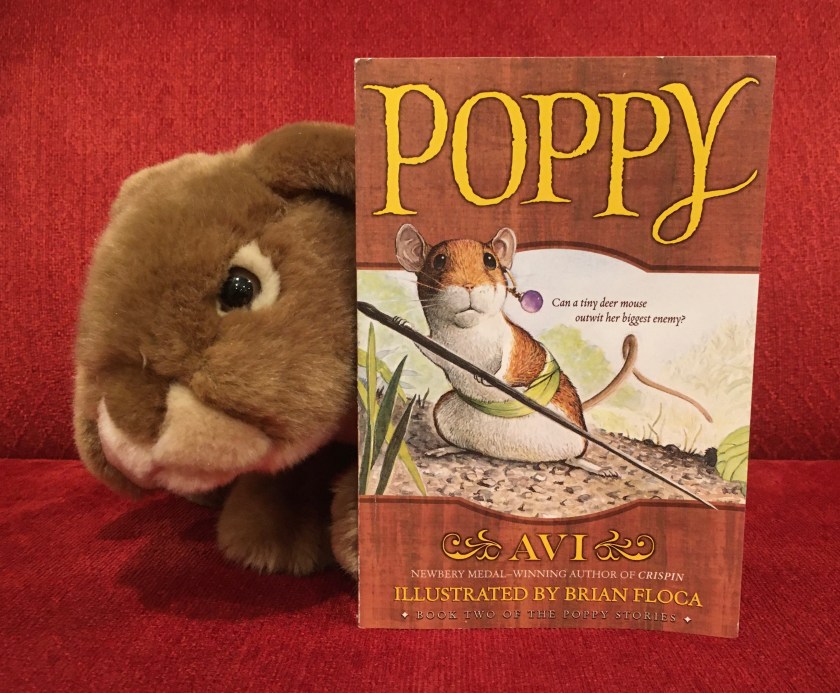
S: Yes, apparently Avi, the author, first wrote a book named Poppy, about a mouse named Poppy. And then he wrote Ragweed as a prequel. Do you know what’s a prequel?

C: A book that comes before another?

S: Right. So there is apparently a Ragweed in Poppy, and the author wanted to tell his backstory. So I guess you should eventually read that Poppy book as well.

C: I might read it next then.

S: That sounds good to me.

Caramel is reading Ragweed by Avi and looking at the illustrations by Brian Floca.

S: What else do you want to tell our readers about this book?

C: Can I rate it then?

S: Yes, give me three words that describe the book.

C: Adventure, danger, cliffhangers.

S: What do you mean by cliffhangers?

C: Well, it ends in a cliffhanger. Sort of.

S: I guess you will just have to read Poppy then.

C: Exactly.

S: Then let us wrap this up so you can get started. What are your last words for this review Caramel?

C: Stay tuned for more book bunnies reviews!
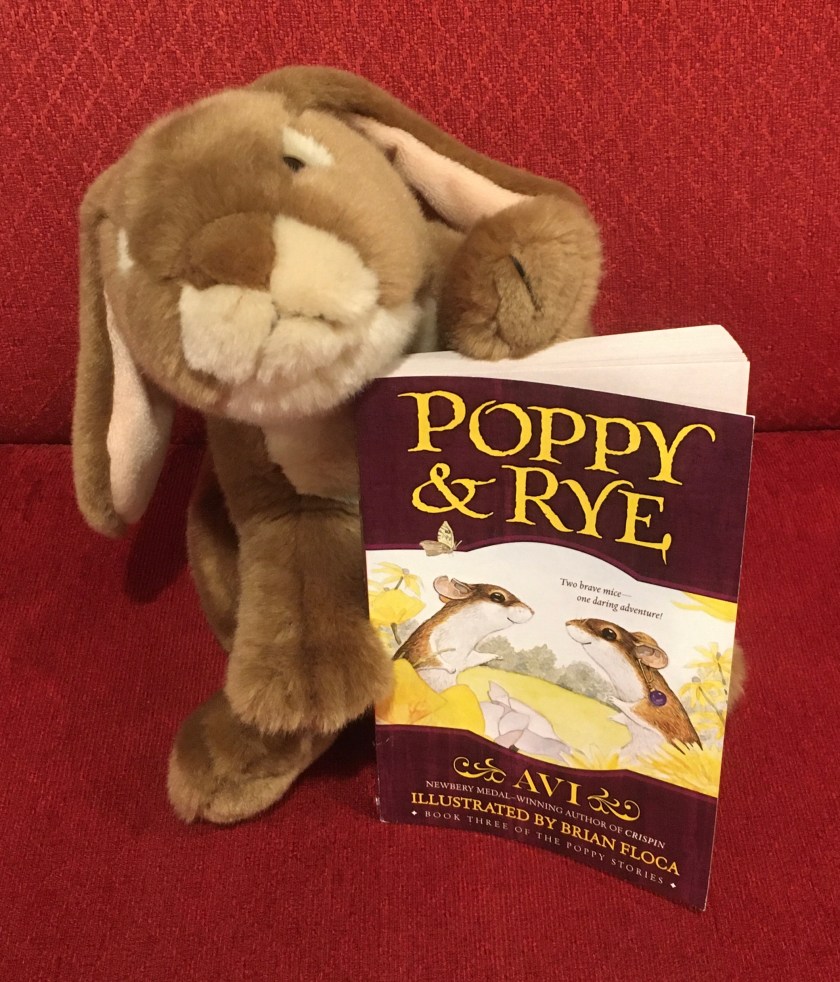
Caramel enjoyed reading Ragweed, written by Avi and illustrated by Brian Floca.

Caramel reviews The Magnificent Book of Ocean Creatures by Val Walerczuk and Tom Jackson

A few weeks ago Caramel reviewed a beautiful nonfiction book titled The Magnificent Book of Animals, illustrated by Val Walerczuk and written by Tom Jackson. Today he decided to talk about a similar book: The Magnificent Book of Ocean Creatures, once again illustrated by Val Walerczuk and written by Tom Jackson. As usual Sprinkles is taking notes and asking questions.

Caramel reviews The Magnificent Book of Ocean Creatures by Val Walerczuk and Tom Jackson.

Sprinkles: I have been seeing you read and reread this book for the last few weeks. What is it about?

Caramel: It’s about ocean animals. Well, there is also corals…

S: Are corals animals?

C: They’re made of polyps which are little animals. Tiny, probably microscopic.

S: Hmm, let’s see. Wikipedia tells us that corals are made up of polyps as you said. And polyps are tiny invertebrates but nowhere do I see how big they are. So I guess I will take your word for it for now…

C: Oh, wait, I want to tell you this fact: Polyps are relatives of jellyfish! Did you know that?

S: No!

C: And they have “tentacles for sifting food from water”.

S: That is interesting Caramel! I can see why you find this book fascinating! It is full of interesting facts.

C: Yep. Let me tell you a few facts about my favorite ocean creature in this book.

S: Oh, I am curious. What is it about?

C: Here, I found it: Flying fish!

Flying fish do not actually fly. They leap out of the water at high speeds and then glide on their winglike fins. The fish glide to escape larger predators that are attacking them underwater.

Caramel is reading his favorite pages (about flying fish) in The Magnificent Book of Ocean Creatures by Val Walerczuk and Tom Jackson.

S: This is all very interesting!

C: There’s more!

S: But we should talk more about the book more generally. So tell me more about the book. What creatures are described in it?

C: I’ll tell you all of the animals in this book.

S: So you’ll read me the table of contents basically?

C: Yes.

S: That’s alright. Go ahead.

C: Sea otter, walrus, hooded seal, blue whale, humpback whale, narwhal, orca (killer whale), bottlenose dolphin, manatee, yellowfin tuna, marine iguana, whale shark, great white shark, ocean sunfish, manta ray, oarfish, humpback anglerfish, sea horse, queen parrotfish, clownfish, green sea turtle, lionfish, sailfish, flying fish, tufted puffin, emperor penguin, pelican, giant clam, lobster, giant Pacific octopus, giant squid, insulamon freshwater crab, sea slug, sea star, lion’s mane jellyfish, and coral.

S: Wow! That is a lot of creatures. And just like in the other Magnificient Book you reviewed, each of these animals gets two pages to itself, right?

C: Yes. And they also have amazing drawings! They are actually hand-drawn! It’s amazing!

S: I know! Some people are really good at drawing and illustrating, right?

C: They’re so good! They’re out of this world! At first I actually thought they were photos, but no, they are hand-drawn.

S: Yes, I am sure the illustrator worked really hard on them. And she must have worked really hard to get this good!

C: This reminds me of a quote, I do not know who it is from: “We do not do it because it is easy. We do it because it is hard.”

S: Oh, that is President John F. Kennedy’s speech about going to the moon. Here is the full transcript. The part you are remembering is:

We choose to go to the moon. We choose to go to the moon in this decade and do the other things, not because they are easy, but because they are hard, because that goal will serve to organize and measure the best of our energies and skills, because that challenge is one that we are willing to accept, one we are unwilling to postpone, and one which we intend to win, and the others, too. 

Isn’t it an inspiring speech? And you are right in remembering it just now. Good illustrators work hard at their craft, and even if they probably find drawing easier than you and me, drawing that well needs a lot of hard work.

C: I guess all that hard work be tiring.

S: Probably. But in the end they have a truly magnificent book!

C: Yes!

S: Okay, Caramel. Let us wrap this up. Do you want to rate it again, by finding three words to describe this book?

C: Yes. Here they are: Awesome, amazing, beautiful.

S: Well, these basically say the same thing, but I know what you mean. The book is beautiful. Alright, here are my three words: “colorful”, “big”, because it is a pretty big book, and “interesting”, because there are a lot of interesting facts in this book that I did not know about.

C: I agree!

S: Ok, and now you tell everyone:

C: Stay tuned for more book bunny reviews!

Caramel enjoyed reading The Magnificent Book of Ocean Creatures by Val Walerczuk and Tom Jackson, and is looking forward to many more reads where he will study once again the many amazing creatures of the world's oceans.
Caramel enjoyed reading The Magnificent Book of Ocean Creatures by Val Walerczuk and Tom Jackson, and is looking forward to many more reads where he will study once again the many amazing creatures of the world’s oceans.