Caramel reviews The Five Sides of Marjorie Rice: How to Discover a Shape by Amy Alznauer

Today Caramel reviews an intriguing and colorful picture book: The Five Sides of Marjorie Rice: How to Discover a Shape, written by Amy Alznauer and illustrated by Anna Bron. Published in June 2025, this beautiful book was recommended to the book bunnies by a long-time friend of the blog: thank you, you-know-who-you-are! As usual Sprinkles is taking notes and asking followup questions.
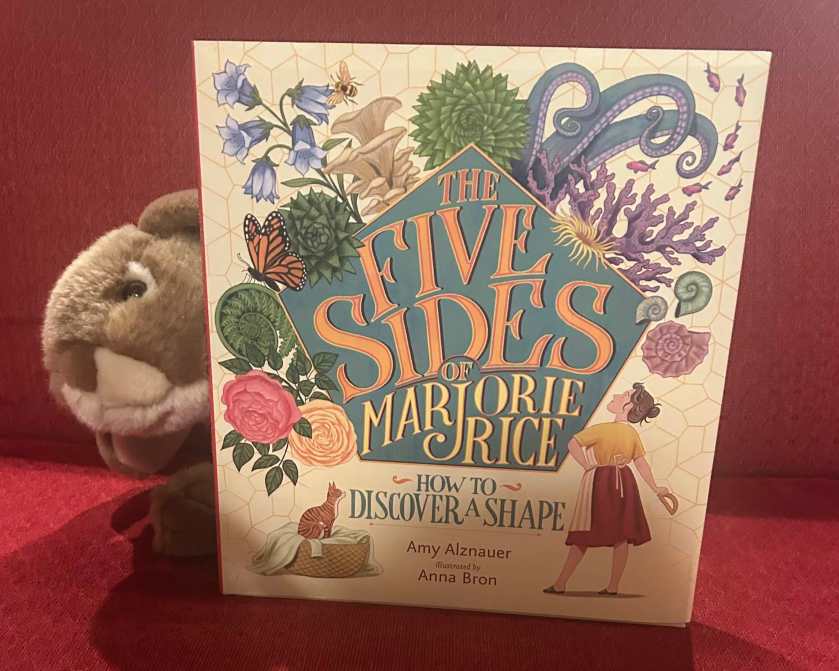
Caramel reviews The Five Sides of Marjorie Rice: How to Discover a Shape, written by Amy Alznauer and illustrated by Anna Bron.

Sprinkles: Today we are talking about another picture book, written by Amy Alznauer. We reviewed another book by her a while back.  

Caramel: Yes, I remember! That was a cool book, too; it was about a mathematician who thought about beautiful number patterns. This one is about a woman who discovered a new pentagon.

S: A new pentagon? How does one discover a new pentagon? I mean, pentagons are five-sided geometric shapes, and there are infinitely many of them. 

C: So yes, there are a lot of different types of pentagons, right? So she just found a new type. Pretty cool, right?

S: Yes, sounds cool, but I am still not sure I understand. Among the infinitely many different pentagons, the one she found has to be special somehow to be important. 

C: So, let me try to say it more carefully then. She found multiple new types of five-sided shapes that could cover the whole plane.

S: Oh, I see. So she found a new tile! I know about these! The problem is if you have a bathroom or a kitchen and you want to tile it with tiles, then in the hardware store, they usually will have square tiles, because squares tile the plane. That means you can use square tiles to cover a surface without leaving any gaps. It turns out that you can use hexagonal (six-sided) tiles or triangular (three-sided) tiles too. But these are the only options if you want to use regular tiles. That means each side has to be the same length and the corners in the angles should be the same. Here is a nice picture, showing the angles meeting at a corner for the three regular tiles:

Image from https://pappagallodifermat.blogspot.com/2012/07/ma-che-bel-pavimento.html

C: Yeah, so when she learned about this, she wondered why not five-sided tiles.

S: The math does not add up with five sides, at least if you want regular tiles, with the same side lengths and corner angles. See:
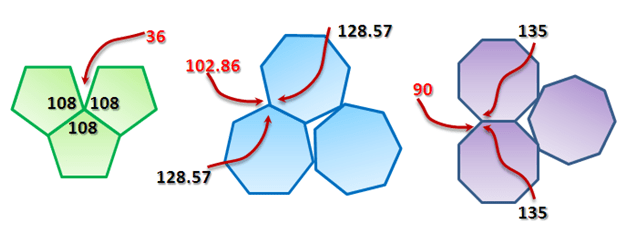
Image from https://pappagallodifermat.blogspot.com/2012/07/ma-che-bel-pavimento.html

C: Cool, I think I understood it a bit when reading the book, but these pictures help me understand it better. So let us keep them for our readers, too. Hopefully it will help them too. .

S: Sure. So all of that means that regular pentagons don’t work. So then she must have found a five-sided shape that can still tile the plane. That sounds really cool! 

C: Yeah, I agree. It looks like a crooked house! And she kept playing with different crooked houses in her head until she found one that worked. It is really cool. And the pictures are also very interesting. 

S: Yeah, I had a chance to look over the pages of the book, too, and agree with you. It is very colorful, and shapes of all types are all over the place. It is visually a very satisfying book. 

C: Yep. 
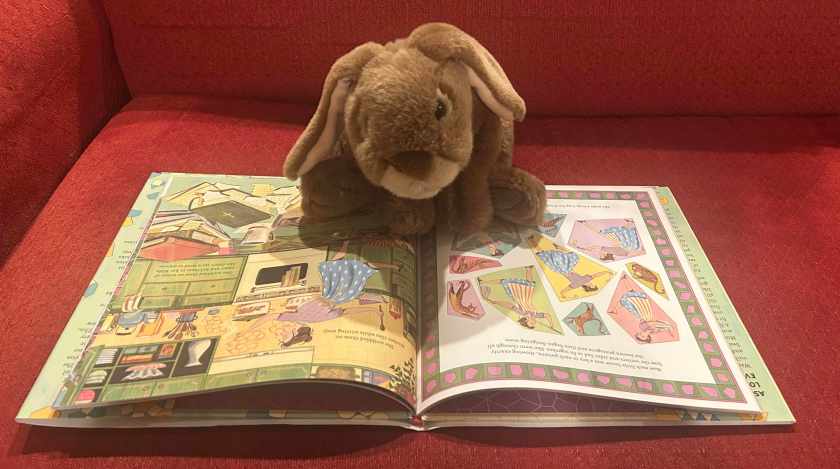
Caramel is reading The Five Sides of Marjorie Rice: How to Discover a Shape, written by Amy Alznauer and illustrated by Anna Bron.

C: So the book does tell us a bit about all the people who worked with this tiling problem you described above. But I wondered why this Marjorie Rice was the only woman among them, and no other women were mentioned other than her.

S: Hmm, you know, this is kind of a challenge for many people who want to encourage everyone to be more expansive about how they think of just who can do math. It seems that throughout human history, the mathematicians who made names for themselves have almost all been men. So I think Marjorie Rice’s story is a very interesting one, not only because the math she did is fascinating but also because she is a woman who did not become a famous mathematician, but while going about doing her life – she was a homemaker – she just happened to find a mathematical problem so interesting that she could not stop thinking about it. And she found a really neat solution to it, too!

C: Yeah, it is really cool, isn’t it?

S: Yes, I agree. This all reminds me of this article I read about what it means to be a mathematician. The author, a cool math blogger, basically says that you find mathematical problems interesting and you give yourself the freedom to work on them. 

C: Huh, cool, I like that! It means I could be a mathematician, too, if I found a problem that I could not stop thinking about and just kept at it. 

S: Yes, exactly. It is about curiosity and keeping at it. 

C: But maybe I want to become an astronaut instead?

S: Well, that is part of the point of the story, right? You don’t have to be a professional mathematician to do math. You can be anything else, and also play with math on the side. You know, some of the very famous mathematicians we still talk about today did math as a hobby. Like Pierre de Fermat, who was a lawyer but also did a lot of very interesting math on the side. 

C: Hmm, that is interesting… I am not sure I want to become an astronaut by the way. I like this planet too much, and as a tiny bunny, being in orbit is kind of intimidating. 

S: Yeah, I think you are very much planted on this planet. Me too. But you think reading about space is cool, though, right? 

C: Yeah, it really is. Hmm, I have not reviewed a space book recently. 

S: Well, you did just review Space Case: The Graphic Novel

C: True. And that is a really good book by the way. But I was kind of hinting toward another space book review coming up soon, wink wink! 

S: I know! Okay, maybe we should wrap this up because it is getting close to your bedtime. What would you like to tell our readers as we end this post Caramel?

C: Stay tuned for more book bunny reviews!
Caramel enjoyed reading The Five Sides of Marjorie Rice: How to Discover a Shape, written by Amy Alznauer and illustrated by Anna Bron, and is now looking around himself to see if he can find new hexagons.

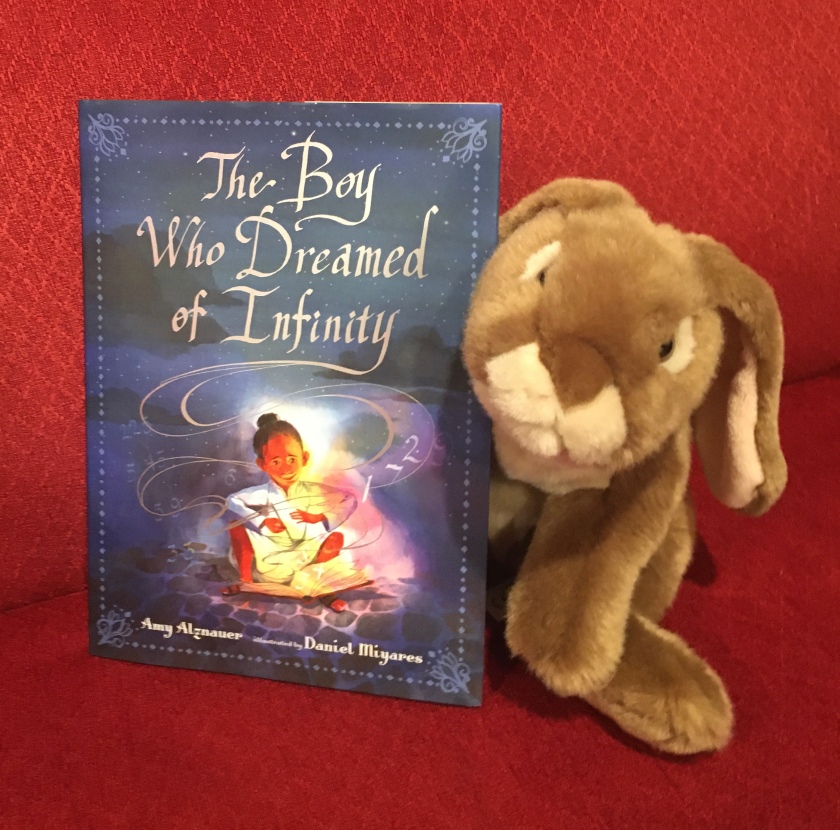
Caramel reviews The Boy Who Dreamed of Infinity by Amy Alznauer

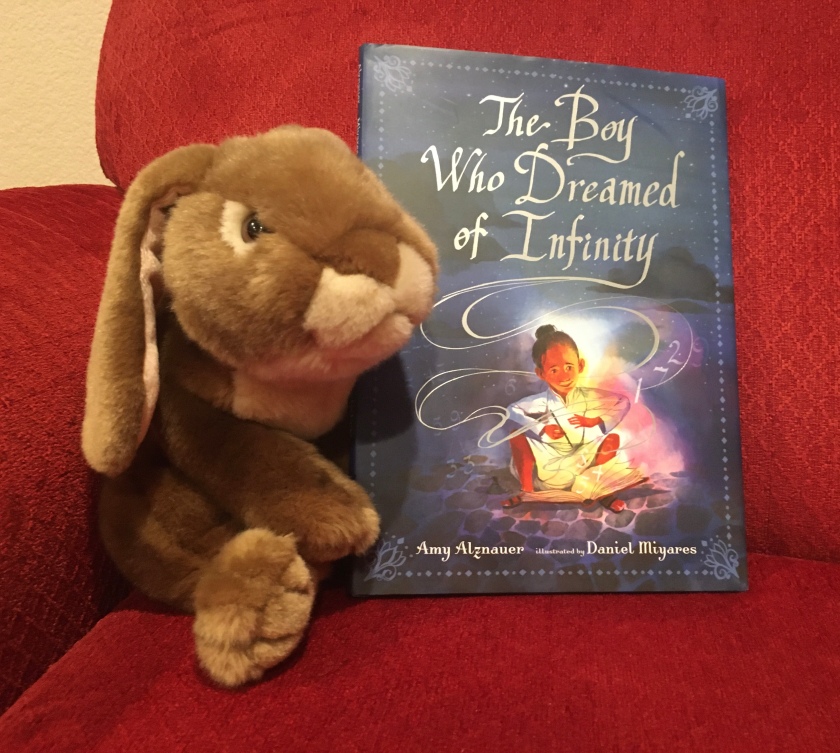
This week Caramel is talking about The Boy Who Dreamed of Infinity, written by Amy Alznauer and illustrated by Daniel Miyares, the beautifully told and magically illustrated story of the mathematician Srinivasa Ramanujan. As usual Sprinkles is taking notes and asking questions.

Caramel reviews The Boy Who Dreamed of Infinity, written by Amy Alznauer and illustrated by Daniel Miyares.

Sprinkles: So Caramel tell us about this book.

Caramel: You say that all the time!

S: I know, right? I do that because I think that is a good way to get you to start talking about the book. So?

C: Hmm, let me think a bit. This book is about a boy who went to school but his math is far more advanced than his classmates’.

S: So what does he do with that math?

C: He keeps on writing in a notebook, doing more and more math. And then he gets another notebook and writes in it.

S: So he is doing math almost compulsively. He seems like he cannot stop himself, right? He is driven to do math.

C: Yes. He sees numbers everywhere and then he opens up, divides, or cracks up the numbers to find more numbers in them.

S: Right! I liked the way the author put it (and this is also in the back cover of the book):

If Ramanujan could crack the number 1 open and find infinity, what secrets would he discover inside other numbers?

Caramel is reading The Boy Who Dreamed of Infinity, written by Amy Alznauer and illustrated by Daniel Miyares. These pages are about when Ramanujan as a little boy was not yet speaking. Instead, he "just lined up the copper pots across the floor. And when he didn't get his curd rice and mango, he rolled in the monsoon mud."
Caramel is reading The Boy Who Dreamed of Infinity, written by Amy Alznauer and illustrated by Daniel Miyares. These pages are about when Ramanujan as a little boy was not yet speaking. Instead, he “just lined up the copper pots across the floor. And when he didn’t get his curd rice and mango, he rolled in the monsoon mud.”

C: So why did he do math? Because he had to.

S: What do you mean? Is someone forcing him to do math?

C: No he wants to do it. And he cannot stop doing it. It’s almost compulsive.

S: That’s a big word for a little bunny Caramel!

C: I know. I do read a lot.

S: So the title of this book is The Boy Who Dreamed of Infinity. This reminds me of the book with a similar title: The Man Who Knew Infinity, by Robert Kanigel. That book is also about Ramanujan, but it is not a beautifully illustrated book for kids like this one. And that book tells us about Ramanujan’s whole life while this one is more about him as a little boy when he was dreaming math and finding it all around him.

C: Oh that is interesting. I think I remember us watching a movie with that name.

S: You have a good memory!

C: Can we put in the trailer here?

S: Sure. Here we go.

S: So tell me more about this book. Do you like the pictures?

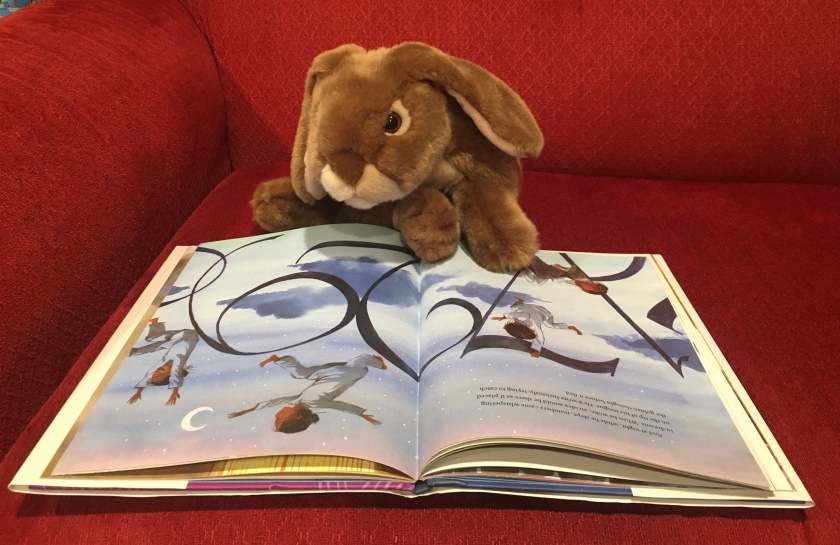
C: Yep. They are very detailed, and they are like they are from a dream. There are two pages where the boy is dancing around and jumping over numbers.

Caramel is reading The Boy Who Dreamed of Infinity, written by Amy Alznauer and illustrated by Daniel Miyares. These pages are about the nights when "while he slept, numbers came whispering in dreams."
Caramel is reading The Boy Who Dreamed of Infinity, written by Amy Alznauer and illustrated by Daniel Miyares. These pages are about the nights when “while he slept, numbers came whispering in dreams.”

S: Yes, that page especially but the rest of the pictures are also dreamlike. The colors and the combination of images… But back to that page where Ramanujan is jumping around numbers: Can you imagine yourself jumping and flipping around numbers?

C: Of course! I like jumping! I’m a bunny!

S: That is true! Here is my last question: What does this book make you think about math?

C: Multiplication and division and addition, and numbers, and infinity.

S: Does it make you like them? Do you feel like you could enjoy playing around with numbers?

C: Yes, I already do! I like math!

S: That is great! Ok, this is a good time to wrap things up.

C: I want to rate this!

S: Ok. Give me three words that describe this book.

C: Detailed, mathematics, beautiful.

S: These are good descriptors for the book. I agree. I’d add “dream, infinity, imagination”. So what do we say to end this review?

C: Stay tuned for more book bunnies adventures!

Caramel enjoyed reading The Boy Who Dreamed of Infinity, written by Amy Alznauer and illustrated by Daniel Miyares, and recommends it to all little bunnies.