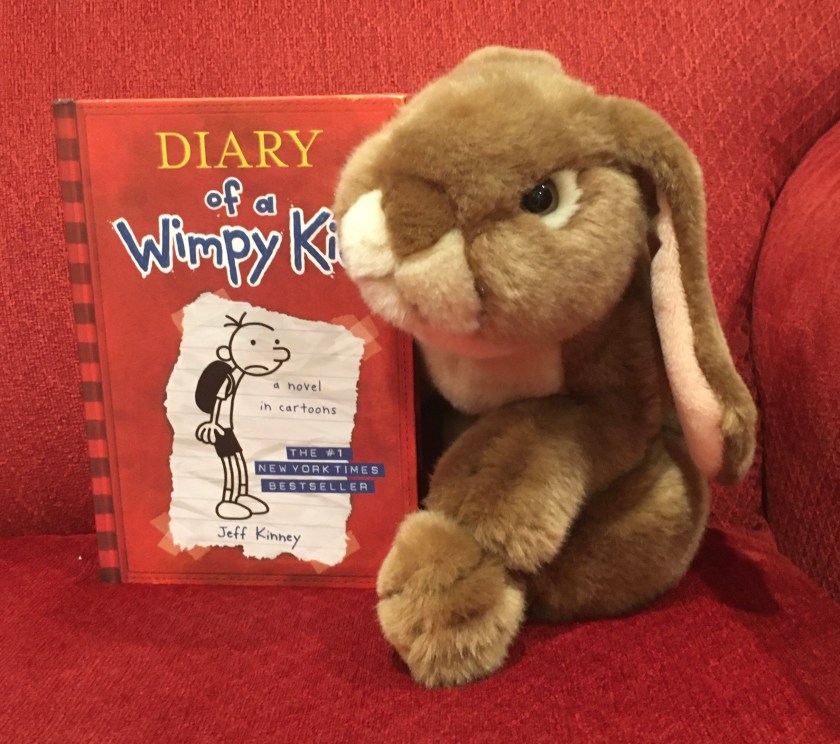
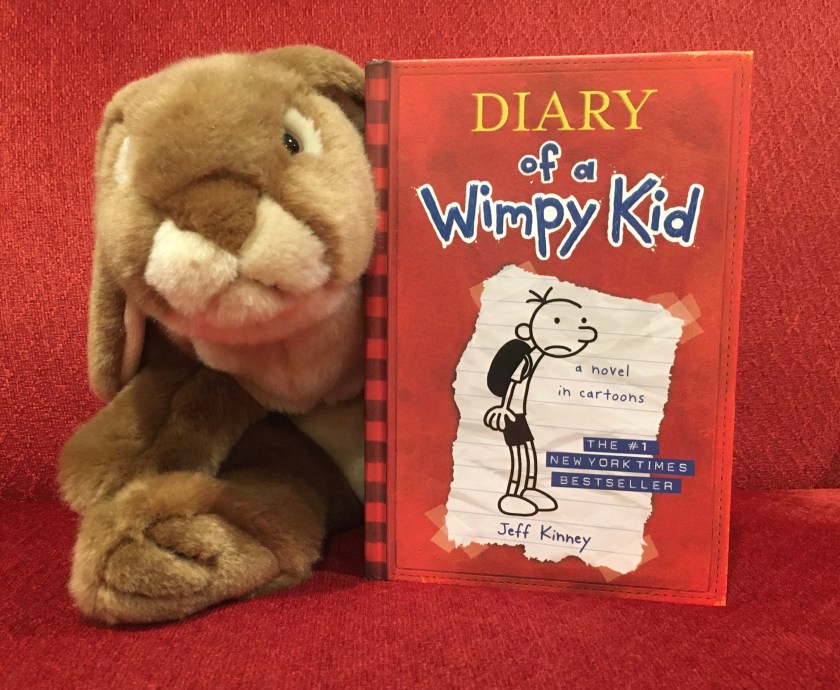
Today Caramel reviews the first book in the Diary of a Wimpy Kid series by Jeff Kinney: Diary of a Wimpy Kid, published first in 2007. As usual Sprinkles is taking notes and asking questions.
Caramel reviews Diary of a Wimpy Kid by Jeff Kinney.
Sprinkles: Caramel, let us start with you telling us a bit about this book.
Caramel: This book is about Greg Heffley, who is just starting middle school. AS he writes, he is “stuck in middle school with a bunch of morons”.
S: Hmm, so Greg does not like his school friends much.
C: He does not like most of the other kids in school, that’s right. All except for his one friend, Rowley. Greg is not very happy at school.
S: Hmm, so this Greg does not sound like a very good role model for a little bunny.
C: Greg is definitely not a good role model.
S: But I think a lot of kids sometimes feel out of place and maybe they have some unpleasant feelings about other people. So maybe Greg is in some ways representing the unsatisfied and unhappy part of being a kid.
C: I guess so. He is kind of a jerk actually.
S: Hmm, how so?
C: He is mean to Rowley, and he does write a lot of mean things about people. Like would you ever say your school friends are all morons?
S: Well, moron is a pretty bad word.
C: Then again there are two bullies in the school and they are really really mean to Greg and Rowley.
S: So I can then understand Greg being upset and angry towards those kids, but no, we would not say all kids in our school are morons. Greg is pretty unfiltered that way.
C: Well, it is his diary after all. He uses some bad words in there too.
S: That is true, we can assume he is not planning to say any of the bad words in real life but uses this diary as an outlet for all his negative feelings.
C: Yes, but he calls it a journal, not a diary.
S: What is the difference?
C: I don’t know. I think he thinks diaries are for girls.
S: Hmm, not sure if I like that! You recently reviewed a book about a writer’s notebook, and there, too, we tried to make a distinction between a writer’s notebook and a journal. So maybe Greg thinks calling it a journal rather than a diary makes it sound more serious.
C: Yes, I think he wants to sound all grownup and mature.
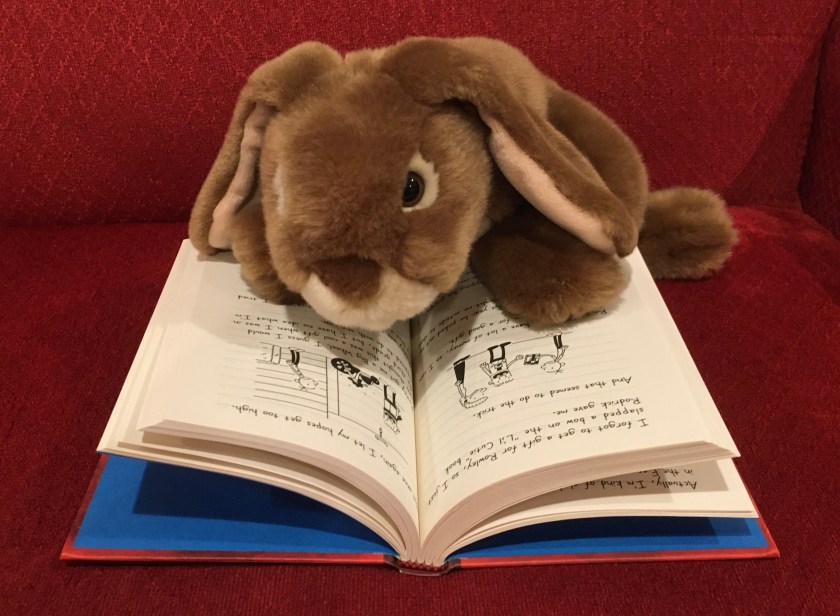
Caramel is reading Diary of a Wimpy Kid by Jeff Kinney.
S: But he is in middle school!
C: That is pretty old for me!
S: That is true. Then since you are so far away from middle school, did this book feel alien to you?
C: Well not quite. School is school, and Greg is trying to act big and mature, and he seems to think he is better than everyone else, and that can happen everywhere.
S: Do you really think he thinks he is better than everyone else? I have a sneaking suspicion that he is actually not that confident about himself.
C: I guess he is not happy with who he is, but he is really behaving like a jerk sometimes.
S: But through the course of the year, he does learn some things about being a good friend and finding a place for himself in the school, right?
C: I guess so.
S: Did you know that this is the first of a series and there are many more books about Greg and his friends?
C: Yes, but I might want to wait a bit before reaidng those. Middle school is a long way away.
S: I know. But maybe we will watch the animated version of this book?
C: Yes! I think I’d like that. Can we insert the trailer here?
S: Sure. Here you go:
Diary of a Wimpy Kid | Official Trailer | Disney+ (YouTube).
S: The pictures are straight out of the book itself.
C: Yes they really look like the book.
S: What did you think of the illustrations?
C: They are funny, I think the author wanted to make it look like Greg is drawing things in his diary. The book is like a notebook too, there are lines on each page, each page looks like a lined notebook page, and the writing is almost like handwriting.
S: Very neat handwriting though, because I can read it.
C: Yes. I can read my handwriting too but not everyone else can.
S: It is getting much better through the years though. Practice practice practice.
C: Yep.
S: So what three words would you use to describe this book?
C: Funny, multiple plots, funny drawings.
S: Hmm, you used “funny” twice but let’s let it pass. I agree with you, the word works in both places. So what do you want to tell our readers as we wrap up this review?
C: Stay tuned for more book bunny reviews!
Caramel enjoyed reading Diary of a Wimpy Kid by Jeff Kinney, and is thinking he might come back to it right before starting middle school.
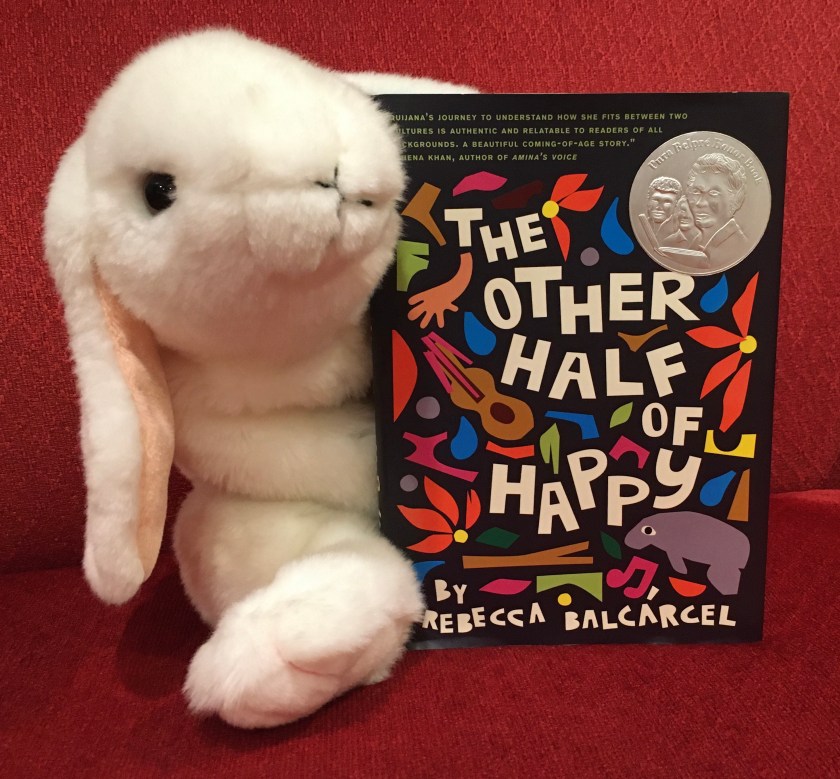
Today Marshmallow reviews the 2019 novel The Other Half of Happy by Rebecca Balcárcel.
Marshmallow reviews The Other Half of Happy by Rebecca Balcárcel.
Marshmallow’s Quick Take: If you enjoy reading books about school, friendship, and family, then this might be the book for you.
Marshmallow’s Summary (with Spoilers): Quijana is one-half Guatemalan and one-half American. However, when her Guatemalan cousins move in to the town she lives in, she feels like she is not living up to her Guatemalan part. A main reason for this is because she can’t speak Spanish very well, whereas her cousins speak Spanish as a first language, and they speak English perfectly. But she has other issues too. Her parents have been “Spanish-izing” their house, and trying to introduce Guatemalans culture to their children. Quijana thinks that she is too abnormal as it is and doesn’t want to be “Spanish-ized”.
In the meantime, Quijana’s grandmother is diagnosed with cancer and has to undergo treatment. Quijana loves her grandmother very much and is very worried about what will happen to her. Quijana is also having issues at school. Spanish-speaking children are very dismissive of Quijana. They seem disappointed by her lack of fluency in Spanish, and tease her for it. Another issue that Quijana has to deal with is the fact that her little brother is becoming remote and harder to reach. (Quijana has other issues too, involving a boy, who is a good friend, but she wants him to be more than that.)
On top of all this, Quijana’s parents want to go to Guatemala on vacation, but Quijana desperately doesn’t want to. She comes up with an escape plan, selling a huipil sent to her by her other grandmother. She plans to board a bus to Florida to avoid having to go to Guatemala.
Marshmallow is reading The Other Half of Happy by Rebecca Balcárcel.
Marshmallow’s Review: The Other Half of Happy is a beautiful book that really shows its main character’s internal conflicts and concerns. The author, Rebecca Balcárcel, invites the reader into Quijana’s world. The book is narrated by Quijana and she is very open about her thoughts and feelings. Quijana feels like she has disappointed her father and her Guatemalan family, because she doesn’t know how to speak Spanish well.
I think that Rebecca Balcárcel writes in a very poetic way. Here is an excerpt, from page 1, to show you what I mean:
“I live in a tilted house. A bowling ball on our living room floor would roll past the couch, past the dining table, all the way to the kitchen sink. And if the sink wasn’t there and the wall wasn’t there and the bathroom behind that wasn’t there, the ball would roll all the way to my room at the end of the house. That’s what it’s like being twelve. Everything rolling toward you.”
Rebecca Balcárcel, The Other Half of Happy, page 1.
I think that Balcárcel does a good job of creating unique characters. The characters have unique characteristics or quirks, which make them a lot more realistic. By the end of the book, I felt like I knew Quijana very well.
Marshmallow’s Rating: 95%.
Marshmallow rates The Other Half of Happy by Rebecca Balcárcel 95%.
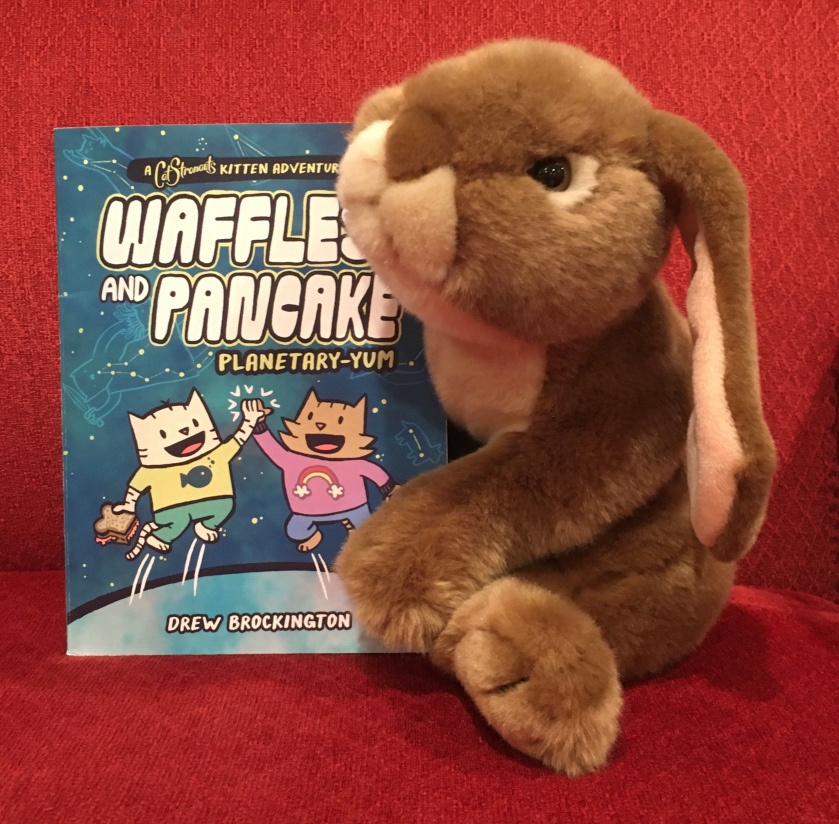
Today Caramel talks about Wafles and Pancake: Planetary-YUM, by Drew Brockington. As usual Sprinkles is taking notes and asking followup questions.
The book bunnies received this book as a review copy.
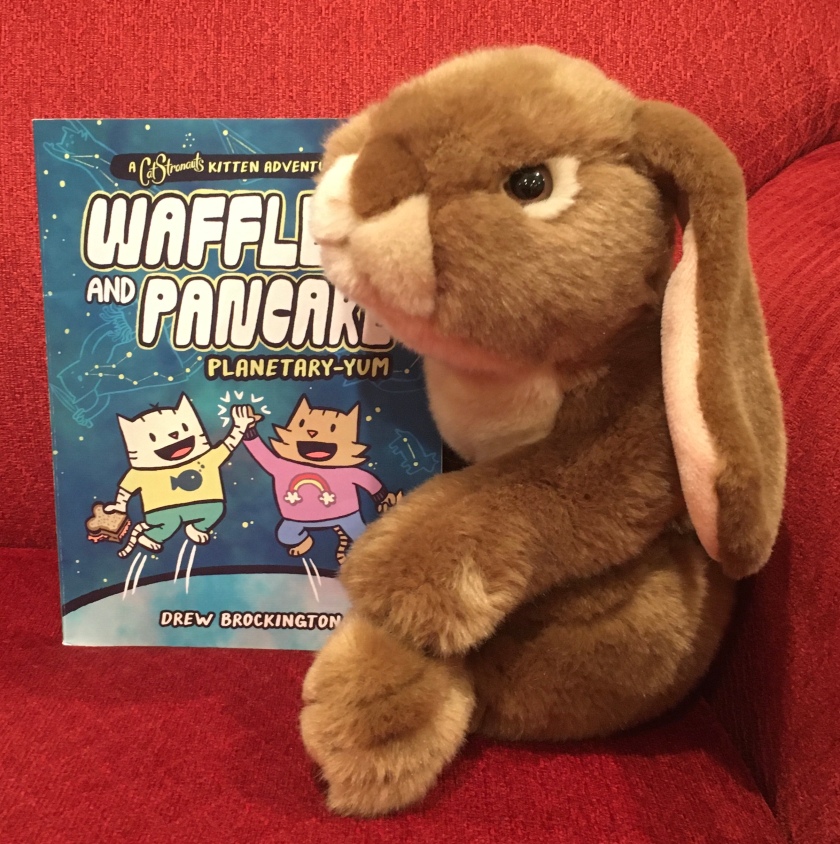
Caramel reviews Waffles and Pancake: Planetary-YUM by Drew Brockington.
Sprinkles: So Caramel, tell us a bit about this book.
Caramel: This book is about two cats named Pancake and Waffles. Pancake is Waffles’s sister I think.
S:So what happens to them? Do they go to a planetarium?
C: Yes. They go to a science museum and there is a planetarium there. They go with their father, and they see the dino-cats and the saber tooth tiger …
S: Wait, what is a dino-cat?
C: Basically dinosaurs, but they are cats too.
S: So maybe prehistoric cats?
C: I guess so.
S: Then what happens?
C: They go to watch Hairballs in 4D.
S: So is that a film?
C: Yes, They always have these types of movies in science centers, so this is one of those. Then they go to the planetarium, and they look at the skies and so on, but then they get separated from their dad. And they are really worried.
S: That does sound like it could be scary.
C: Yes. Then they talk to someone who is working there. And in the end, they go to their mom’s home and see some constellations in the night sky and they can recognize them!
S: Wait, so they eventually find their dad?
C: Yes, of course. Otherwise this would not be a funny book, it would be tragic.
S: I understand. So the book is funny then?
C: Yes. Their dad asks them their favorite part of the trip to the museum and apparently it was lunch!
S: That is quite funny!
C: And there are other funny parts too. It is a funny book!
Caramel is reading Waffles and Pancake: Planetary-YUM by Drew Brockington.
S: So then funny would be one of your words to describe the book. What other words would you use?
C: Funny, colorful, and … easy to read.
S: Yes, you did read it fast.
C: It was fun so I read it quickly.
S: So were there some facts about space in the book too? It kind of seemed like that to me.
C: Yes some but not as much as some other books, like the Narwhal and Jelly books have a lot more facts. But this did have some facts.
S: Any that was new to you?
C: It takes 27.32 days for the moon to orbit the earth.
S: You might have kind of known it takes about a month but not the exact time, right?
C: That’s right. They also talk about meteorites and such but I knew about those before. They also talk about Neil Pawstrong, which is the cat version of Neil Armstrong, the first human on the moon.
S: That is cool! I saw that other words were cat-ified, too…
C: Yes, like fur-ever, when the kitty siblings are worried they might have to live forever at the museum because they lost their dad, they say “we might have to live here fur-ever” instead.
S: Would you like to live at a museum?
C: No. All the dinosaur skeletons would freak me out, especially at night.
S: I undertand.
C: Wouldn’t you be scared of a museum full of dinosaurs at night?
S: I guess I would.
C: But reading this book, I also learned that there are other books with Waffles the cat, and he is a CatStronaut.
S: What is that?
C: The cat version of an astronaut I think. So there are apparently a lot of other books about the adventures of Waffles when he is a grown cat and an astronaut.
S: Sounds like you are curious …
C: Yes, I am! I want to read more about Waffles …
S: Hmm, we will see if we can get your paws on some of them some day. But for now, what would you like to tell our readers?
C: Stay tuned for more book bunnies reviews!
Caramel really enjoyed reading Waffles and Pancake: Planetary-YUM by Drew Brockington, and is looking forward to reading some of the earlier books about the adventures of CatStonauts.
This week Sprinkles reviews a few books about gender identity written for children.
Marshmallow and Caramel have been complaining that Sprinkles has not written a post since last Halloween (when she had reviewed a handful of children’s books about zombies). So she decided to write another one before the anniversary of that post came around. This is the post that resulted.
This week Sprinkles reviews a few books about gender identity written for children, with a nod to the International Pronouns Day, which was just this past Wednesday.
Sprinkles reviews children’s books on gender identity.
There have been a range of children’s books about gender identity written recently. In this post I would like to share some of my thoughts about eight of them: Julián Is A Mermaid by Jessica Love; Red: A Crayon’s Story by Michael Hall; Neither by Airlie Anderson; Pink Is For Boys written by Robb Pearlman and illustrated by Eda Kaban; The Gender Wheel by Maya Gonzalez; Who Are You? The Kid’s Guide to Gender Identity, written by Brook Pessin-Whedbee and illustrated by Naomi Bardoff; It Feels Good To Be Yourself, written by Theresa Thorn and illustrated by Noah Grigni; and They, She, He, Me: Free To Be! by Maya Gonzalez and Matthew Smith-Gonzalez.
I begin with a review of a handful of them that aim to emphasize the point that being different is alright, and there is a place for all of us in this world.
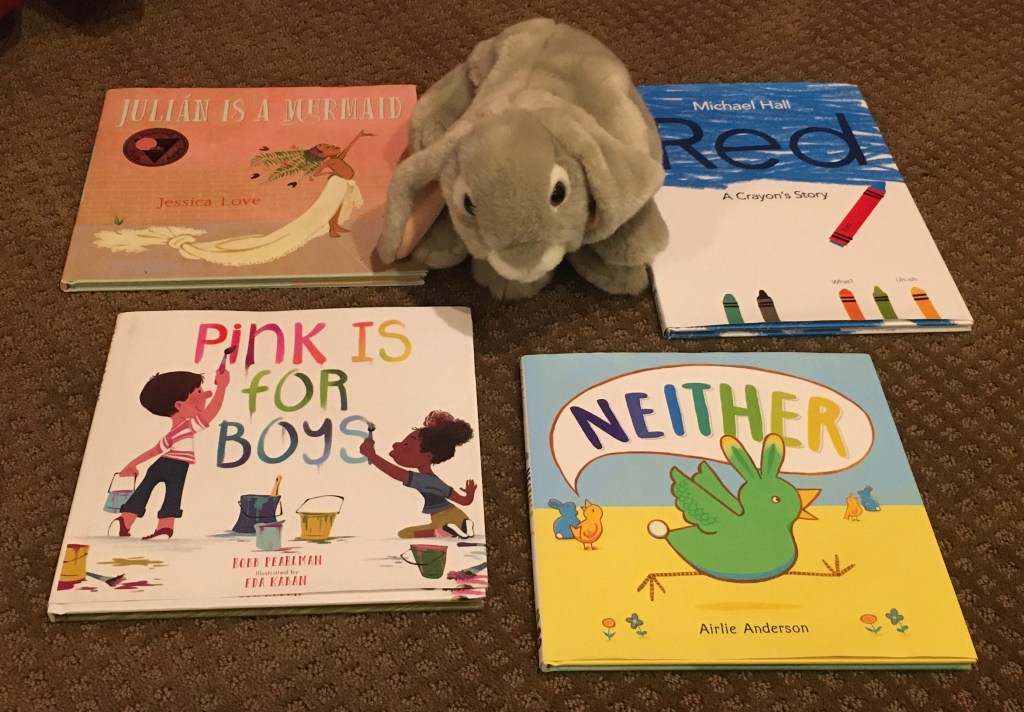
Sprinkles is posing with four books that emphasize that being different is okay: Julián Is A Mermaid by Jessica Love, Red: A Crayon’s Story by Michael Hall, Neither by Airlie Anderson, and Pink Is For Boys written by Robb Pearlman and illustrated by Eda Kaban.
In Julián Is A Mermaid by Jessica Love we meet a little boy named Julián who wants to dress up as a mermaid. He finds acceptance in an unexpected place. The book ends as a celebration of differences. The colors of the book are pastel and lively at the same time, inviting us to Julián’s beautiful world.
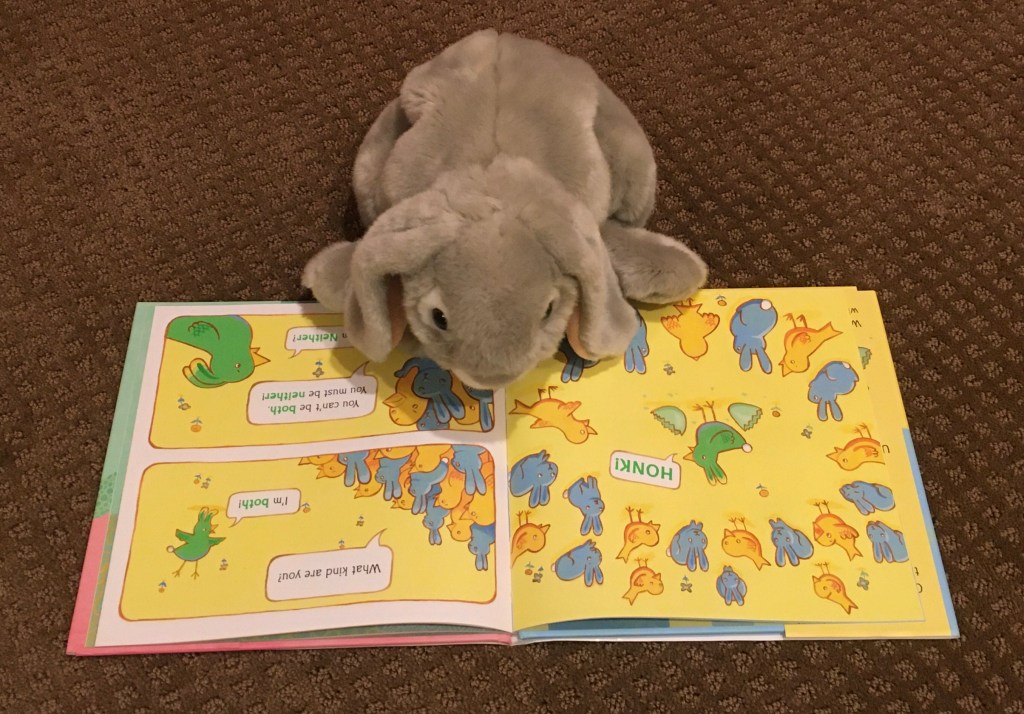
Sprinkles is reading Julián Is A Mermaid by Jessica Love.
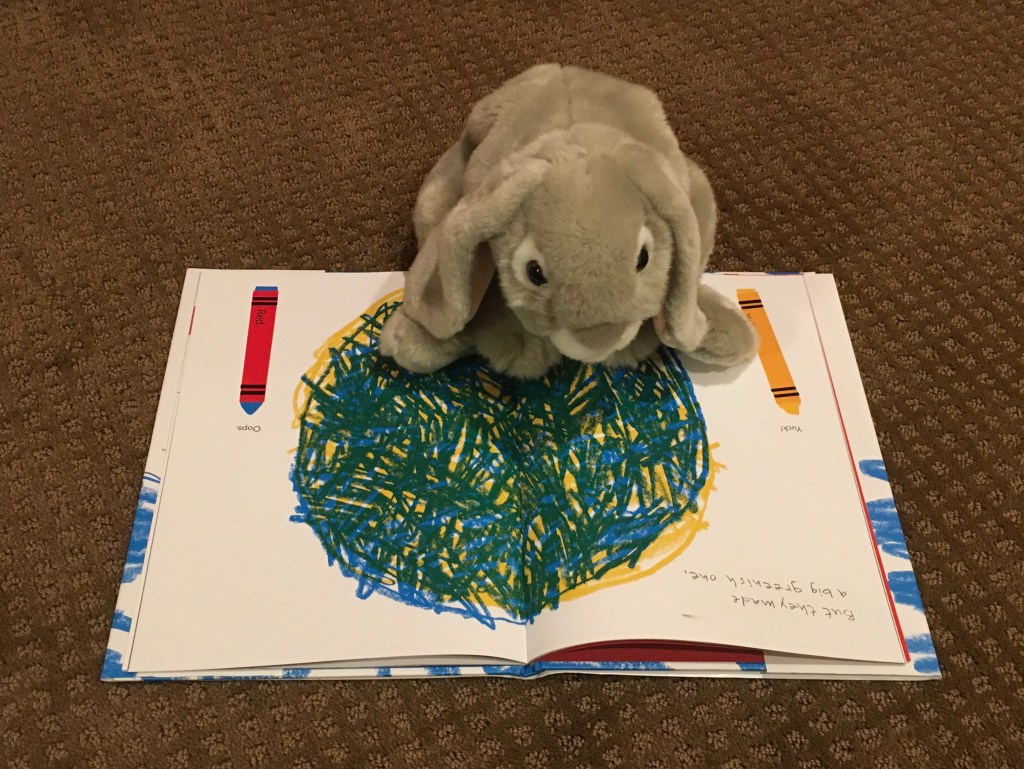
In Red: A Crayon’s Story by Michael Hall, we meet a little crayon who is blue but is in a red covering paper. He has a difficult time at the start trying to fit in. But in the end he finds that he can be who he is, and life is good again. The color scheme used is simple and reminded me a bit of the book series about crayons by Drew Daywalt. (Caramel reviewed The Crayons’ Christmas, the third book of that series, for our blog.) The illustrations are not intricate but they do exactly what they are meant to and give us a sense of this crayon’s inner world and the world around him as well.
Sprinkles is reading Red: A Crayon’s Story by Michael Hall.
In Neither by Airlie Anderson, we learn of a land of This or That, where every creature has to be this or that, and when there is an individual who does not fit either, they are mocked and excluded from the two groups formed around being This and being That. Eventually we see our outcast, who sees themself as a Both but is called Neither by the two groups, finds themself in a land where they are accepted, along with everyone else. The colors are bright and cheery, and the little creatures are simply drawn but pretty cute.
Sprinkles is reading Neither by Airlie Anderson.
All three books remind me a bit of a fascinating little book Caramel reviewed a while ago for this blog: From the Stars in the Sky to the Fish in the Sea by Kai Cheng Thom. That book had a dreamy atmosphere, and the main character was a child though magically different from others. Julián from Julián Is A Mermaid is also a little child, and I can see a little boy being comforted by reading about him and his dream of being a mermaid coming true. In some ways though, Neither and Red: A Crayon’s Story might be easier for parents who want to broach the subject of being different without explicitly bringing up gender identity. It is easy to identify the perceived and assumed boy-girl gender binary underlying the stratification of the land of This and That in Neither, though it is never explicitly stated. Similarly, the Blue Crayon in Red: A Crayon’s Story is also suffering from his peers’ expectations about how he should behave given what he looks like, but there is no explicit discussion of boyhood or girlhood.
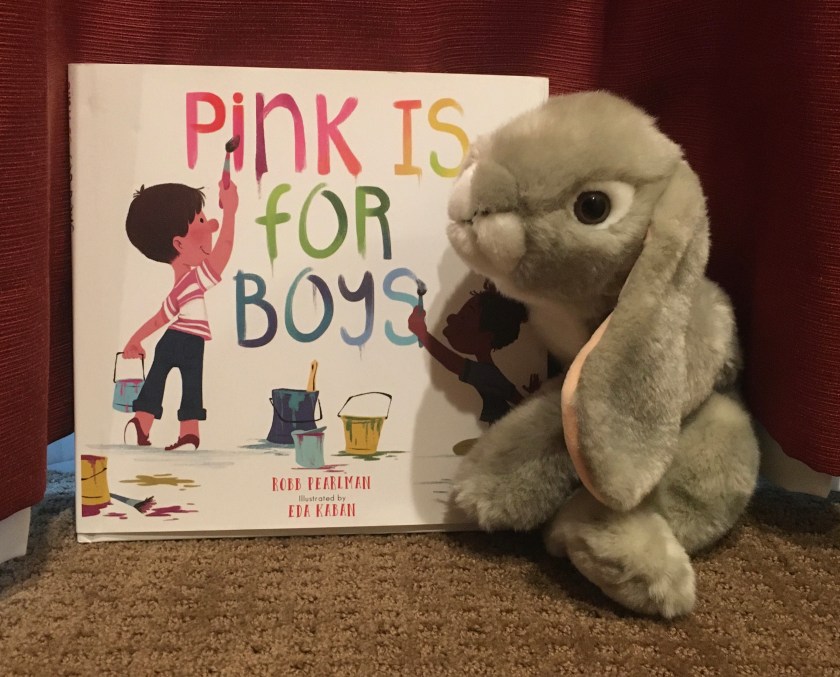
On the other hand, Pink Is For Boys, written by Robb Pearlman and illustrated by Eda Kaban, brings up the boy-girl binary right up front. The main point here is that boys can like pink just like girls can like blue. Similarly boys can enjoy bows on dresses and girls can like baseball. The binary is not really questioned here, but instead, children are told that the boundaries of the two categories are porous in many ways, that boys and girls can enjoy all sorts of things and still be themselves.
Sprinkles poses with Pink Is For Boys, written by Robb Pearlman and illustrated by Eda Kaban.
The first three books I described above were stories and could easily be viewed as fictional, though obviously the authors were writing with a particular goal and an intended moral. The fourth book was more an advice book, a nonfiction text that openly tells the child reading it (or being read to) what to think about the topic.
The next four books fit this mold as well. They are more like an adult talking to a child who is maybe a bit concerned about being different or simply curious about gender identity, even if they may not be asking explicitly to talk about the topic.
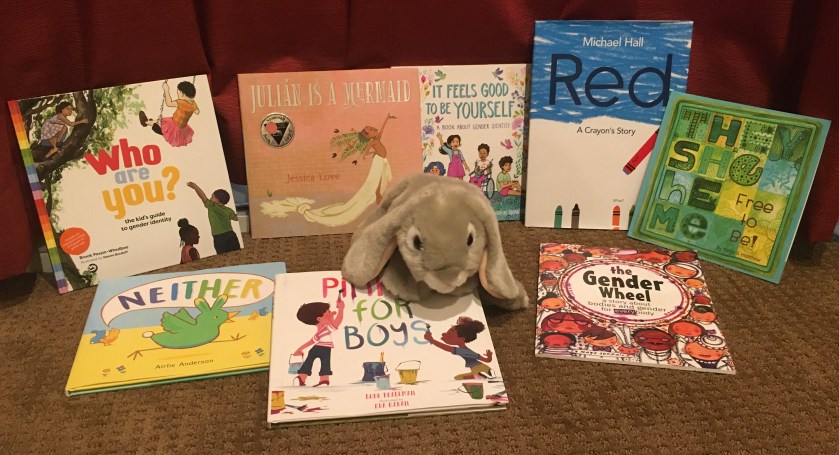
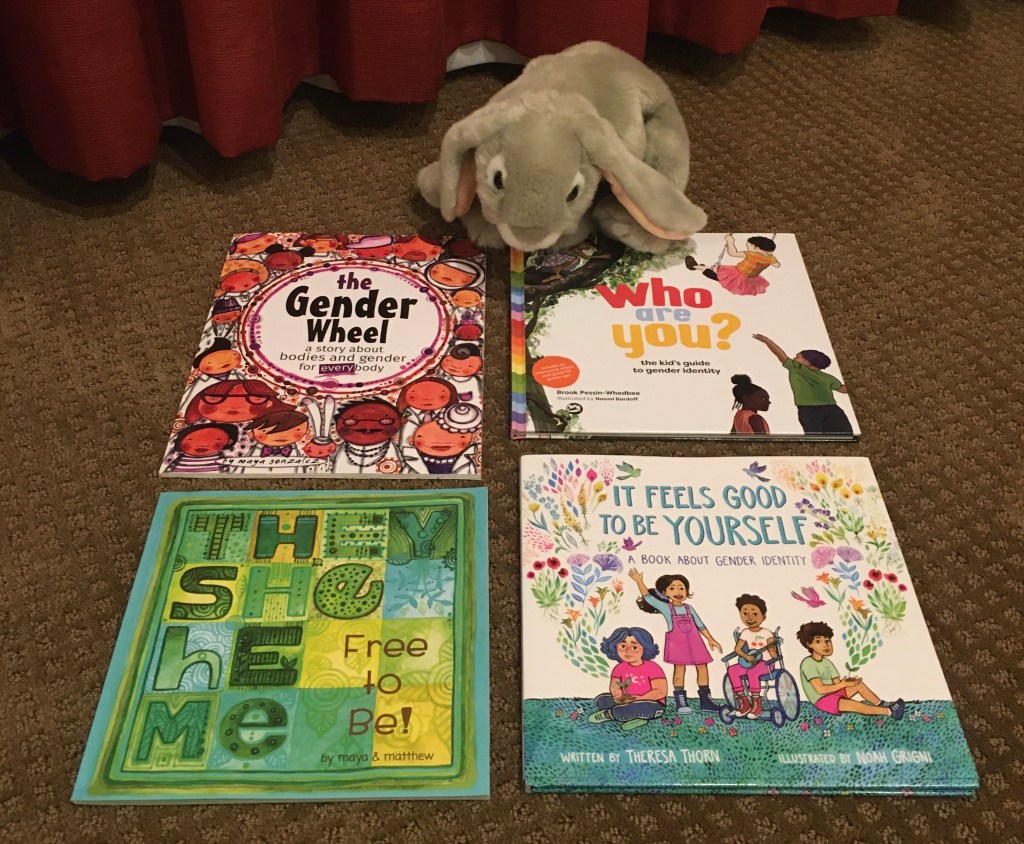
Sprinkles is posing with four books that explain pronouns and gender identity to children (and possibly also the adults who are reading with them): The Gender Wheel by Maya Gonzalez, Who Are You? The Kid’s Guide to Gender Identity, written by Brook Pessin-Whedbee and illustrated by Naomi Bardoff, It Feels Good To Be Yourself, written by Theresa Thorn and illustrated by Noah Grigni, and They, She, He, Me: Free To Be! by Maya Gonzalez and Matthew Smith-Gonzalez.
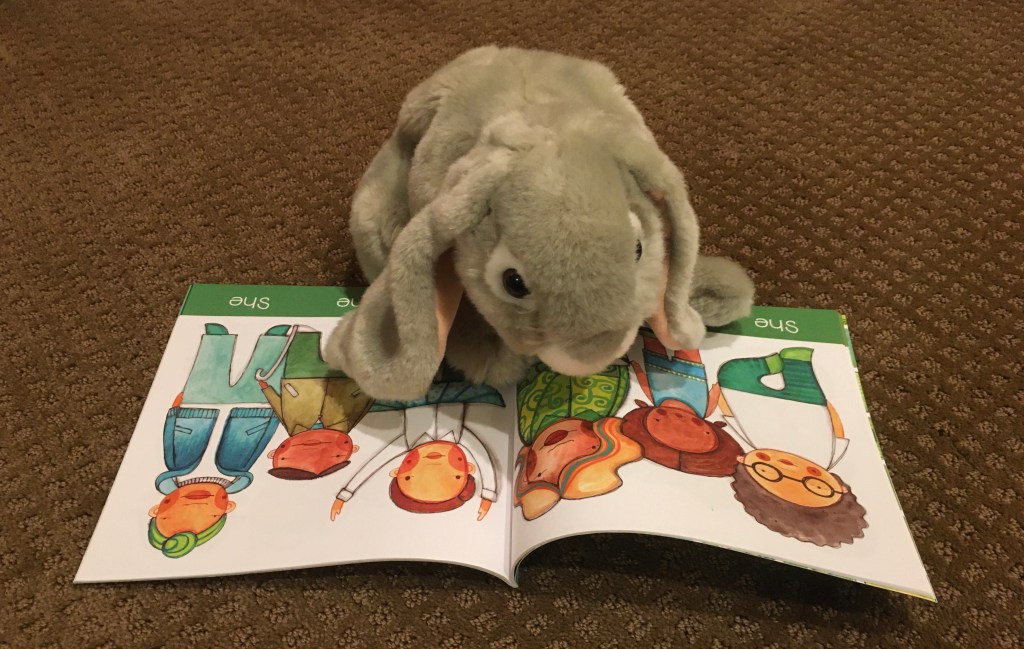
Let me start with They, She, He, Me: Free To Be! by Maya Gonzalez and Matthew Smith-Gonzalez. Among the four books explicitly about gender identity, this one is perhaps the simplest though definitely not oversimplified. The book starts with page after page of pronouns and pictures of people, and the pictures are pretty amazing.
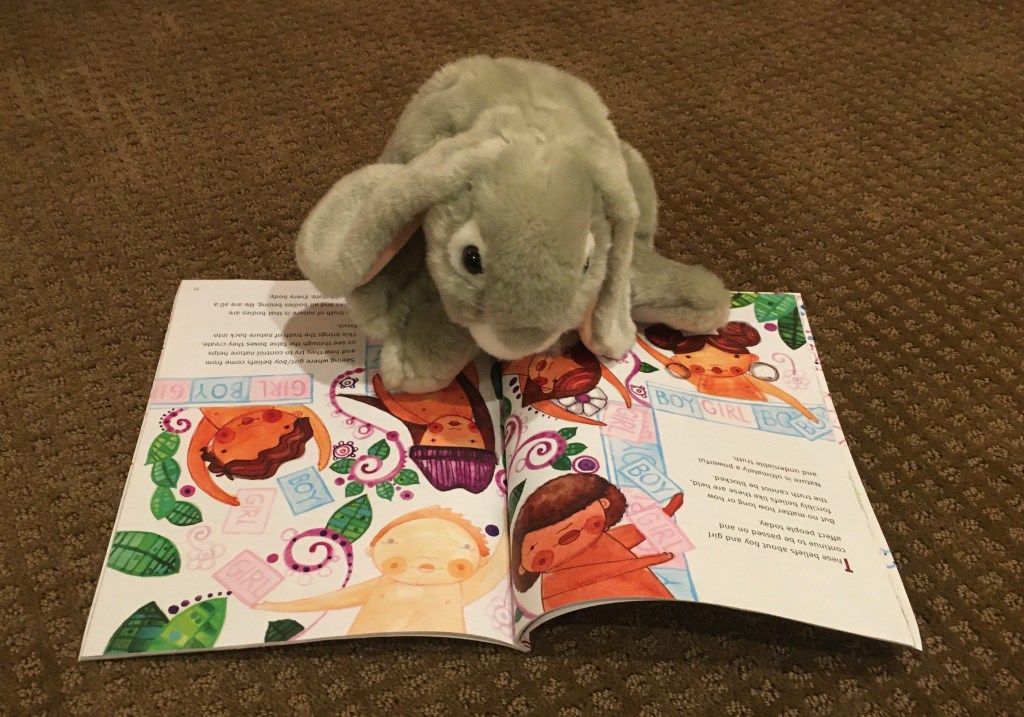
Sprinkles is reading the pages in They, She, He, Me: Free To Be! by Maya Gonzalez and Matthew Smith-Gonzalez that display various ways of being a “she”.
The emphasis of the book is on pronouns, but the main text that starts after the pronoun depictions is quite extensive. Though organized under headings of Pronouns, Freeing Pronouns, Claiming Pronouns, Creating Pronouns, Using Pronouns, and Playing With Pronouns, the text touches upon the uniqueness of each individual, the creative possibilities of pronouns, and the freedom to be who you want to be. Creators of this book share a bit about themselves too and then have a few words for the grownups. They summarize the main goal of this book really well in their personal introduction:
As parents we want our kids to feel fully free to blossom into their maximum magnificence.
They, She, He, Me: Free To Be! by Maya Gonzalez and Matthew Smith-Gonzalez
The Gender Wheel is written and illustrated by Maya Gonzalez, too. This book is a bit broader in its coverage of gender identity, and is beautifully illustrated, with lyrical language that explores the implications of thinking of the world and our identities as parts of a circle. I loved how the author kept coming back to the circle as a metaphor and a reflection of the world as well as our own inner lives.
However, the book is very U.S. centric, and explicitly asserts that the boy-girl gender binary was brought to North America by European settlers, who had “linear and rigid” beliefs and so they “boxed people in and kept nature out”. Though I sympathize with the author’s perspective, I see it as quite limited in the global context, as the gender binary is alive and well all around the world, without direct need for any seventeenth-century European influences. And though some native peoples of this continent may have had more fluid perceptions of gender than the ones we are living with these days (according to this Berkeley website for example, “more than 150 different pre-colonial Native American tribes acknowledged third genders in their communities”), this was definitely not always as freeing as some might imagine, and may not have meant what we might think it does. (The same website asserts that “By no means did all pre-colonial Native American communities accept or celebrate gender and sexual orientation diversity.”) So I saw this pass at colonialism as an unnecessary distraction.
Sprinkles is reading The Gender Wheel by Maya Gonzalez.
The gender wheel in the title of the book is extremely useful as a tool however. It is a beautiful way to visualize and understand the complexities of the construct of gender and it allows the reader to be able to distinguish between physical and biological bodies, how one feels inside their body, and how one chooses or needs to engage with the outside world. While scholars of gender studies dig deep into the nuances of their constructs and appreciate all their complexities, for the rest of us these very same intricacies might be barriers in understanding ourselves and our loved ones. Gonzalez and her wheel make the ideas quite transparent and very much easier to understand (and even discuss with young ones in our lives).
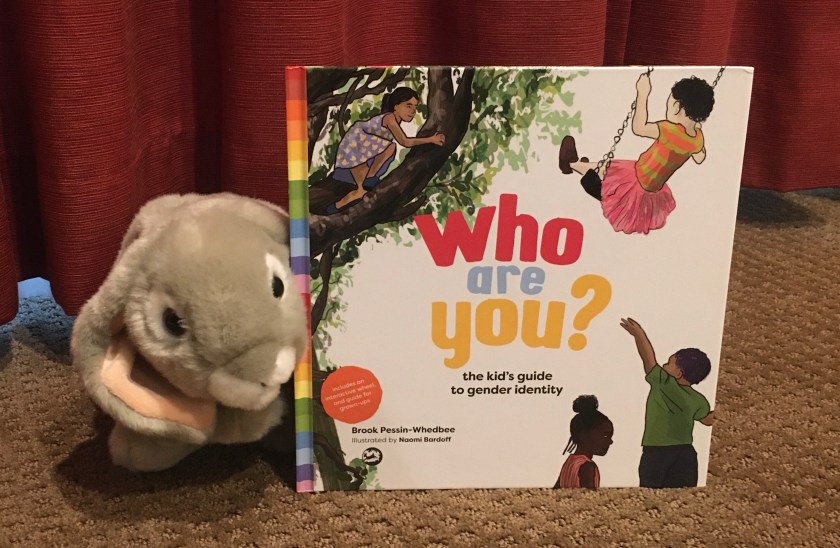
A similar idea is used and offered as a tool in Who Are You? The Kid’s Guide to Gender Identity, written by Brook Pessin-Whedbee and illustrated by Naomi Bardoff. This book, too, explicitly describes gender as made up of three layers; these are called Body, Identity, and Expression. (In The Gender Wheel, Gonzalez labels the layers as the body circle, the inside circle, and the pronoun circle.) Having read the two books together, I now find both sets of labels making a lot more sense to me. Unfortunately it seems that the latter book (Who Are You?) does not acknowledge the source of their own wheel construction, and as a result, it is highly likely that this is a case of plagiarism (see Maya Gonzalez’s blog post about the issue here.)
The illustrations in Who Are You? are in some ways a bit less whimsical than those in The Gender Wheel, which definitely reflects its creator’s particular style (as also seen in her book with Matthew Smith-Gonzalez, They, She, He, Me: Free To Be!). But they are definitely not boring or unattractive. Actually they occasionally reminded me very much of the style of the If You Give … series written by Laura Numeroff and illustrated by Felicia Bond, and could sufficiently capture a young reader’s attention.
Sprinkles poses with a copy of Who Are You? The Kid’s Guide to Gender Identity, written by Brook Pessin-Whedbee and illustrated by Naomi Bardoff.
Who Are You? also comes with a few pages of advice for the adult reader. I think the author makes the (probably correct) assumption that an adult who shares this book with a young person will likely want to have as much support and ideas for resources as they can. So there are resources about how to use the wheel tool provided, how to engage with particular parts of the book with a young person, and where to find other resources (books and films) that can help support a conversation with a young person exploring these issues.
Finally let me say a few words about It Feels Good To Be Yourself: A Book About Gender Identity, written by Theresa Thorn and illustrated by Noah Grigni.
Sprinkles is posing with It Feels Good To Be Yourself: A Book About Gender Identity, written by Theresa Thorn and illustrated by Noah Grigni.
It Feels Good To Be Yourself introduces the reader to a few different children who have different gender identities and sexual expressions. Terms like “transgender” and “non-binary” are explicitly defined in child-friendly language, and the book depicts all gender identity-related difference positively and ends with the main moral:
No matter what your gender identity is, you are okay exactly the way you are. And you are loved.
It Feels Good To Be Yourself: A Book About Gender Identity, written by Theresa Thorn and illustrated by Noah Grigni.
Having read these eight books, what can I tell the reader who probably already regrets diving into such a long blog post?
First I have to admit I am grateful. I am grateful that our children today have these types of books. I am also grateful that we the parents, too, have access to these types of resources to help support our kids in finding and growing into the people they want to be, despite prejudices and oppressive social models of being a boy / man or a girl / woman in the world. I have found each and every one of the books I mentioned in this post to be helpful, and I think there are little people out there that could very much benefit from reading any of them.
Secondly I think these books would be great conversation starters, with all young people. If your child is not comfortable with the gender binary and its impositions on their life, then pick up one or more of these books and let them read it and then discuss. Or why not curl onto a couch or into a bed together and read them together? Depending on how you usually choose to broach various issues with your little one, there is definitely a book out there that will open the right communication channels for you.
Even if your child is already comfortable in their gender identity, it makes sense to bring these books and topics up for conversation. Sometimes children can be rigid adopters of social assumptions without questioning, and their reactions and comments can be hurtful to other people. If you want to raise children who are open-minded and flexible, and who can respect and love people of all ways of being, then these topics do belong, if not at your dining table (and then again why not there?) then definitely somewhere.
Finally I will add that Caramel told me his two favorites among these were Red: A Crayon’s Story, by Michael Hall, and Neither, by Airlie Anderson. I can see how the less openly didactic texts might be easier to share with young ones. At some point, though, especially for the slightly older crowd, the books with more explicit discussion of gender identity might be more appropriate. These books can easily introduce these growing readers to the correct terms and constructs to think about, understand, and express their own gender identities as well as to learn about other people around them.
Sprinkles enjoyed and very much appreciated reading each one of these eight books (Julián Is A Mermaid by Jessica Love; Red: A Crayon’s Story by Michael Hall; Neither by Airlie Anderson; Pink Is For Boys written by Robb Pearlman and illustrated by Eda Kaban; The Gender Wheel by Maya Gonzalez; Who Are You? The Kid’s Guide to Gender Identity, written by Brook Pessin-Whedbee and illustrated by Naomi Bardoff; It Feels Good To Be Yourself, written by Theresa Thorn and illustrated by Noah Grigni; and They, She, He, Me: Free To Be! by Maya Gonzalez and Matthew Smith-Gonzalez), and thinks that there is definitely at least one book among these that will work for you and your little one.



 BookBunnies