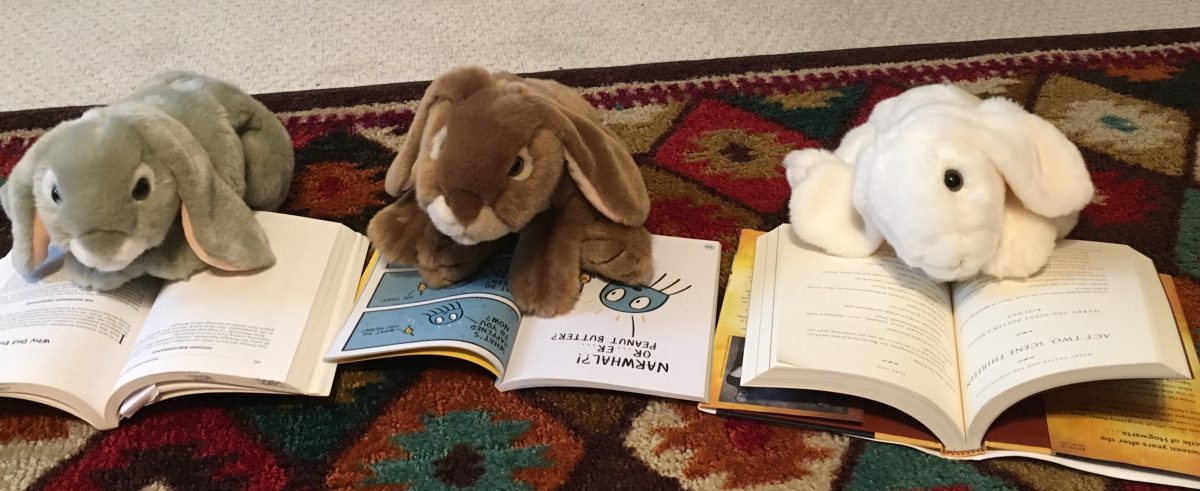
Caramel reviews Glow Animals by K.C. Kelley

A few weeks ago, Caramel visited the book fair held in his school campus and picked a handful of nonfiction books for himself. A couple weeks ago, he reviewed two of them: Sea Bunnies by Kelly Hargrave and Hot Lava! Fiery Facts About Volcanoes by Alice Fewery. Today he talks about the third book he got from the book fair: Glow Animals by K.C. Kelley. As usual, Sprinkles is taking notes and asking questions.

Caramel reviews Glow Animals by K.C. Kelley.

Sprinkles: Okay, Caramel. This is the third book from the book fair. Are you still happy you managed to get your paws in this one?

Caramel: Yes.

S: So tell us a bit about this book.

C: This book is about all sorts of animals that glow.

S: What does that mean?

C: It’s called bioluminescence.

S: That’s a big word for a little bunny.

C: Yep. I have all the words!

S: Okay, so tell me what bioluminescence means.

C: It’s animals and other living beings creating light somehow.

S: That is pretty fascinating stuff.

C: It is.

S: So what kinds of animals do we meet in this book?

C: For one, my new amazing squishy friend Jellyfish. He is bioluminescent. Like about 50% of all jellyfish. I learned that from this website of a lab at the University of California San Diego.

S: That’s interesting! Do you know how jellyfish make their light?

C: Bioluminescence.

S: I get that, but what is the mechanism?

C: There is a segment in their body that holds a bunch of chemicals and the jellyfish mixes them to make light. Well, actually I am making that up because the book does not really talk about how they make their light.

S: Okay, I thought your explanation was plausible, you could have fooled me. But so the book did not tell you about the mechanism of how a jellyfish can make light? I’m thinking they should have!

C: Well, they do explain things more generally. Most animals which glow have some chemical, luciferin, in a part of their body, and when they mix it with oxygen, it glows.

S: Hmm, I did not know that! And I did not know what luciferin was till now. So Wikipedia tells me that “luciferin (from the Latin lucifer, “light-bearer”) is a generic term for the light-emitting compound found in organisms that generate bioluminescence”. So some mechanisms are explained then.

C: Yes.

S: And fireflies and jellyfish are pretty different animals! What other animals do we meet in this book?

C: Lantern fish, click beetle, dragon fish, lantern shark. Which is different from the lantern fish.

S: Hmm, I did not know there were sharks that could make light!

C: Yes, there are!

S: Apparently they are rather small. At most three feet or so.

C: Well, for a bunny, that is not really small. I’d not want to meet one if I could help it.

S: I understand Caramel.

C: At least the dwarf lantern shark is really small. It is about four inches. Now I would not mind meeting one of those.

S: Makes sense to me.

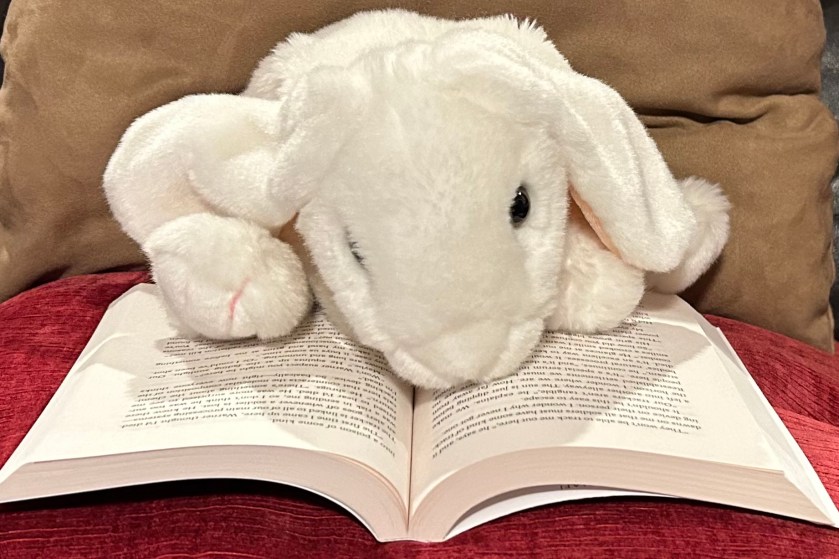
Caramel and his new squishy friend Jellyfish are reading Glow Animals by K.C. Kelley.

S: What else is in the book?

C: There are more animals with bioluminescence. And then there are other animals which don’t make their own light, but their skin or fur reacts to UV light. That is called fluorescence.

S: Oh that’s cool too. What are some examples of fluorescent animals?

C: Glowing sea slug and pyrosome.

S: Hmm, I know about sea slugs because you told me all about them when you were reviewing that book Sea Bunnies, but what are pyrosome?

C: According to the book, they are actually colonies of tiny animals called zooids, and they look like purple fuzzy cucumbers.

S: Wikipedia says they are also called sea pickles. That’s interesting too, Caramel. I learned a lot today. So did you like this book then? It seems to have a lot of facts.

C: Yes. And it has lots of colorful pictures of weird animals. So I like the book. And my new friend Jellyfish, of course.

S: Of course. So how about describing the book to me in three words?

C: Colorful weird animal facts. Well, that’s four words.

S: It will do, Caramel. Let us wrap this up then. What do you want to tell our readers?

C: Stay tuned for more book bunny reviews!

Caramel loved reading Glow Animals by K.C. Kelley and playing with his new squishy friend Jellyfish (who eventually went back to his little room to rest). He expects he will look over these pages many times in the coming weeks and months.

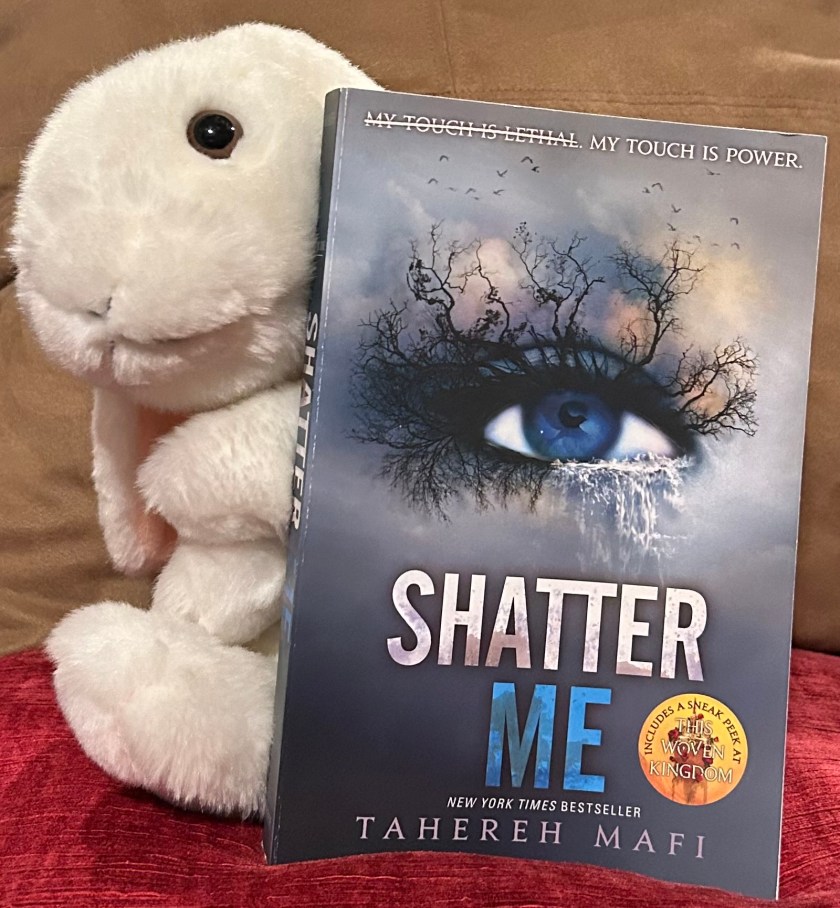
Marshmallow reviews Shatter Me by Tahereh Mafi

A couple weeks ago, while Marshmallow was writing her review of Miss Peregrine’s Home For Peculiar Children, she and Sprinkles looked up some information on the author, Ransom Riggs, and learned that he is married to a fellow author, Tahereh Mafi, who has a significant following of her own. When the bunnies learned about her first novel, Shatter Me (2011), they were intrigued by its plot, and so they decided to check it out. What follows is Marshmallow’s review of this book.

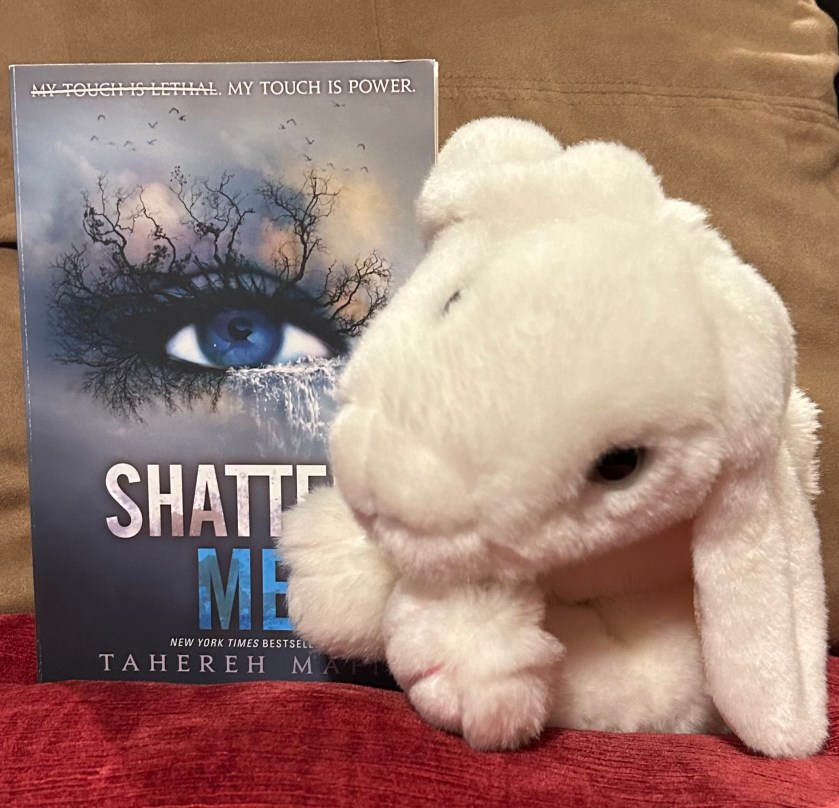
Marshmallow reviews Shatter Me by Tahereh Mafi.

Sprinkles: So Marshmallow, you read this book rather quickly.

Marshmallow: You know I am a quick reader.

S: That’s true. What did you think about this book?

M: Let me first tell you what the book is about. No?

S: Okay.

M: The book is about a girl named Juliette who is living in a special institution, in solitary confinement, because her touch is deadly to other people. And she is living in a strange world, kind of dystopian.

S: That really sounds intriguing! So how old is Juliette?

M: She’s seventeen I think.

S: Okay. Do we ever learn why her touch is deadly? That is a weird condition.

M: Sort of, towards the end, but I won’t tell. You do need to read it yourself.

S: I am going to, for sure. I’m very curious.

M: Well, you won’t learn everything. But you will have a better idea of things. This is the first of a series of several books.

S: I see. Does it stand alone on its own?

M: Well, some of the conflicts and problems in the book are resolved, but many others pop up, and when the book ends, you are kind of left hanging, and need to read the next book. And then probably the next. And so on.

S: Hmm. Well, let me read this first and then see if I want to continue. How about you? Do you want to read the next book? Are you curious about what will happen to Juliette and her world? Did you like her as a character?

M: She is a bit too much into romance for my taste. Maybe it makes sense because she cannot touch anyone, until she meets this one person that she can. So I can see how she might be very excited, but then things do get a bit very touchy, kissy, and so on.

S: Hmm, so probably the book would not be very appropriate for bunnies younger than 12.

M: Hmm, maybe even older than that.

S: I guess we are seeing one of the differences between middle grades and young adult literature.

M: I think that’s right.

Marshmallow is reading Shatter Me by Tahereh Mafi.

S: So let us get back to the plot. So she is in this confined space, but then she meets this one other person who can touch her and not be hurt. Does she ever get out?

M: Yes, there are some folks who want to use her as a weapon. One specific guy especially, and so they help her get out. And the rest of the book is about her learning about these people who want to use her, about the power structure around her, and so on. It is a dystopian world, reminds me a bit about Nineteen Eighty-Four by George Orwell.

S: Yes, you used that word, dystopian, before. But what did you mean?

M: There is an oppressive regime. People have messed up the planet, and a group took charge claiming they’d help, they call it the Reestablishment, but they have not really. And they have erased all other power structures, all other institutions, and so on. Pretty depressing actually.

S: That makes for an interesting setting, I can see that.

M: Yes, I did want to know more, and maybe in the later books, Juliette and her friends will fight the Reestablishment and maybe take them down.

S: Yes, something to look forward to, I’m sure. So tell me a bit about the style of the book.

M: Sure. The whole book is written from a first-person perspective, Juliette’s. And she has a very distinctive voice.

S: How so?

M: When she uses numbers, she does not spell them out even when they are small numbers. She always uses the numerals. Except the chapter numbers in the book; those are all spelled out. She always writes in present tense. And she crosses out things and corrects herself. Of course you can still read what she wrote originally, so that makes her voice different from many other narrators I read.

S: I skimmed through it and I did see some lines crossed out. Even on the title page, there is a part which I am assuming is Juliette saying: MY TOUCH IS LETHAL, crossed out, and followed by MY TOUCH IS POWER. That is really interesting. Then the book reads kind of like a diary, right?

M: Yes, though, apparently, she also has a diary, but this is not quite the diary, I think. I’m not sure actually.

S: Okay, I am now really curious to read the book. Let us wrap this up so I can take it from your paws and get started. How would you rate the book in the end?

M: I’d rate it 90%. I really like the plot, I like the author’s writing style, and I really really want to learn more about Juliette and her story, but the mushy stuff is not terribly exciting for me.

S: That makes sense to me Marshmallow, thanks. What do you want to say to our readers as we close this up?

M: Stay tuned for more amazing reviews from the book bunnies!

Marshmallow rates Shatter Me by Tahereh Mafi 90%.

Caramel reviews Kepler’s Intergalactic Guide to Spaceships by Jake Parker

A few months ago Sprinkles heard about a Kickstarter project initiated by Jake Parker for a book about spaceships. Knowing how much Caramel loves spaceships (see, for example, his review of Star Trek: Ships of the Line by Doug Drexler, Margaret Clark, and Michael Okuda), Sprinkles decided that they would back the project. Just last week, the book finally arrived in the mail, and Caramel was delighted. Below, he shares his thoughts about Kepler’s Intergalactic Guide to Spaceships. As usual, Sprinkles is taking notes and asking followup questions.

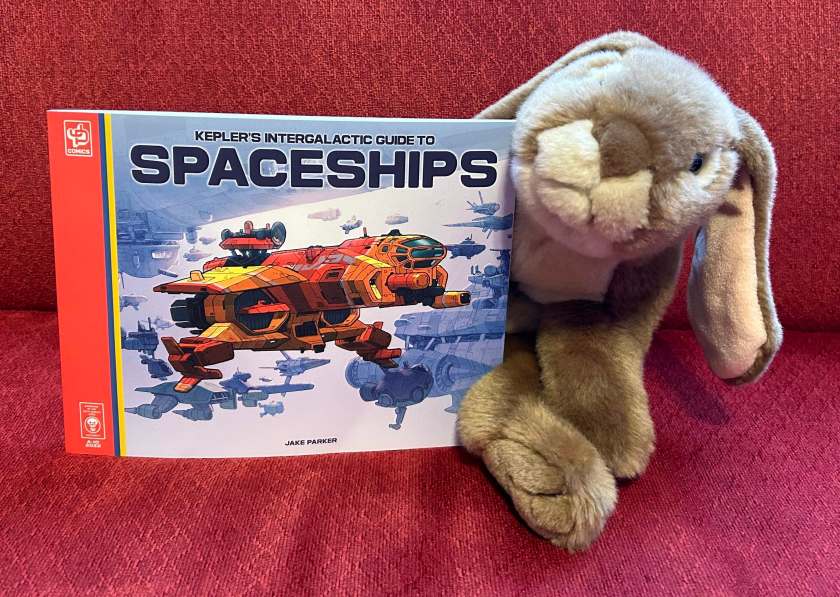
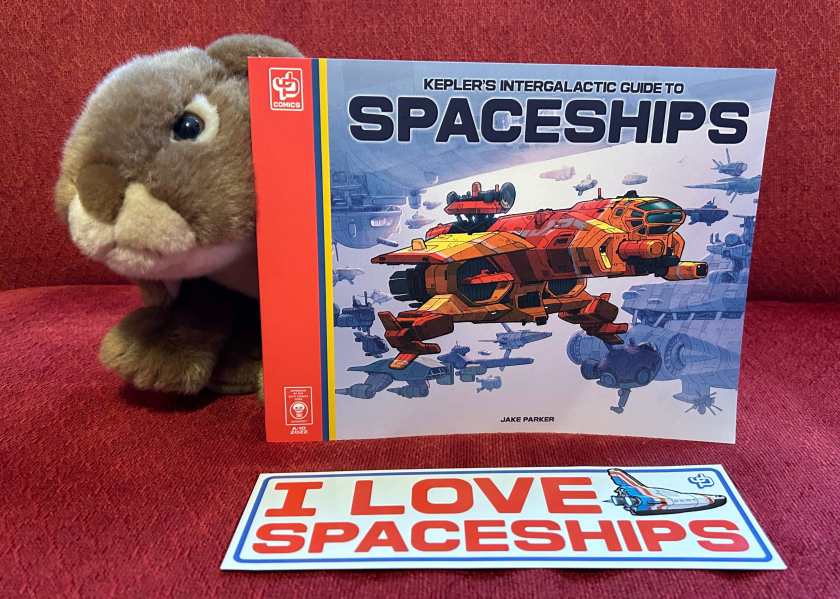
Caramel reviews Kepler's Intergalactic Guide to Spaceships by Jake Parker.
Caramel reviews Kepler’s Intergalactic Guide to Spaceships by Jake Parker.

Sprinkles: So Caramel, after months of waiting, you finally have Kepler’s Intergalactic Guide to Spaceships under your paws! How does it feel?

Caramel: Great!

S: So tell me about the book. What is in it?

C: Spaceships, spaceships, spaceships! (I’m trying to sound like the spaceship guy in The Lego Movie.)

S: I see. And I of course know the book has spaceships in it, because I know its title, but I wanted to know what kinds of spaceships.

C: All kinds.

S: Real spaceships?

C: No. Fake ones, obviously.

S: So they are all inventions of the creator, Jake Parker, right?

C: Yes. And they are all very cool. My favorite one is Zahhak; I think it looks the best.

S: Tell me more.

C: The Zahhak is an attack fighter. The full model is called XAF-9 Zahhak. It’s 13 meters long and has a crew of two pilots. It can have a variety of weapons, and it is powered by two Thrasos Engines. And it was created by the Xovax system.

S: Wait! All of those are made up, right? I mean, there is no real thing called a Thrasos Engine, or a star or planet system named Xovax, right?

C: True, but that is also why this is an awesome book! There are so many spaceships Jake Parker thought up and drew, and they are all so cool!

S: So let me see if I get it right: there are many many fictional ships the author / illustrator created, and it is kind of a guide book of these.

C: Yes. But I think some of the guide is incomplete. The ship Alastor is supposed to be a heavy weapons fighter, but the entry for its armament is empty. Which can’t be, because it is a fighter, and is supposed to have weapons of some sort.

S: Hmm, maybe the guide is created by this Kepler guy and he does not have full information.

C: Yes, Kepler does seem to have full information on all the enemy ships, even though he has not seen all of them. But maybe he does not know the Alastor very well.

S: Okay. So tell me a bit more about Kepler. What or who is he?

C: He is a ship repair person, working in Spartha’s North Quadrant, probably a made-up place, but sounds cool. And he knows a lot about ships.

S: He is named after a famous scientist; did you know about Johannes Kepler?

C: No.

S: Well, Kepler is one of the fathers of modern astronomy. He lived around the same time as Galileo and developed the laws of planetary motion. He also did some work in optics, and that was useful for telescopes. And his work led to Isaac Newton‘s development of the laws of gravitation and all that good stuff.

C: That’s cool! But I don’t think the Kepler in the book is a human, or even a bunny. He looks more like an alien.

S: I thought he also looked a bit like some of the characters in the Beast Academy books.

C: Yes, kind of. The book is very colorful, also like those books. But those books have a definite disadvantage against this one. They have no spaceships!

S: Totally agreed, Caramel. Though I do like the Beast Academy books, they are mainly for math learning fun. They are not for learning about amazing spaceships like this one.

C: Exactly.

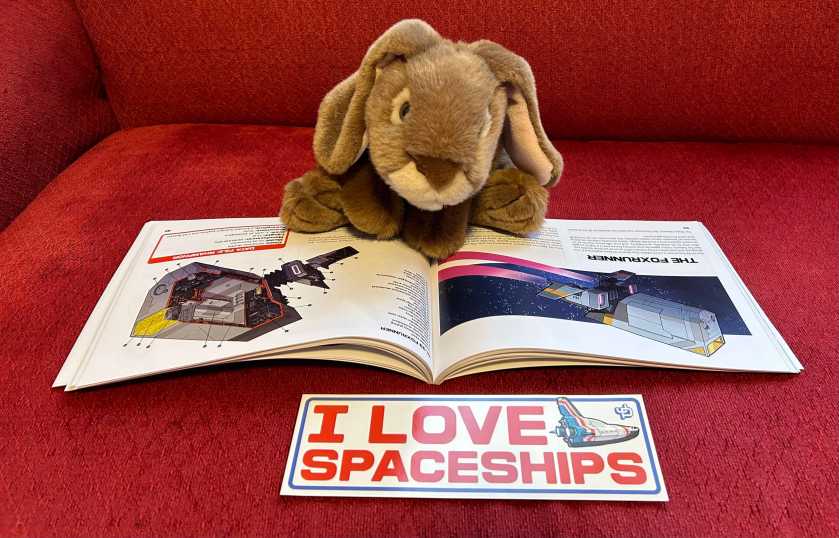
Caramel is reading Kepler's Intergalactic Guide to Spaceships by Jake Parker.
Caramel is reading Kepler’s Intergalactic Guide to Spaceships by Jake Parker.

S: Before looking over this book, I really did not know much about Jake Parker. But I think you would actually enjoy some of his other work too. He wrote a really sweet book about a little robot who makes friends with a sparrow.

C: Yes, we found a librarian reading it on YouTube; it is a neat book. Maybe we can put a link to it here?

S: Sure. Here it is:

OML Story Time: Little Bot and Sparrow by Jake Parker, read by Hadassah (YouTube video).

C: I really like this story. You know I like robots, too, maybe as much as I like spaceships.

S: Do you like robots or spaceships more?

C: Hmm, I can’t choose. I love them both.

S: I know. It is a hard choice. And this little robot is very cute. Jake Parker says he was influenced in his art a lot by Bill Watterson, the creator of Calvin and Hobbes, and you can see it a bit in the pages of the book, right?

C: Yes, not at all in the Spaceships book, but I can definitely see some of it in Little Bot and Sparrow. And maybe after this review I can go and reread some Calvin and Hobbes.

S: Yes, of course. Marshmallow has already reviewed our copy of The Authoritative Calvin and Hobbes: A Calvin and Hobbes Treasury. And you can definitely read it again.

C: I might. But then again, maybe I will continue to look over the spaceships in this book.

S: I know, right? I think you won’t get tired of this book for a while.

C: True. One can never get tired of spaceships, and one can never have too many spaceships. So no, I won’t get tired of this book at all.

S: That’s great Caramel. So let us wrap up this review. Can you describe the book in three words before we do that?

C: Colorful spaceship fun.

S: I like that description! Okay, what do you want to tell our readers then?

C: Stay tuned for more book bunny reviews!
Caramel loved reading Kepler's Intergalactic Guide to Spaceships by Jake Parker and will surely spend many many more hours looking at the pictures of this book in the coming weeks and months.
Caramel loved reading Kepler’s Intergalactic Guide to Spaceships by Jake Parker and will surely spend many many more hours looking at the pictures of this book in the coming weeks and months.

Marshmallow reviews The English GI by Jonathan Sandler and Brian Bicknell

Marshmallow, just like Caramel, enjoys and appreciates graphic novels of various types. As such she has reviewed several of these books for the book bunnies blog. Today she reviews another recent graphic novel, The English GI: World War II Graphic Memoir of A Yorkshire Schoolboy’s Adventures in the United States and Europe, written by Jonathan Sandler and illustrated by Brian Bicknell. Sprinkles was curious about the book too, and so she is taking notes while asking questions.

The book bunnies received this book as a review copy.

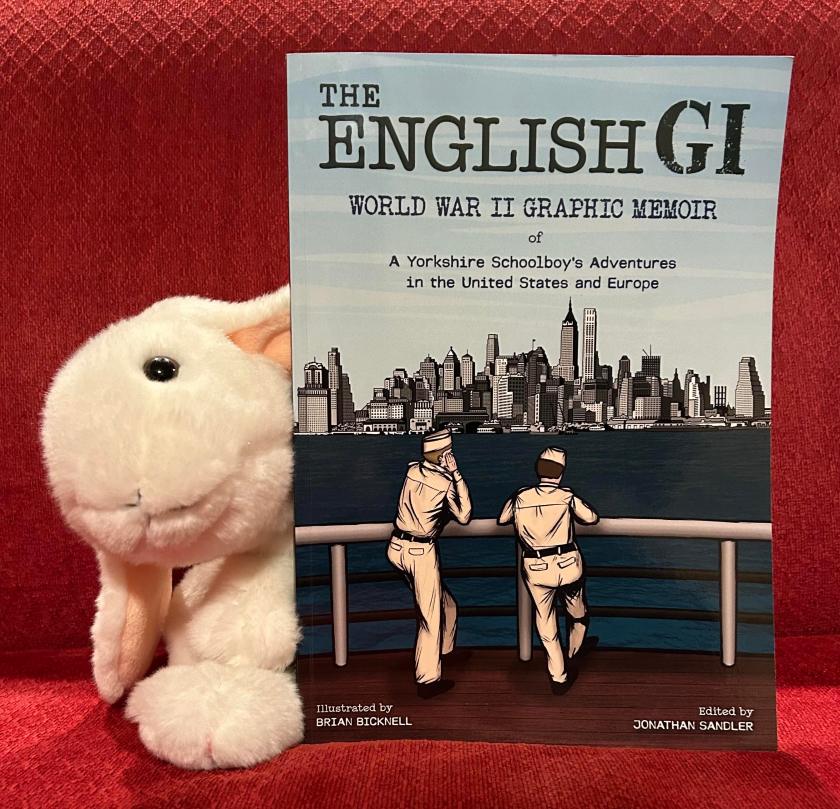
Marshmallow reviews The English GI: World War II Graphic Memoir of A Yorkshire Schoolboy's Adventures in the United States and Europe, written by Jonathan Sandler and illustrated by Brian Bicknell.
Marshmallow reviews The English GI: World War II Graphic Memoir of A Yorkshire Schoolboy’s Adventures in the United States and Europe, written by Jonathan Sandler and illustrated by Brian Bicknell.

Sprinkles: So Marshmallow, let us start with a quick summary. What is this book about?

Marshmallow: This book is about Bernard Sandler, a seventeen-year-old boy from Yorkshire, England, who goes on a school trip to the US. Then the second world war starts and he cannot go back home. He has to find his own way through life in a new country. And he eventually joins the US army and fights in the war too.

S: That sounds like a really rough path for a young person.

M: I think so too. But he does survive and he lives a good life. And the author is his grandson who wanted to tell his story.

S: That is so neat! A lot of families have stories to tell, but not everyone ends up writing them up for others to learn about. So the book is not fiction, then?

M: No. In fact there is a long epilogue at the end of the book, which takes almost a fourth of it actually, and it gives a lot of details about Bernard’s life and his family.

S: I did see that. It looked really well documented. And in some ways it reminded me of two books you reviewed before.

M: Which ones?

S: Nothing But The Truth by Avi and They Called Us Enemy by George Takei.

M: I see how the second one is similar. That too was about real life, written by George Takei, whose childhood was during the second world war, and he went through a lot of difficult times. How do you connect this book to Avi’s?

S: That book also had a lot of documentation, no? Though of course that was fiction, and this is a real story.

M: Hmm, I see. Yes, you are right. This is not quite a typical graphic novel; first off it is true, and then it has a lot of historical documentation that connects it to history.

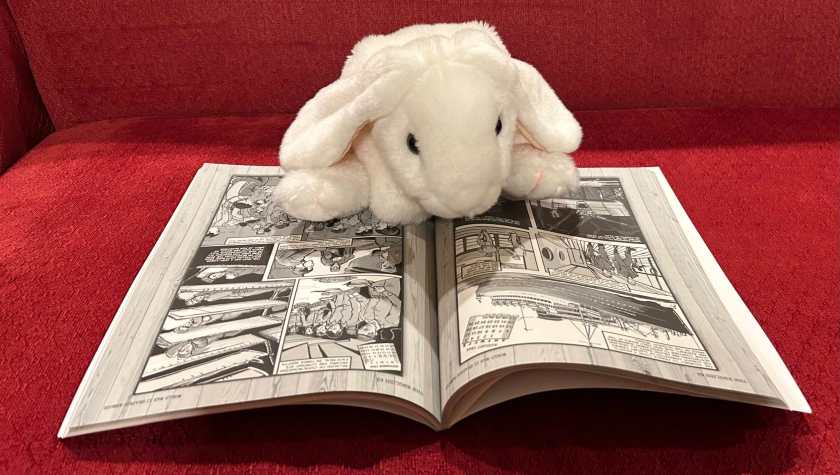
Marshmallow is reading The English GI: World War II Graphic Memoir of A Yorkshire Schoolboy's Adventures in the United States and Europe, written by Jonathan Sandler and illustrated by Brian Bicknell.
Marshmallow is reading The English GI: World War II Graphic Memoir of A Yorkshire Schoolboy’s Adventures in the United States and Europe, written by Jonathan Sandler and illustrated by Brian Bicknell.

S: So what else would you like to tell us about the book?

M: I really liked the illustrations.

S: They are black and white, no?

M: Well, they are more or less grayscale, but you can see a lot of details, and they are almost like photos, and since it is a history being told, I think it fits really well.

S: That totally makes sense.

M: Also I’d like to say that this would be appropriate for readers of all ages.

S: Especially if someone is a history buff, no? I think a lot of people like to read and learn about the second world war. This could be really perfect for such a reader.

M: Yes, but even if you are not particularly interested in that war, this is a good book. It has a really interesting story. And there is not much that would be difficult for young bunnies, except of course it is about war, which is a terrible thing, and Bernard has to separate from his original family and his original country, so those could be too sad for really young bunnies.

S: I agree with you Marshmallow. Some young bunnies might be really sad, so for them, this might not be a good choice. But if a bunny is willing to read a book about the war, and if they are keen on graphic novels, this would be a neat book for them.

M: Yes.

S: So did you learn some things from this book?

M: Yes. It was like looking through a window to see what life was like for a young person during the war. So I found it very interesting that way.

S: Did you know what a G.I. is?

M: I knew of the G.I. Joe action figures, but I did not know exactly what the initials meant, so I had to look it up! Wikipedia says: “G.I. are initials used to describe the soldiers of the United States Army and airmen of the United States Air Force and general items of their equipment. The term G.I. has been used as an initialism of “Government Issue”, “General Issue”, or “Ground Infantry”, but it originally referred to “galvanized iron”, as used by the logistics services of the United States Armed Forces.”

S: The evolution is interesting, isn’t it?

M: Yes.

S: So maybe it is about time to wrap up this review. How would you rate the book overall Marshmallow?

M: I’d rate it 97%. I like how it is a real story and I like the illustrations.

S: That’s great Marshmallow. So what do you want to tell our readers then?

M: Stay tuned for more amazing book reviews from the book bunnies!

Marshmallow rates The English GI: World War II Graphic Memoir of A Yorkshire Schoolboy's Adventures in the United States and Europe, written by Jonathan Sandler and illustrated by Brian Bicknell 97%.
Marshmallow rates The English GI: World War II Graphic Memoir of A Yorkshire Schoolboy’s Adventures in the United States and Europe, written by Jonathan Sandler and illustrated by Brian Bicknell 97%.