Marshmallow reviews Daughter of the Deep by Rick Riordan

Marshmallow has reviewed several book series by Rick Riordan for the book bunnies blog. Today she talks about a stand-alone book by Riordan, Daughter of the Deep, published first in 2021. Sprinkles was curious about the book, too, so she is asking questions and taking notes.
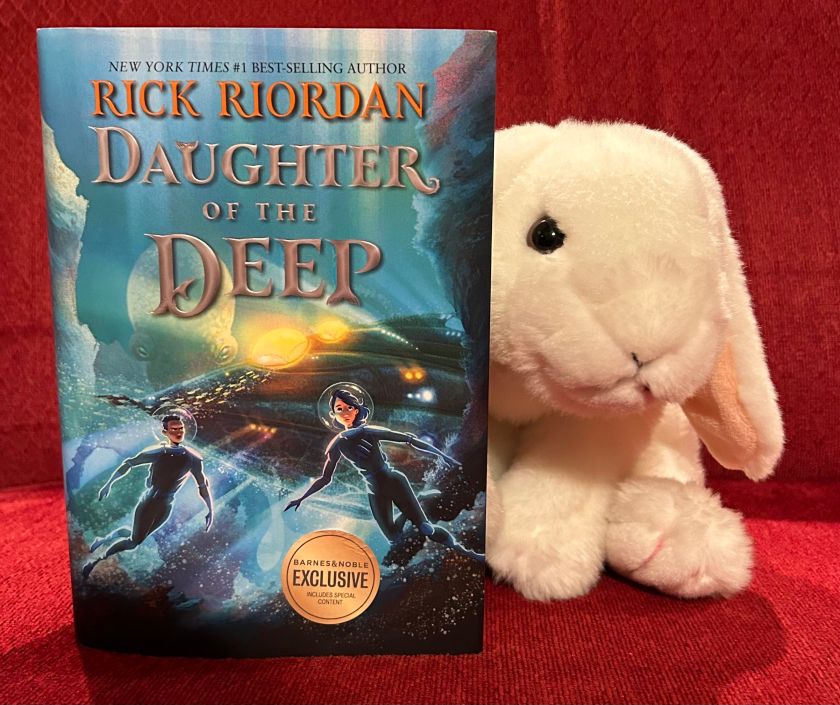
Marshmallow reviews Daughter of the Deep by Rick Riordan.

Sprinkles: So Marshmallow let us start with your one-to-two sentences overview of the book.

Marshmallow: If you like to read books about family, friends, and ocean life, or if you have enjoyed books by Rick Riordan before, then this might be the book for you.

S: Well, that is a good start. Tell me a bit about the story.

M: There is this girl named Ana Dakkar, and she is wrapping up her second year at a special high school intended for young people who want to go into professions involving the ocean. The school is named Harding-Pencroft Academy, and honestly it sounds like an awesome place to be.

S: How so?

M: It is a fancy private school, but more importantly, the classes are all oriented towards the ocean. The students are split into four houses, a bit like the four houses in Hogwarts

S: Well, I can see how that sounds similar, but a lot of boarding schools have such things.

M: In any case, the school is not like Hogwarts at all in any other way. For example, it is in Southern California. And they have climbing walls and cinnamon rolls and other fancy things, like a lot of exciting classes about the sea. And they also study things like cryptography, and navigation, and communication, and defense.

S: So okay, I see. HP is kind of like a naval academy, but at the high-school level. Let us get back to the story now. What is going on in the book?

M: On the last Friday of her second year at her school, Ana and her classmates go on a field trip, and they are supposed to face a challenge or something. But then the school blows up!

S: Wait, what??

M: Yes, everyone else in the school is gone, all at once. And Ana’s brother, who was a senior at Harding-Pencroft, was there, too. So Ana is understandably heartbroken. And Ana does not have her parents anymore, so she feels totally lost. Their teacher, who was coming along to the field trip with them, tells the class that their school was attacked by a rival school.

S: Wow, that is some serious rivalry.

M: Yes. It is called the Land Institute, and they are pretty serious. They are also a marine biology oriented school. But HP is more research-oriented, and the Land Institute is more militaristic. Anyways, from here on, it is open war with the Land Institute, and it turns out that along the way Ana learns a bit about her own family history.

S: Hmm. That is kind of cryptic.

M: I don’t want to spoil it too much. Okay, but if the readers have read Jules Verne’s Twenty Thousand Leagues Under the Sea, and some of his other books, then they have a lot of fun revelations to look forward to.

S: Hmm. I’m getting quite curious. And I have some ideas…

M: Maybe you should read the book then.

S: I think I will.
Marshmallow is reading Daughter of the Deep by Rick Riordan.

S: Okay, so how did it feel like reading another book by Rick Riordan?

M: I thought it would be about mythology again, and I was kind of surprised that it was not. It was a pleasant surprise. It is a really well-written book.

S: Tell me more about how it is written.

M: Well, the story is all told in first person through the voice of Ana herself. And as you might recall from my reviews of the Percy Jackson books, Riordan is really great at channeling the thoughts and voice of his characters.

S: Is Ana funny?

M: Not as funny as Percy, but she felt like a real person, and I really liked her. Though I was kind of confused about how she could be so empathetic towards the sentient submarine that killed–

S: Wait, don’t you think that is kind of a big spoiler??? And a sentient submarine! Wow!

M: Yes, it is a really interesting book! You just have to read it Sprinkles.

S: I am starting to think that Caramel might like it, too, with his love of robots…

M: We did watch the movie version of Twenty Thousand Leagues Under the Sea together. So I agree, he might like this book, too.

S: Okay, then, but I will have to read it first.

M: Sure.

S: So let us wrap up this review then. What would be your rating, Marshmallow?

M: I’d rate it 100%.

S: Sounds good. And what do you want to tell our readers?

M: Stay tuned for more amazing book reviews from the book bunnies!
Marshmallow rates Daughter of the Deep by Rick Riordan 100%.

Caramel reviews Hope and Fortune by Marissa Bañez

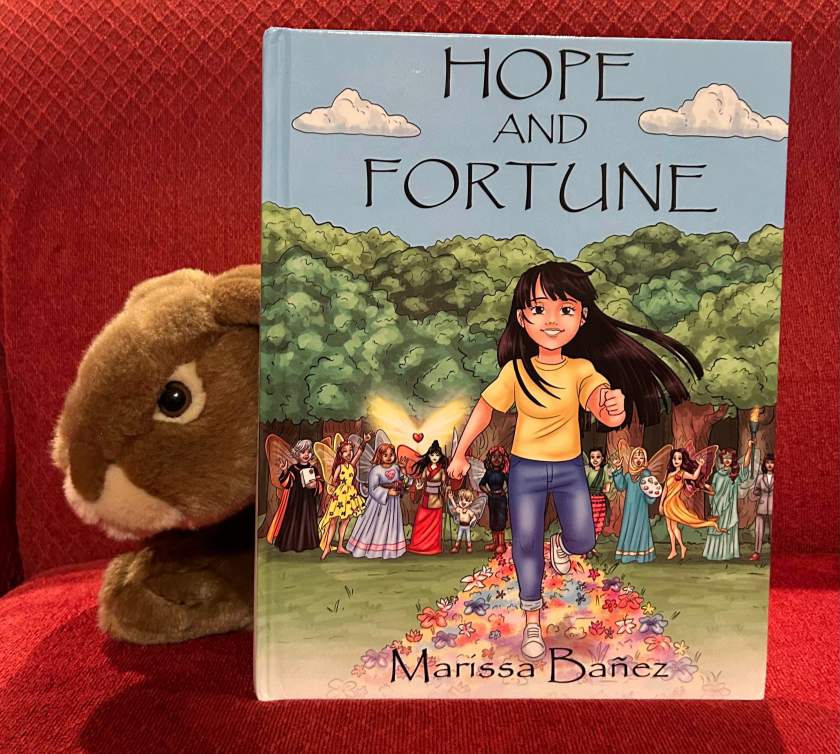
Caramel is growing up: even though he started the book bunnies blog as a little bunny reading and reviewing picture books, he has in the intervening years moved on to chapter books and eventually more traditional novels and even encyclopedias. However he still enjoys reading and talking about picture books. Today he reviews Hope and Fortune, a picture book by Marissa Bañez published in 2023. As usual Sprinkles is taking notes and asking questions.

The book bunnies received this book as a review copy.

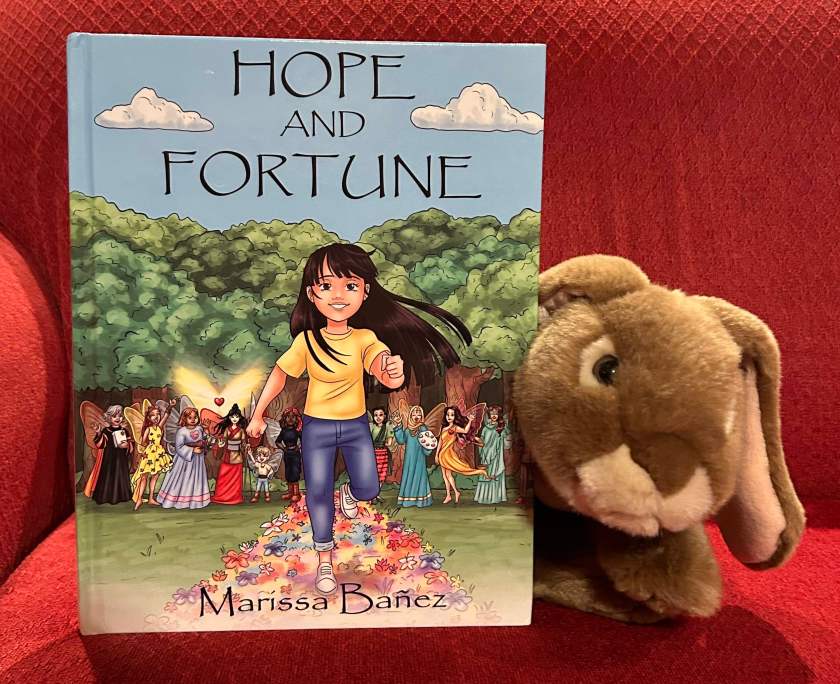
Caramel reviews Hope and Fortune by Marissa Bañez.

Sprinkles: So Caramel, why don’t you start by telling us what this book is about?

Caramel: This book is about a girl named Esperanza who goes into a forest following a butterfly and gets lost. Then she meets twelve fairies who tell her things, and they help her find her way out.

S: The twelve fairies are all different, right?

C: Yes. They are all fairies of different things. For example, there is the Fairy of Innocence and Wonder. And that is the only one who is a boy. All the other fairies are female.

S: Yes, that is true. Good observation, Caramel! What else do you notice about the fairies?

C: They are each representing some good thing. There is one who represents strength and courage; that one looks like an Asian warrior. Then there is one who represents wisdom and intelligence.

S: That one has gray hair and is holding a book or a binder in her hand which has the symbol of Princeton University.

C: I did not notice that.

S: Actually, I think that each page is full of interesting details. For example, all the fairies seem to have some animal companion.

C: Not really. Almost all do. But the first one, the Fortune Fairy of Hope, and the last one, the Fortune Fairy of Love and Friendship, do not.

S: Hmm, again, good observing Caramel. I liked the animal companions, but I guess not all of them have them. By the way, that fairy of love and friendship reminded me of Boticelli’s famous painting, The Birth of Venus.

C: Yes, I can see the oyster shell, and the way they are holding themselves resemble one another!

S: You are right! The arm positions are the same!

C: Of course the fairy in the book is not naked.

S: Yes. I suppose it would not be appropriate otherwise, even though the ancient Greek gods and goddesses were often depicted naked, so Boticelli’s painting makes sense in that context.

C: Wait! Venus is Roman!

S: Yes, thank you for correcting me. I should have known to be more careful talking with you about Greek and Roman mythologies…

C: Well, Marshmallow knows a lot more than I do about them.

S: But you are not that bad yourself!

C: Well, I try.

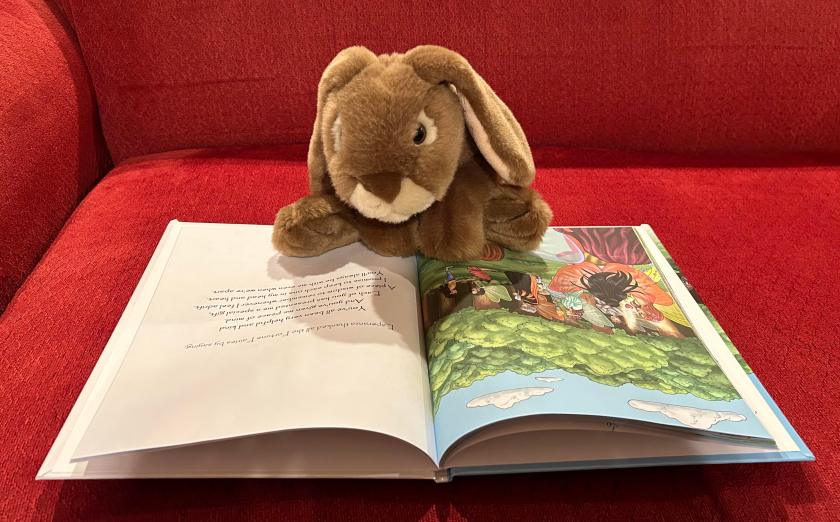
Caramel is reading Hope and Fortune by Marissa Bañez.

S: Let us get back to the book. What did you think about the script?

C: Each page is one page picture and the other a poem. The fairies all speak in rhyme.

S: Yes, I noticed that, too. A lot of picture books have rhyming text, and it makes them more fun to read out loud and more fun to listen, I think.

C: I can see that.

S: So when do you think one should read this book?

C: I think maybe when a little bunny is feeling down, they might feel lost, and then this book might help them. So maybe a parent bunny can read it to them.

S: Yes,. I agree that that could be useful. It does offer some good advice to lift a sad person’s spirits.

C: Yes. For example, the Fortune Fairy of Respect and Dignity tells Esperanza to “value yourself” and “don’t give others the power to put you down”. The Fortune Fairy of Confidence tells her to “be proud of everything that you accomplish”.

S: And the Fortune Fairy of Wisdom and Intelligence tells her to “remember that you learn the most from things that are hard.”

C: You keep telling me that, too.

S: Yes, I do. Because I believe it is really true.

C: But hard things are hard!

S: I know. So we sprinkle in some fun and take on the hard stuff, too. Because we can do hard things. And then we grow stronger.

C: Well, I will have to take your word for it, because you have lived a lot longer than me.

S: That’s fair. Okay, so let us wrap up the review then. What three words would you use to describe this book?

C: Hopeful, colorful, and rhyming.

S: I think those will work well. And what do you want to tell our readers?

C: Stay tuned for more book bunny reviews!

Caramel enjoyed reading Hope and Fortune by Marissa Bañez and recommends it to all the little bunnies who are looking for a colorful book that will lift their spirits up.

Marshmallow reviews Our Missing Hearts by Celeste Ng

Today Marshmallow reviews Our Missing Hearts, a novel by Celeste Ng, first published in 2022. Sprinkles has also read the book and is asking her questions, while also taking notes.

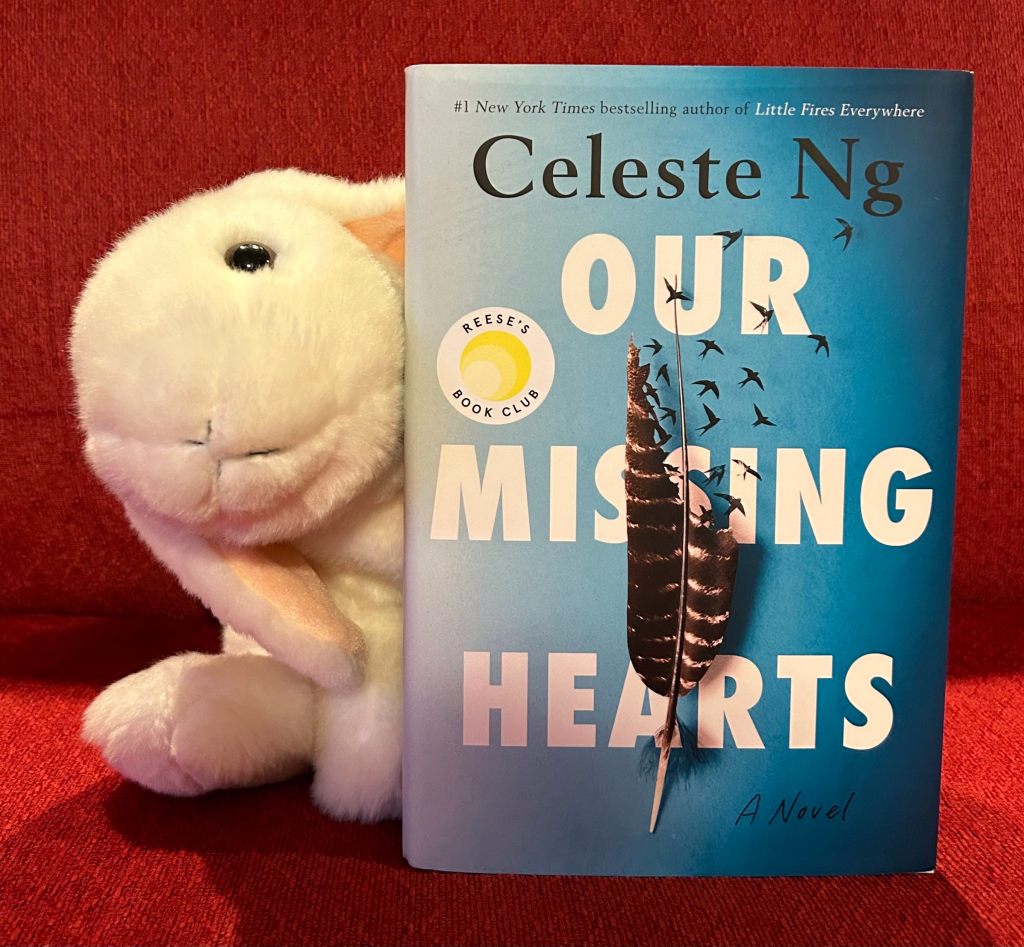
Marshmallow reviews Our Missing Hearts by Celeste Ng.

Sprinkles: So Marshmallow let us start at the beginning. In your reviews, you always start by telling us who this book would be good for. So go ahead.

Marshmallow: This book would be a good choice for readers who enjoy realistic fiction. Or if you are interested in possible near-futures in the United States, especially dystopian ones, this might be the book for you.

S: Okay, I think that is a good start. Can you give us a brief summary of the plot?

M: Sure. So there is this kid whose mother ran away after her poem was used in controversial protests about this law called PACT.

S: Okay, so maybe let us stop there a bit. Tell us about the setting, and of course, PACT.

M: PACT stands for Protecting American Culture and Traditions Act. This law was, in the book, passed about ten years before the story starts. And it essentially allows the government to do things that are supposedly in the interest of preserving American culture. In reality, it is used to take children away from their families, if the families are not “American” enough. In this world, the law specifically targets Asian Americans, due to a fear of China.

S: The author may have been somewhat inspired by the USA PATRIOT Act that was passed after 9/11, and it was very controversial too, because many argue that it cut into people’s civil liberties. This PACT Act was passed after a different but very impactful crisis, right?

M: Yes, and in fact, in the book that crisis was called The Crisis. That left everyone very susceptible to xenophobia, and some people blamed China for all that went wrong, and then of course that distrust of China translated into a distrust of Chinese Americans and then spread all over to a distrust of all Asian Americans. So when the government began to remove children from the homes of some Asian American families, most of the other people remained quiet, believing that there should be a reason for the removal. And most people did not even know how many children were being taken away. The numbers and the full impact of the removals were downplayed by the media, and the families who dared to speak out were demonized.

S: But still there were some protests against the law and these removals, right?

M: Yes, and those are my favorite part of the book actually.

S: So tell us about them.

M: I liked the protests because they were so creative. For example, one involved a bunch of trees which were wrapped up with red yarn and small dolls representing the stolen children. And they were mainly emotional and only subtly political, so people would be more intrigued by them rather than immediately dismiss the message.

S: And that is where the title of the book comes in, right?

M: Yes. The poem that the main character’s mom wrote is called “Our Missing Hearts,” and the protestors took that as their motto, that they wanted their missing hearts to be brought back.

S: Okay, so let us get back to the main character and the plot then.

M: Yes, the main character is a twelve-year-old boy named Bird. Actually his legal name is Noah Gardner, but his mom Margaret Miu always called him Bird, but since she left, people are calling him Noah again. And she left because her poem became too visible with the protests, and Bird’s parents were worried that the government would take Bird away. The mother left so that Bird would at least be able to continue to live with his dad.

S: So the book starts with Bird getting a message which he believes is from his mom.

M: And it is full of cat drawings. And it triggers some memories, Bird is not sure why he knows it is from his mom, but he is sure it is from her. And that part is also very neat. but I cannot say more without spoilers.

S: I guess that is fair. Let us stop with the plot then.

Marshmallow is reading Our Missing Hearts by Celeste Ng.

S: Tell us a bit about the characters.

M: Well, there is Bird, who is the boy who is looking for his mom. And there is Sadie, a half-black girl who was removed from her family because they spoke out against PACT. The law is mainly targeting Asian Americans, but anyone who speaks up against it is also in danger. So Bird meets her at school, where she is sort of an outcast. Sadie is braver than Bird, and she becomes his friend. And then we also meet Bird’s parents. Margaret plays a big role in a large part of the book; she tells her story and we learn about the Crisis a bit more from her. But anyways, Margaret is maybe more timid than Sadie and her parents, and she ran away instead of fighting, but then again, running away meant that maybe her child would be able to stay with his dad, and it could also be seen as a brave sacrifice.

S: Agreed. So did you feel like you connected with these characters? Did you like any of them a lot? Did any of them make you angry or feel something strongly? Did they feel like real people?

M: I think they were all pretty well developed. I thought reading Bird’s perspective felt like I was seeing the world through his eyes, it was a pretty bad place, but anyways, very realistic. And when Margaret told her story, you could also hear her voice very clearly. So I think the author was very successful in creating very compelling and very realistic characters.

S: I agree with you, again. Okay, so I am guessing you liked this book? I certainly did, and that is why I suggested you read it, too.

M: Yea. I really liked it. I’d rate it 100%.

S: That is high praise coming from you, Marshmallow.

M: Yes, I think Our Missing Hearts is a really good book.

S: Okay, so how do we finish this review? What would you like to tell our readers?

M: Stay tuned for more amazing book reviews from the book bunnies!
Marshmallow rates Our Missing Hearts by Celeste Ng 100%.

Caramel reviews The Last Olympian: The Graphic Novel by Rick Riordan

While tidying up his books this weekend, Caramel happened to come across his copy of The Last Olympian: The Graphic Novel, by Rick Riordan, and just realized that he had not yet reviewed it for the book bunnies blog. As he had already reviewed the first four books in the Percy Jackson and the Olympians series, he thought it would be only appropriate if he also reviewed this fifth book. So today that is exactly what he is doing. As usual, Sprinkles is taking notes and asking questions.

The whole book bunny household loved reading the Percy Jackson and the Olympians series by Rick Riordan. Marshmallow reviewed the first three novels (The Lightning Thief, The Sea of Monsters, and The Titan’s Curse), and Caramel reviewed the graphic novel versions of the first four (The Lightning ThiefThe Sea of MonstersThe Titan’s Curse, and The Battle of the Labyrinth).

Caramel reviews The Last Olympian: The Graphic Novel, by Rick Riordan, adapted by Robert Venditti, with art from Orpheus Collar, Antoine Dodé, and Chris Dickey.

Sprinkles: So Caramel you have reviewed the fourth book a little bit more than a year ago. So maybe let us start by reminding our readers what the Percy Jackson and the Olympians series is all about.

Caramel: Okay. The series is about Percy Jackson, who is a demigod, which means he is a half-god. Percy is the son of the Greek god Poseidon, and the whole series is about him and his friends trying to help save the Olympian gods from Kronos, who is a titan and wants to take them down.

S: Okay, I think this is a good overview. So what happens in this book?

C: Percy first tries to attack Luke’s ship, Princess Andromeda. You might remember Luke as the demigod who is working with Kronos. But there is an explosion, and one of their friends dies. Or actually, the friend sacrifices himself by blowing up the ship. Then Percy finds himself in Poseidon’s underwater palace, which is under attack itself. He is then sent to Camp Halfblood and then eventually goes home, too, to see his mom. Along the way he picks up Nico, who is the son of Hades, and they try to plan a new strategy.

S: I remember Nico. He also had a sister, right?

C: Yes, but the sister, Bianca, joined the Hunters of Artemis in Book Three, The Titan’s Curse. And then she died. Anyways, then, Percy bathes in the River Styx and becomes invulnerable except in one single point on his back. Then there is a big fight on a bridge, and then many many more fights, in Camp Halfblood, in New York City, by Olympus, and so on.

S: Yes, I remember reading this book and thinking that it was probably the most action-filled book in the series.

C: I agree with that.

S: But now that you are reminding me of the plot once more, I am thinking there were so many characters and so many places introduced through the series that it would be pretty hard to describe them effectively to someone who has not read the first four books. Would someone who has not read the first four books understand anything from The Last Olympian: The Graphic Novel?

C: No. I really don’t think so. As you said, there are a lot of characters and events from the first four books that you need to know to follow everything. It is best if you have read the first four books before this one. But they are all good books anyways, so why not read all of them? And in order?

S: I agree Caramel.

Caramel is reading The Last Olympian: The Graphic Novel, by Rick Riordan, adapted by Robert Venditti, with art from Orpheus Collar, Antoine Dodé, and Chris Dickey.

S: Okay so tell me a bit about the graphics. Looking over the book I see that it is pretty dark most of the time.

C: Well, a lot of the story is in the Underworld, or at night, or in the underwater palace of Poseidon, which was not too long, but you get the point. A lot of things happen in dark places.

S: I see.

C: The art is created by the same people, so the book looks quite similar to the others actually. Other than the whole being a bit too dark thing, of course.

S: I can see that. So did you know that Rick Riordan is publishing a sixth Percy Jackson book this fall?

C: Really? I did not know that. I want to read it, too.

S: Sure. But I think Marshmallow will want to read it first and review it too. And you like to review the graphic novel versions, but that will probably take a while. But The Lost Hero, the first book of the next series did already come out as a graphic novel. You might recall that Marshmallow reviewed that already.

C: I read that series, too. And I want to see the graphic novel version of it.

S: Maybe we will see if we can get you a copy, Caramel.

C: Yes, let’s.

S: Okay, Caramel. So as we are wrapping up this review, what three words would you use to describe The Last Olympian: The Graphic Novel?

C: Exciting, philosophical, well-concluded.

S: Hmm, I can see what you mean. The book does tie things up and finishes the series really well.

C: Yep.

S: What would you like to tell our readers?

C: Stay tuned for more book bunny reviews!

Caramel enjoyed (re)reading The Last Olympian: The Graphic Novel, by Rick Riordan, adapted by Robert Venditti, with art from Orpheus Collar, Antoine Dodé, and Chris Dickey, and diving back into the world of Percy Jackson after so long.