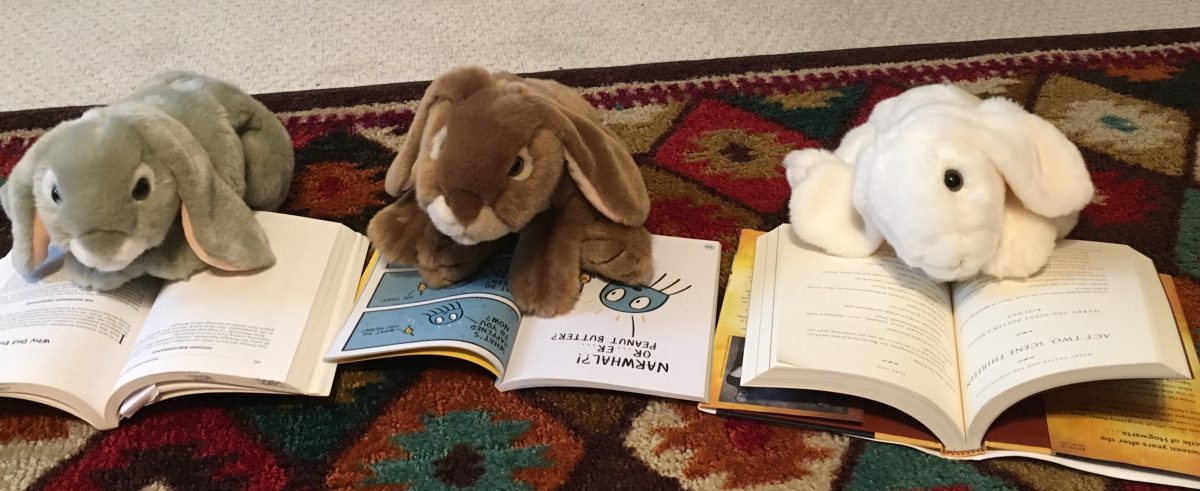
Marshmallow reviews An Absolutely Remarkable Thing by Hank Green

The book bunnies household have learned a boatload of chemistry from Hank Green’s Crash Course Chemistry series on YouTube. So they all were excited to discover that Green had also published a couple of novels way back when. This summer, first Sprinkles, then Caramel, and finally Marshmallow got their paws on the first of these books, and once started, could not put it down until they were done. Today Marshmallow shares with our readers her thoughts on this book, An Absolutely Remarkable Thing, first published in 2018.

[Starting this week, we are moving our weekend posts to Sundays. We hope you will continue to follow us with our new schedule.]

Marshmallow reviews An Absolutely Remarkable Thing by Hank Green.

Marshmallow’s Quick Take: If you like science fiction books that are fun, fascinating, and feel almost real, then this is the book for you!

Marshmallow’s Summary (with Spoilers): April May is an artist. Unfortunately, after going to a private art school, she is now in a lot of debt. Working at a start-up under a very bad contract, April is struggling to find time to make her own art. Her appreciation for true pieces of art is what draws her attention to Carl. While this may sound like the start of a romantic relationship, it is anything but. Carl is a giant, ten-foot-tall, metal sculpture that appears one day on a sidewalk in New York City. Late at night, April walks by it and—thinking that it must be the work of a fellow artist—coerces her friend Andy to record her in a video highlighting how wonderful the piece is, despite the lack of interest from the other passersby. They post this video on YouTube and go to sleep.

The next morning, April and Andy wake up amidst a maelstrom of news. It turns out that sculptures just like Carl (which is the name April used during the video to describe the sculpture in New York) suddenly showed up all over the world; there are sixty four of them in total, all standing perfectly still in plain view on sidewalks in major cities. The news and the Internet are reeling in confusion. Security checks and video surveillance cameras in each area where a Carl appeared went dark for five minutes before the sculptures showed up. The rather impossible, illogical arrival of the Carls leaves the world in need of an explanation.

Since April was the one who “discovered” New York Carl, she becomes somewhat of a celebrity. Soon, she and Andy start raking in thousands from their video and interviews. The attention, especially on social media, is overwhelming, but April’s sort-of girlfriend (Maya) helps her cope, advising her to slow down the speed at which April is exposing herself to the world. But the overwhelming attention is also addictive; to keep it coming, April and Andy hatch a scheme to keep themselves poised as the go-to experts on the Carls. April, Maya, and Andy all met at their art school and are all experts in designing brands. April decides that she will brand herself as the curious, yet calm human person in contrast to the other-worldliness of the Carls. And I mean that literally. Miranda, a material scientist at UC Berkeley, reaches out to April and they realize that the characteristics of the Carls cannot physically exist because there is no existent or create-able material that matches it. The Carls must have come from out of this world!

As April and Miranda work together, they start realizing that there are sequences, or puzzles, that seem to be left by the Carls for humanity to solve together. Many of them are in the Dream, a shared experience that almost every human on the planet starts to have during sleep. The Carls have yet to say a word, yet the world is holding its breath. Driven by ambition, curiosity, and a little bit of arrogance, April May plans to be the one who uncovers why the Carls are here and what they really are.  

Marshmallow is reading An Absolutely Remarkable Thing by Hank Green.

Marshmallow’s Review: This was an absolutely remarkable book (see what I did there?) I would highly recommend An Absolutely Remarkable Thing to all readers to read at some point. However, it is not quite appropriate for young bunnies because it does use a lot of bad words and it does make a lot of references to sexual activity (though, luckily, none is shown!)

An Absolutely Remarkable Thing is both intensely entertaining and fast paced, but it also is also very thought-provoking. At the beginning of the book, I did not enjoy Green’s style too much, but I became more accustomed to it later on. His writing is very smooth and the story never has a single lull. The plot is fascinating and literally keeps you hooked until the end. Green builds a world around you and it is very hard to disassociate from it while you are reading. Green makes the book feel so real that there were times I stopped reading and forgot that there are not, indeed, Carls in the real world.

I think Green exceeded all expectations for a first-time writer. He excels in all standard aspects of storytelling, but I think the thing that stood out to me the most was the philosophical part of this book. The main character is definitely not perfect. She is very dis-likable, which I think is a testament to Green’s prowess because one ends up on her side at the end anyways. Every person in this book is so real and flawed and truly human that this could actually take place right now. Part of what I think made this book so realistic was the consistent themes of social media, celebrity, and people’s need for attention. I kept thinking of how much of Green’s own personal experience in the virtual world was reflected in the book.

I was mildly annoyed that An Absolutely Remarkable Thing ends in a cliffhanger because I wanted to know how things really end. Though many of the mysteries were resolved in this volume, there are a lot more that were not. Green wrote this to be the first in a two-part series so I am probably going to have to read the next one too! 

April May, the main narrator, is a very honest yet blunt person. But I really liked how, through April, Green managed to make a convincing argument for humanity. I loved how he showcased both the bad and the good of characters and of humanity as a whole. There are a lot of too-real moments that mimic what politics and some industries look like now. I think overall An Absolutely Remarkable Thing is a work of art because it takes every broken, ugly part of humanity and glues it together with the beautiful parts to create something that is glaringly imperfect yet honest and meaningful. 

Marshmallow’s Rating: 100%.

Marshmallow rates An Absolutely Remarkable Thing by Hank Green 100%.

Caramel reviews The Five Sides of Marjorie Rice: How to Discover a Shape by Amy Alznauer

Today Caramel reviews an intriguing and colorful picture book: The Five Sides of Marjorie Rice: How to Discover a Shape, written by Amy Alznauer and illustrated by Anna Bron. Published in June 2025, this beautiful book was recommended to the book bunnies by a long-time friend of the blog: thank you, you-know-who-you-are! As usual Sprinkles is taking notes and asking followup questions.

Caramel reviews The Five Sides of Marjorie Rice: How to Discover a Shape, written by Amy Alznauer and illustrated by Anna Bron.

Sprinkles: Today we are talking about another picture book, written by Amy Alznauer. We reviewed another book by her a while back.  

Caramel: Yes, I remember! That was a cool book, too; it was about a mathematician who thought about beautiful number patterns. This one is about a woman who discovered a new pentagon.

S: A new pentagon? How does one discover a new pentagon? I mean, pentagons are five-sided geometric shapes, and there are infinitely many of them. 

C: So yes, there are a lot of different types of pentagons, right? So she just found a new type. Pretty cool, right?

S: Yes, sounds cool, but I am still not sure I understand. Among the infinitely many different pentagons, the one she found has to be special somehow to be important. 

C: So, let me try to say it more carefully then. She found multiple new types of five-sided shapes that could cover the whole plane.

S: Oh, I see. So she found a new tile! I know about these! The problem is if you have a bathroom or a kitchen and you want to tile it with tiles, then in the hardware store, they usually will have square tiles, because squares tile the plane. That means you can use square tiles to cover a surface without leaving any gaps. It turns out that you can use hexagonal (six-sided) tiles or triangular (three-sided) tiles too. But these are the only options if you want to use regular tiles. That means each side has to be the same length and the corners in the angles should be the same. Here is a nice picture, showing the angles meeting at a corner for the three regular tiles:

Image from https://pappagallodifermat.blogspot.com/2012/07/ma-che-bel-pavimento.html

C: Yeah, so when she learned about this, she wondered why not five-sided tiles.

S: The math does not add up with five sides, at least if you want regular tiles, with the same side lengths and corner angles. See:

Image from https://pappagallodifermat.blogspot.com/2012/07/ma-che-bel-pavimento.html

C: Cool, I think I understood it a bit when reading the book, but these pictures help me understand it better. So let us keep them for our readers, too. Hopefully it will help them too. .

S: Sure. So all of that means that regular pentagons don’t work. So then she must have found a five-sided shape that can still tile the plane. That sounds really cool! 

C: Yeah, I agree. It looks like a crooked house! And she kept playing with different crooked houses in her head until she found one that worked. It is really cool. And the pictures are also very interesting. 

S: Yeah, I had a chance to look over the pages of the book, too, and agree with you. It is very colorful, and shapes of all types are all over the place. It is visually a very satisfying book. 

C: Yep. 

Caramel is reading The Five Sides of Marjorie Rice: How to Discover a Shape, written by Amy Alznauer and illustrated by Anna Bron.

C: So the book does tell us a bit about all the people who worked with this tiling problem you described above. But I wondered why this Marjorie Rice was the only woman among them, and no other women were mentioned other than her.

S: Hmm, you know, this is kind of a challenge for many people who want to encourage everyone to be more expansive about how they think of just who can do math. It seems that throughout human history, the mathematicians who made names for themselves have almost all been men. So I think Marjorie Rice’s story is a very interesting one, not only because the math she did is fascinating but also because she is a woman who did not become a famous mathematician, but while going about doing her life – she was a homemaker – she just happened to find a mathematical problem so interesting that she could not stop thinking about it. And she found a really neat solution to it, too!

C: Yeah, it is really cool, isn’t it?

S: Yes, I agree. This all reminds me of this article I read about what it means to be a mathematician. The author, a cool math blogger, basically says that you find mathematical problems interesting and you give yourself the freedom to work on them. 

C: Huh, cool, I like that! It means I could be a mathematician, too, if I found a problem that I could not stop thinking about and just kept at it. 

S: Yes, exactly. It is about curiosity and keeping at it. 

C: But maybe I want to become an astronaut instead?

S: Well, that is part of the point of the story, right? You don’t have to be a professional mathematician to do math. You can be anything else, and also play with math on the side. You know, some of the very famous mathematicians we still talk about today did math as a hobby. Like Pierre de Fermat, who was a lawyer but also did a lot of very interesting math on the side. 

C: Hmm, that is interesting… I am not sure I want to become an astronaut by the way. I like this planet too much, and as a tiny bunny, being in orbit is kind of intimidating. 

S: Yeah, I think you are very much planted on this planet. Me too. But you think reading about space is cool, though, right? 

C: Yeah, it really is. Hmm, I have not reviewed a space book recently. 

S: Well, you did just review Space Case: The Graphic Novel

C: True. And that is a really good book by the way. But I was kind of hinting toward another space book review coming up soon, wink wink! 

S: I know! Okay, maybe we should wrap this up because it is getting close to your bedtime. What would you like to tell our readers as we end this post Caramel?

C: Stay tuned for more book bunny reviews!

Caramel enjoyed reading The Five Sides of Marjorie Rice: How to Discover a Shape, written by Amy Alznauer and illustrated by Anna Bron, and is now looking around himself to see if he can find new hexagons.

Marshmallow reviews Soseki Natsume’s I Am A Cat: The Manga Edition

Today Marshmallow reviews Soseki Natsume’s I Am A Cat: The Manga Edition, the graphic novelization of the Japanese classic I Am A Cat, originally written by Soeki Natsume in 1905-1906. This “manga edition” was retold and illustrated by Chiroru Kobato, translated into English by Zack Davisson, and published in 2021. Sprinkles is taking notes and asking questions.

[In this post, we mention suicide as it relates to the content of the book, so if this is a sensitive topic for you, please consider not reading further.]

Marshmallow reviews Soseki Natsume's I Am A Cat: The Manga Edition, retold and illustrated by Chiroru Kobato, and translated into English by Zack Davisson.
Marshmallow reviews Soseki Natsume’s I Am A Cat: The Manga Edition, retold and illustrated by Chiroru Kobato, and translated into English by Zack Davisson.

Sprinkles: I am so excited we are finally talking about this book! I am very curious about it. So let us start with your standard overview. 

Marshmallow: Sure! If you like thought-provoking and eye-opening books from other cultures and other time periods, then this is the book for you!

S: That is a great start. Okay, now please do tell us a bit about what this book is about.. Since the title is “I am a cat”, I am guessing it is probably about a cat.

M: Yes, actually the main character is a cat who narrates the whole story (which takes place in early twentieth century Japan). He was separated from his family at a young age and was taken in—reluctantly—by the family of an English teacher named Sensei Kushami. He describes his life with them and the silly human occurrences / things they experience. 

S: So what kinds of things does he talk about? 

M: Early on, he describes his near-death experience with mochi. He also watches the humans gossip a lot about a rich woman named Ms. Kaneda and her nose (which I thought was very insensitive). The woman, whom the cat calls Lady Nose, has a very ungrateful yet beautiful daughter who may marry one of Sensei Kushami’s friends. There is a lot of confusion that surrounds this affair though and a lot of false rumors and accusations get thrown around. 

S: So the cat witnesses and talks about a whole lot of silly, trivial, petty things humans worry about. 

M: Yes. In the original version of the book, according to this neat recap we found online, this makes him feel pretty superior. In this manga version, he also seems a little amused by their behavior; however, he seems a little less judgemental.

S: In that recap and also on the Wikipedia article for the book, we also learn that the Japanese version of the title “I Am A Cat” also has sort of this formal feel to it because it uses a particular version of the first person pronoun “I” that is “a very high-register phrasing more appropriate to a nobleman, conveying grandiloquence and self-importance”. I am guessing that also makes the book funny to begin with, the cat is kind of pretty full of himself. 

M: I presume it does in Japanese, but of course, I didn’t quite catch that joke myself in English. 

Marshmallow is reading Soseki Natsume's I Am A Cat: The Manga Edition, retold and illustrated by Chiroru Kobato, and translated into English by Zack Davisson.
Marshmallow is reading Soseki Natsume’s I Am A Cat: The Manga Edition, retold and illustrated by Chiroru Kobato, and translated into English by Zack Davisson.

S: English has a single first-person pronoun which makes it a lot easier to learn or speak it, but you also lose a lot of nuance in this way, I suppose. Anyways, so this cat is observing his humans, kind of like Garfield. Garfield is kind of self-important in a way, but maybe a bit less interested in the humans.

M: Yes. I felt like the main character here did seem to care about his human family, but they did not really seem to always care about him too much (Sensei Kushani originally did not want him in the house at all). 

S: Hmm, that is interesting. So I know that when you first read this book, you were a bit disturbed by it. Can you tell us a bit about that? 

M: I felt that the book made too many references to suicide too lightly. Several characters consider hanging themselves on a pine called the Hanging Tree. None of the main characters ends up killing themselves, but it felt like it was mentioned too many times in the course of such a short book. 

S: I can see how that made the feel of the book kind of dark and uncomfortable for you. I am sorry about that. I had thought that this book is supposed to be satirical and philosophical, so I suggested that you read it. 

M: It’s okay! It was a little dark and unexpected, but the rest of the book was amusing to read. I can see why people find it both satirical and philosophical. It is pretty amusing to read a cat pontificating about the silly ways of humans. Like we bunnies do sometimes. People-watching is one of my favorite hobbies. 

S: I know, right? People-watching is fun! Okay, so tell us a bit about the satire or the philosophy then. 

M: Okay, the philosophy part was also pretty dark and depressing though. Sensei Kushani and his friends in academia and one in business discuss the integration of Western ideals into traditional Japanese culture. They also say some very sexist things about women to their friend who just got engaged. Meanwhile, the cat narrating the book ponders about life and whether it is worth it. At some point, he reaches the conclusion (which I disagree with) that life is only suffering and that death is the only peace. 

S: Okay, I can see that maybe these ideas are a bit too heavy for a “manga edition”. Maybe the original book deals with them with more nuance. So maybe let us now talk about the manga nature of the book. I know both you and Caramel have read a lot of graphic novels. But is this your very first manga?

M: I think so. I have never read a book that was meant to be read backwards which was a little difficult to adjust to.

S: Backwards for us of course, not for many other people around the world who read from right to left. 

M: Yes, but  I am still not sure whether I was supposed to start from the top of the page or somewhere else. 

S: I can imagine that can be disorienting. I have read only one manga-style book and that was disorienting for me, too. But I am honestly disoriented by all graphic novels, so maybe it was also that. Anyways, so let us wrap up this review then. All in all, did you enjoy reading this book? Did you find it interesting?

M: This book was definitely interesting. It helped me understand a little bit more about Japan’s culture and its understated, natural aesthetics and style. I also liked how this version simplified a classic book into a format that was somewhat easy to understand and definitely a lot easier to read for people who can’t read Japanese. I liked how this made one of the great Japanese novels accessible to others! I would rate this book around 95%. 

S: That is wonderful, Marshmallow. Then I am also glad you read it. What would you like to tell our readers as we end the post?

M: Stay tuned for more amazing book reviews from the book bunnies!

Marshmallow rates Soseki Natsume's I Am A Cat: The Manga Edition, retold and illustrated by Chiroru Kobato, and translated into English by Zack Davisson, 95%.
Marshmallow rates Soseki Natsume’s I Am A Cat: The Manga Edition, retold and illustrated by Chiroru Kobato, and translated into English by Zack Davisson, 95%.

Caramel reviews The Wild Robot on the Island by Peter Brown

Caramel has read and loved all three Wild Robot books by Peter Brown. He has also appreciated the Wild Robot movie when it came out last year. Today he is talking to Sprinkles about the most recent Wild Robot book, The Wild Robot on the Island: An Illustrated Picture Book Adaptation of The Wild Robot, written and illustrated by Peter Brown and published this past summer (June 2025).

Readers should also check out Caramel’s reviews of The Wild Robot, The Wild Robot Escapes, and The Wild Robot Protects.

Caramel reviews The Wild Robot on the Island: An Illustrated Picture Book Adaptation of The Wild Robot, written and illustrated by Peter Brown.

Sprinkles: So Caramel, we are finally talking about the picture book version of The Wild Robot; are you excited?

Caramel: Yep, because it is a very good book, the original and this version.

S: When I first heard about this, I thought it would be a new story, but it seems this is basically the original story, right?

C: Yes it is the same story, but more simplified. So there is a robot named Roz that gets lost in the ocean after a boat loses all of what it is carrying. And the robot finds itself on an island. And then it goes around looking for and making friends. It is really a sweet story!

S: Yes, I remember the book and the movie.

C: I am guessing this one is for younger bunnies. Because the original book was for bunnies who could read a big book. This is a picture book. 

S: Yes, that makes sense to me. Younger bunnies could not read the original book really. It was over two hundred pages. This one is a nice standard-sized picture book.

C: And there are very few words on each page in this version. The other one had a lot more words of course. 

Caramel is reading The Wild Robot on the Island: An Illustrated Picture Book Adaptation of The Wild Robot, written and illustrated by Peter Brown.

S: I think the book is illustrated by the author, right? 

C: Yeah, from what I can tell. 

S: Are they similar to the illustrations in the original? There were some pictures in those too, no?

C: Yeah, the style is very similar to the original book.

S: Maybe the author wanted readers to have the same mental images he has for the characters and the locations and such. The movie was also very pretty, but it was kind of different visually. 

C: Yeah, maybe. The movie was beautiful, and I loved it. But the illustrations in the original book and now in this new picture book are all slightly different. And they are also very beautiful. Speaking of the movie, can we add a link to the trailer? You just reminded me of how good the movie was…

S: Sure. Here it is.

C: Thank you! Maybe we will watch it again some day.

S: Maybe; I could like that too. But now let us get back to the book. Do you think that maybe the author thought the picture book was a good idea now that so many younger bunnies have actually seen the movie?

C: Maybe, I don’t know, but it was a fast read for me. 

S: Well, you are a very good reader, Caramel. 

C: I do read a lot, true. Maybe this book could get some bunnies into the bigger books. After all, there are two more books after the original one! 

S: And I know you actually would love it if there were a fourth book… 

C: Yes, I really want a fourth book. That would be very very very good.

S: Okay, maybe we publish this post and who knows, maybe it will eventually get to the author’s ears…

C: Yes, dear reader, if you are Peter Brown, the creator of The Wild Robot, then please write a fourth book! I really would love to read more of Roz’s adventures. 

S: Okay, maybe we can wrap this up then. You have made your opinions quite clear. So what would you like to tell the rest of our readers then?

C: Stay tuned for more book bunny reviews!

Caramel loved reading The Wild Robot on the Island: An Illustrated Picture Book Adaptation of The Wild Robot, written and illustrated by Peter Brown, and is hoping that soon there will also be new adventures for Roz and friends.