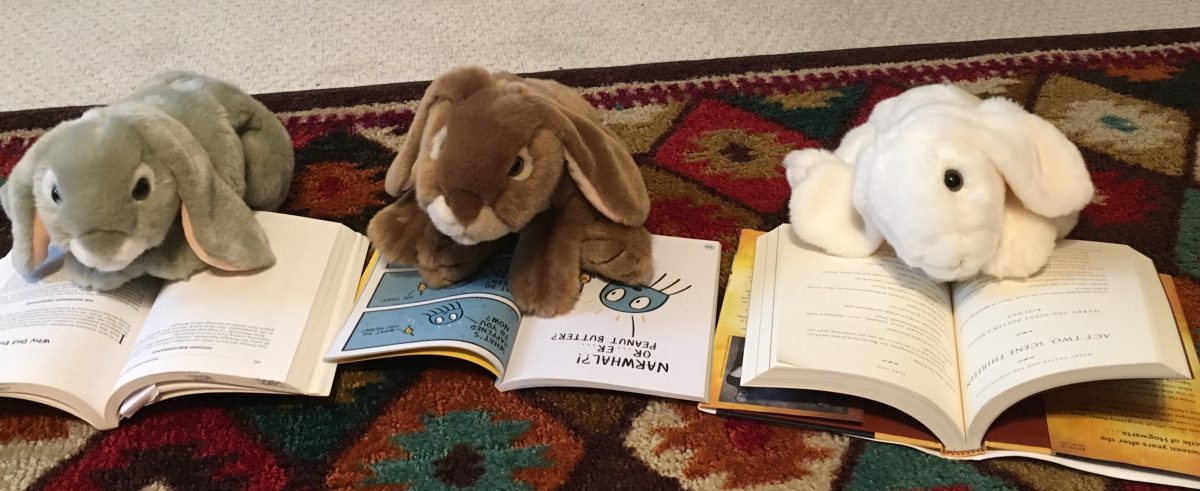
Marshmallow reviews Onyeka and the Rise of the Rebels by Tọlá Okogwu

A while back Marshmallow read Onyeka and the Academy of the Sun by Tọlá Okogwu and, as you can see from her review, enjoyed it a lot. Today she reviews Onyeka and the Rise of the Rebels, the second story recounting Onyeka’s adventures, published in 2023.

The book bunnies will be taking off for a short summer break during the month of July. We look forward to seeing you in August with many new books!

Marshmallow reviews Onyeka and the Rise of the Rebels by Tọlá Okogwu.

Marshmallow’s Quick Take: If you like books about magic, friends, family, and new magical worlds, or have enjoyed reading the previous Onyeka book, then this is the book for you!

Marshmallow’s Summary (with Spoilers): When Onyeka first came to the Academy of the Sun, she learned that there is a whole new world of magic hidden in Nigeria. The Academy shelters and teaches Solari children and young adults, who all have Ike or special magical powers. Doctor Dòyìnbó, who runs the Academy, trained them all to “serve Nigeria” with their Ikes. Until recently, Onyeka believed–just like all the other Solari–that their powers came from exposure to a leaked material. At the end of the first Onyeka book, she learned that the material was leaked by Doctor Dòyìnbó, who intentionally “gave” the Solari their Ike. While this might sound noble, the children who gained Ike were taken from their families to be trained by Dòyìnbó at the Academy to “serve Nigeria,” or more precisely himself. Naturally, once Onyeka and her friends discovered that basically everything Doctor Dòyìnbó told them was a lie, they rebelled.

Now at the beginning of this second book, they are hiding as fugitives since the whole Academy has turned against them, with Doctor Dòyìnbó keeping the truth secret from the rest of the students and staff of the Academy. Onyeka, her friends, and her aunt have to plan their next course of action, and find themselves at a crossroads: they can storm the Academy to try to reveal the truth, or they can search for the Rogues (a group Dòyìnbó characterized as the Solaris’ enemy, likely because they uncovered his plan) to join forces.

At the same time, Onyeka’s scientist aunt has been working to fabricate a formula that corrects the Ike’s negative side effects; normally, all Solari suffer from nausea, sickness, and, after years of using their Ike, death. Luckily, she figures it out! Onyeka and her friends soon elect to find the Rogues, yet Onyeka is reluctant to trust them. After Dòyìnbó’s betrayal and elaborate falsities, she feels as though it is too risky. She does not tell the Rogues (who are also Solari, but they live in a secret base hidden from Dòyìnbó and the Academy) about the formula they made, waiting for proof that they won’t misuse it.

Onyeka, her friends, and the Rebels mount their defenses and plan for how they will overtake Dòyìnbó. But the whole time, Onyeka has been visited by Dòyìnbó in her dreams. She keeps this a secret too. But as Paul Tournier once said, “Nothing makes us so lonely as our secrets.” Throughout the book, Onyeka faces inner turmoil like nothing she has experienced before as secrets are revealed, wars are waged, and her life is forever changed.

Marshmallow is reading Onyeka and the Rise of the Rebels by Tọlá Okogwu.

Marshmallow’s Review: I think that this was a very well thought-out book. Onyeka’s character is front and center, but I am also glad that we got to see more of the other characters. That said, I was so mad that she does the same “I have to be the hero” thing as every other teenage protagonist (*cough, cough* Harry Potter). I would have presumed she would have been able to think about the situation with more understanding of depth. But she still makes the same mistakes because she is looking at everything in a very 2D way. I was a little surprised because her struggles and thoughts were almost identical to Harry Potter’s, which shows how this book is also another great fantasy series. However, I would also warn readers that you might be tempted to yell at the book because of how precisely she follows the same silly hero pitfalls. The plot is definitely unique though and the same can be said for the world Okogwu has created. I really love how the new magical aspects of the Academy and the futuristic tech the Solari use blend into the rich Nigerian culture the characters celebrate. That really makes this book special.

I think reading books like Onyeka and the Rise of the Rebels is definitely vital for a diverse society. It is neat to see heroes from different backgrounds that many people have never really been able to see before. It’s heart-warming to see that there are more and more stories like this! But setting that aside, Onyeka and the Rise of the Rebels is a really good book on its other merits too. The plot is on-point, sharp, and doesn’t lull. Even when the characters are not physically doing much, there is still a lot going on in terms of social dynamics and emotions. This is a really good book and–though it resolves at the end, sort of–I am excited to read the next one!

This being our last post till August, I have to say… Happy summer reading and stay tuned for more amazing reviews from the Book Bunnies!

Marshmallow’s Rating: 100%.

Marshmallow rates Onyeka and the Rise of the Rebels by Tọlá Okogwu 100%.

Caramel reviews Ingo by Helen Dunmore

As his last review before the book bunnies take off for the summer, Caramel chose Ingo by Helen Dunmore, originally published in 2005. As usual, Sprinkles is taking notes and asking questions.

Caramel reviews Ingo by Helen Dunmore.

Sprinkles: So Caramel, as we are getting ready to take off for the summer, you chose to talk about a book about the ocean.

Caramel: Yes. Ingo is about the ocean, that is true. But it is also about a lot more.

S: Tell me.

C: It is about a girl named Sapphire. Her father “mysteriously vanishes into the waves off the Cornwall coast where her family has always lived.” At least that is what the back of the book says.

S: Hmm, I thought you read the book.

C: I did. I thought it would be quicker to use the book’s own summary.

S: I guess that makes sense. But so her father disappears into the waves, does that mean he goes off swimming and does not come back?

C: Yes, almost. He goes sailing and does not come back. But before he disappears, he tells Sapphire about these people of the sea called the mer.

S: Like mermaids?

C: Yes, but they are called the mer, and they hate being called mermaids. They think the humans’ way of thinking about mermaids is silly.

S: That is interesting. I think there were some wild merpeople in one of the Harry Potter books.

C: Yeah I think you are right. In Harry Potter and the Goblet of Fire, there were merpeople too. But those were kind of vicious and almost evil. These mer are a lot less vicious and evil.

S: There were also some mer people in another book, one that you read, I think?

C: Oh yes. There were some mer people and even some selkies in The Menagerie: Krakens and Lies! Those books were cool!

Caramel is reading Ingo by Helen Dunmore.

S: So does Sapphire meet the mer?

C: Yes. She goes looking for her dad and meets some mer. Before that, her brother Conor disappears for hours and does not remember what happened, or so he claims. It turns out that he was meeting with the mer. Conor and Sapphire make friends with two mer children, Faro and Elvira, who help them when some people get into trouble.

S: So the book is about Sapphire discovering the world of the mer and maybe finding her dad?

C: Well, she does not find her dad in this book. Apparently there are four other books after this one, and maybe she will find him, but in this book, she does learn about the mer and their world. It is called Ingo.

S: Oh, that is why the book is titled Ingo!

C: Yup. Ingo is the name of the underwater world that the mer live in.

S: That is interesting Caramel. So did you enjoy this book?

C: Yes. I even want to read the next four books.

S: I see. That is a good sign.

C: Yep, I’d say so!

S: Okay, so would you recommend this book to other young bunnies?

C: Yes! It is fun to imagine other worlds under the sea!

S: Cool! Okay, maybe this is a good time to wrap up this review, which is your last one before our summer break. What would you like to tell our readers Caramel?

C: Have a great summer and stay tuned for more book bunny reviews! We will be back in August with new books! 

Caramel enjoyed reading Ingo by Helen Dunmore and recommends it to all little bunnies looking for an intriguing summer read.

Sprinkles reviews The Death of the Hat: A Brief History of Poetry in Fifty Objects by Paul B. Janeczko and Chris Raschka

Sprinkles has already reviewed several poetry books for the book bunnies blog. Besides single-poet collections, she has also reviewed a handful of anthologies as well as a neat collection of poems by three contemporary poets celebrating a wide range of well-known poets. Today she is reviewing another anthology, The Death of the Hat: A Brief History of Poetry in Fifty Objects, curated by Paul B. Janeczko, illustrated by Chris Raschka, and first published in 2015.

You can take a quick peek into the book here: The Death of the Hat: A Brief History of Poetry in Fifty Objects.

Sprinkles reviews The Death of the Hat: A Brief History of Poetry in Fifty Objects by Paul B. Janeczko and Chris Raschka.

The Death of the Hat: A Brief History of Poetry in Fifty Objects is an interesting collection. The title might give you a hint about what to expect: you might imagine that this will likely be a collection of fifty poems each about a particular object, and the whole collection will likely give us a sense of the history of poetry. And you would be right, mostly.

So yes, most of the poems are about concrete objects, like a hat (the titular poem “The Death of the Hat” by Billy Collins) or a just-finishing candle (a poem by Rumi) or simply the letter E, my favorite (by George Gordon, Lord Byron, who just happens to be the father of Ada Lovelace):

A Riddle, On the Letter E by George Gordon, Lord Byron

The beginning of eternity, the end of time and space
The beginning of every end, and the end of every place.

But there are also quite a few poems which are about nature and natural beings. You can call them objects, sure, but I feel like they do not quite fit the term. Like snowflakes (Henry Wadsworth Longfellow), the midnight frost (Basho), the sun (Ben Jonson), an eagle (Lord Alfred Tennyson), and so on. Still, they are concrete, and I suppose, do make a category that excludes topics like spirituality, romantic love, meaning of life and so on.

Sprinkles is reading The Death of the Hat: A Brief History of Poetry in Fifty Objects by Paul B. Janeczko and Chris Raschka.

The history bit is worth mentioning. The time periods are described at the beginning; the curator of the collection, Paul B. Janeczko, in his introduction gives us a quick recap of the history of Western poetry, mainly focusing on what can be gleaned in poetry written in English. This is helpful and provides the reader some guidelines as they dive into the book. But then we find several poems that were translated into English! Now this is exciting, the poems are all exquisite themselves, but assigning to them the Euro-centric (or rather English-centric) period names feels a bit off then. For example, when you are reading poems from “the Renaissance”, you do not expect to find Basho from Japan, Emperor Le Thanh Tong from Vietnam or Kim Ku from Korea. The timelines work of course (1500s-late 1600s), and I was really excited by the diversity of the poets in the book. But the time period names still disoriented me a bit.

The book is a delight nonetheless, and I recommend it highly to any bunnies young or old. Especially if you want to enjoy some beautiful poetry in company of inspiring water colored sketches on each page. The illustrations by Chris Raschka definitely add an extra something to the book, sometimes whimsical, sometimes elegant, but always interesting, to each page. All in all, a wonderful collection to be read and savored.

Sprinkles enjoyed reading The Death of the Hat: A Brief History of Poetry in Fifty Objects by Paul B. Janeczko and Chris Raschka and recommends it to all current and future lovers of poetry, young and not-so-young.

Caramel reviews Japanese Myths, Legends, and Folktales by Yuri Yasuda

Last summer Caramel read several books on Asian myths and legends. Today he is talking to Sprinkles about one of these: Japanese Myths, Legends and Folktales: Bilingual English and Japanese Edition, written by Yuri Yasuda, illustrated by Yoshinobu Sakakura and Eiichi Mitsui, and published in 2019.

Caramel reviews Japanese Myths, Legends, and Folktales by Yuri Yasuda.

Sprinkles: So Caramel, this is one of your last reviews before we take off for the summer. What do you want to talk about today?

Caramel: It’s this book on Japanese myths and legends. I like all of the nice stories, and the pictures. The colors are nice.

S: You are right, there are a lot of illustrations in this book. Each page has at least one. And they are very stylized. That is, they all kind of fit in one style, they resemble one another in some ways. 

C: That makes sense though. It is all the same people who drew them. So it makes sense they would look like one another. 

S: True. 

C: And they are all very colorful and they use some really cool drawing  techniques!

S: That is a good observation Caramel! I agree with you! Now tell me a bit more about the stories.

C: There are twelve stories. Each of them takes about three to five pages, usually below ten. On each page there is a picture or two, and then the top of the page is in English. And in the second half of the page the story is in Japanese. 

S: Oh, part of the book is in Japanese then! I guess it makes sense: the book is subtitled “The Bilingual Edition” after all. 

C: Well, actually, it’s called, “Bilingual English and Japanese Edition”.

S: Thank you for the correction Caramel. That makes total sense. But you don’t know how to read in Japanese. Was that okay?

C: Well, I don’t know how to read in Japanese YET. But yes, it was more than okay. It was cool to see the difference in the writing. Japanese people use a different alphabet than us. Or rather three different writing systems. I looked it up. There is a long Wikipedia article about it. And we tried to learn a bit of Japanese last summer. It is hard but it is also a lot of fun. I loved using the brush pens! 

S: Yes, that was a lot of fun! And you are so right in saying that you don’t know it YET. You are still such a young bunny, maybe you will learn it at some point.

C: I hope so. I especially want to play more with the brush pens, mostly the pens.

S: Sounds like a plan to me!

Caramel is reading Japanese Myths, Legends, and Folktales by Yuri Yasuda.

S: Okay, so let us get back to the stories. You said there are twelve of them. So tell us a bit about a couple of them. Maybe your favorites?

C: I liked the first one, “The Tongue-Cut Sparrow”. It’s about a kind old man who finds an injured sparrow and saves it. One day as he is out doing something, the sparrow eats the house flour, so the old man’s wife cuts the sparrow’s tongue off as punishment, and the sparrow flies off. Then on another day, the old man goes walking, and he meets the sparrow again. The old man was always kind to the bird, so the sparrow offers him some gifts. The old man takes the smaller gift and walks home to find that it has money. But his wife is not a nice person and she is greedy too so she gets upset that her husband did not get the bigger gift. So the next day she takes off to find the sparrow and asks for the bigger gift. The sparrow gives her the bigger gift and tells her not to open it until she is home. But she does open it before she gets home, and the demons inside the box attack her. Finally the old kind man finds her and saves her and the wife apologizes for being mean and unkind and they all forgive each other and live happily ever after. 

S: Hmm. What do you think the story means?

C: I think the moral of the story is that if you are given a gift, and told not to open it till home, then you should not open it till home. 

S: I can see how that could be one of the messages you get. Anything else?

C: You should not be selfish or greedy? And ask for the bigger gift? Bigger is not always better. 

S: That too could be a good lesson. 

C: Yes, and maybe being kind is always a good thing? The old man was kind to the bird and he was rewarded for it even though he was not being kind to get a reward. 

S: All true. Very good Caramel! I like these messages! And apparently this is a well-known story. There is even a Wikipedia article on it.

C: I am not surprised. The book is supposed to be about myths and legends, and those are probably all well known.   

S: You do have a good point there Caramel. Can you tell us the names of some of the other stories? 

C: Here is the full list: The Strong Boy, The Marriage of a Mouse, The Fisherman and the Tortoise, The Luminous Princess, The Peach Boy, The Kachi Kachi Mountain, The Old Man With Wens, The Old Man Who Made Trees Blossom,  The One-Inch Boy, The Lucky Cauldron, and The Monkey-and-Crab Fight. 

S: What is that last one about?

C: There is a crab who wants some peaches and asks for help from a monkey but the monkey cheats him and steals all the peaches.

S: So these stories are somewhat different from the fairy tales you grew up with, right? 

C: Yes very much so. There are lessons to learn in these too, but sometimes the lessons are a bit harder to see. 

S: Maybe because we did not grow up in Japan, the cultural context is not as transparent to us. 

C: Maybe. But I really liked these stories. They are all somewhat different but also very interesting. Kind of surprising and definitely fun to read. 

S: So I am guessing you would not mind it if other young bunnies read this book too?

C: Mind it? Of course not. In fact I would say they should read it. And maybe also look at the pictures and also the Japanese text below. I will learn how to read it one day, hopefully.

S: Sounds like a good goal, Caramel. Okay, this is a good time to wrap up this review. What do you want to tell our readers?

C: Stay tuned for more book bunny reviews!

Caramel enjoyed reading Japanese Myths, Legends, and Folktales by Yuri Yasuda and recommends it to all curious little bunnies who want to learn about the many different stories young bunnies around the world grow up with.