Marshmallow reviews Harry Potter and the Goblet of Fire by J.K. Rowling

This week, Marshmallow continues her repeat journey through the Harry Potter series by J.K. Rowling, and reviews the fourth book: Harry Potter and the Goblet of Fire. The version she is writing about below is the gloriously illustrated edition, with illustrations by Jim Kay.

For Marshmallow’s reviews of the earlier books see Harry Potter and the Sorcerer’s StoneHarry Potter and the Chamber of Secrets, and Harry Potter and the Prisoner of Azkaban. Marshmallow also reviewed Harry Potter and the Cursed Child, written as a sequel to the whole series.
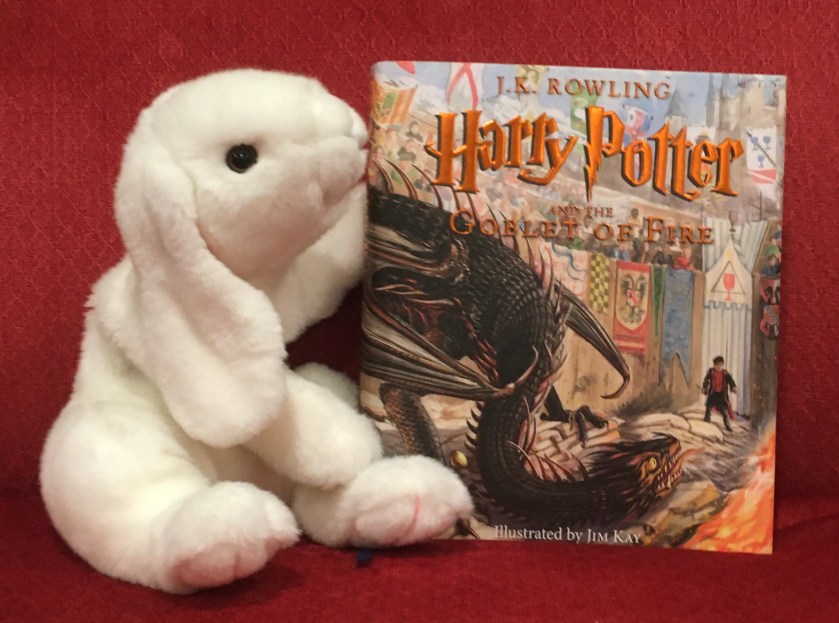
Marshmallow reviews Harry Potter and the Goblet of Fire, written by J.K. Rowling and illustrated by Jim Kay.

Marshmallow’s Quick Take: If you like books about magic and school, or enjoyed the earlier books or any of the movies in the Harry Potter series, then this might be the book for you. 

Marshmallow’s Summary (with Spoilers): Harry Potter is a fourteen-year-old boy who discovered his wizard identity on his eleventh birthday and has ever since been attending Hogwarts, a school for young wizards. This fourth book about Harry’s adventures in and around Hogwarts starts with the murder of an old Muggle, which is the word wizards use for people who don’t have magic. The Muggle is murdered by Harry’s archnemesis, Lord Voldemort, and Harry sees the whole event in a dream. Lord Voldemort is in a large house that Harry does not recognize, but he does recognize one of Lord Voldemort’s accomplices: Peter Pettigrew, who, as we all learned in Harry Potter and the Prisoner of Azkaban, was the traitor who betrayed his parents. 

On a happier note, Harry is going to be visiting his friend, Ronald Weasley, and watching a Quidditch game with Ron’s whole family and their friend Hermione. However, after the game, Death Eaters, servants of Lord Voldemort, attack the camping grounds for the game and set the Dark Mark, the symbol of Lord Voldemort, in the sky. 
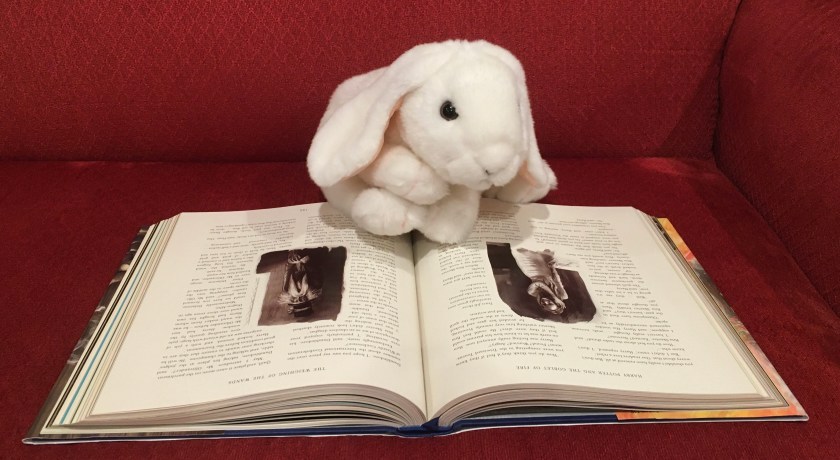
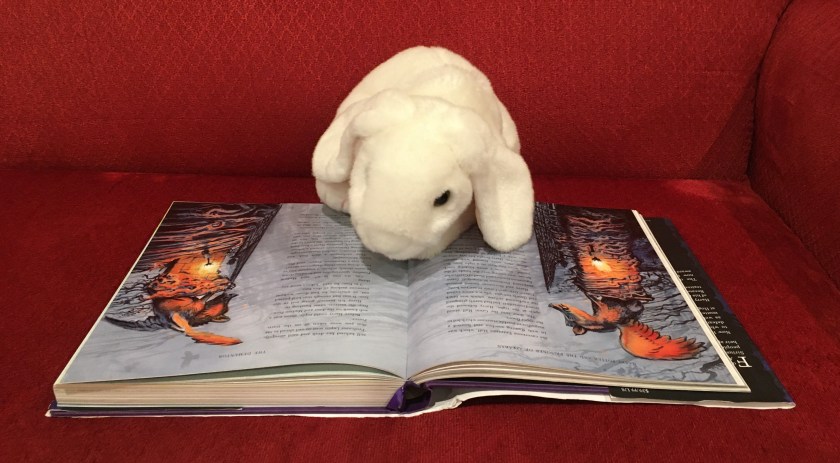
Marshmallow is reading Harry Potter and the Goblet of Fire, written by J.K. Rowling and illustrated by Jim Kay.

When Harry returns to Hogwarts for the new school year, he learns that the Triwizard Tournament is being held. The Triwizard Tournament, which had not been held for a while due to it being extremely dangerous, is a tournament in which three students, one from Hogwarts, one from a wizarding school in France named Beauxbatons Academy, and one from another wizard school in northern Europe named Durmstrang Institute. These students compete in trials and the winner receives the Triwizard Cup and a lot of money. Students who are eligible (they need to be seventeen or older) put their names in to the Goblet of Fire, and the Goblet will select the champions.

In the end, Cedric Diggory from Hufflepuff, one of the houses at Hogwarts, is selected, along with Fleur Delacour from Beauxbatons, and Viktor Krum from Durmstrang. (Viktor is also a famous Quidditch player and we had heard about him before when watching the quidditch game when the Dark Mark had appeared.) Surprisingly, the Goblet also selects Harry, who did not put his name in, nor is eligible because he is too young. However, the judges decide that he will have to compete.

The Triwizard Tournament has always been extremely dangerous, and now, given the impending return of Lord Voldemort, Harry faces more danger than he can imagine. 
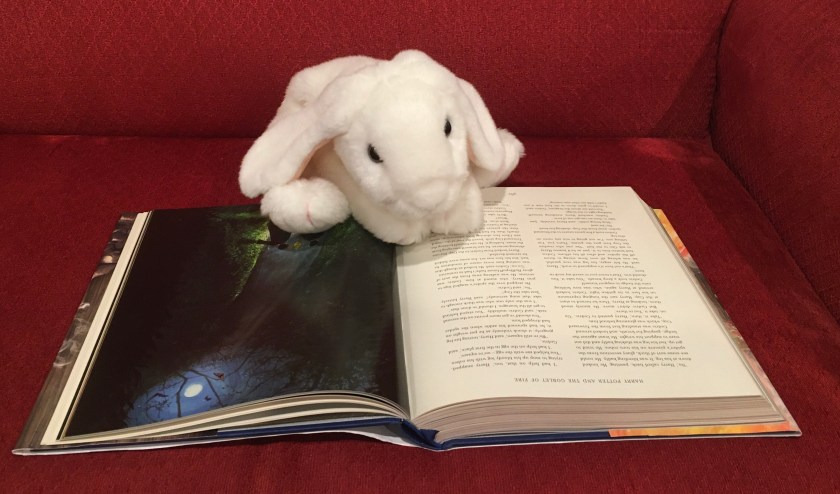
Marshmallow is still reading Harry Potter and the Goblet of Fire, written by J.K. Rowling and illustrated by Jim Kay.

Marshmallow’s Review: I think that Harry Potter and the Goblet of Fire is a great book and makes a great fourth book to the Harry Potter series. The author J. K. Rowling created an amazing world and we continue to learn more about it in this book. Something that really adds to the pleasure of reading these books is all the details that she adds. 

The particular version that I chose to read for this review is the illustrated one, by Jim Kay. The drawings are amazing! There are almost no pages that don’t have a special background related to the story, or a drawing or two in the corner. Sometimes there are pages that are all pictures, beautiful, eerie, haunting, whatever is needed at that point of the story. 

Some of the illustrations reminded me of the movie, which too was pretty awesome. Here is the trailer for it in case you are interested in checking it out:

Harry Potter and the Goblet of Fire – Original Theatrical Trailer (2005).

The plot is very well written. There are some twists and turns that one would not expect, but the evidence is all in the story. Sprinkles tells me that this was the most moving book in the series for her. It is also one of the longest (only the fifth book is longer). But it is definitely worth the read.

Marshmallow’s Rating: 100%.
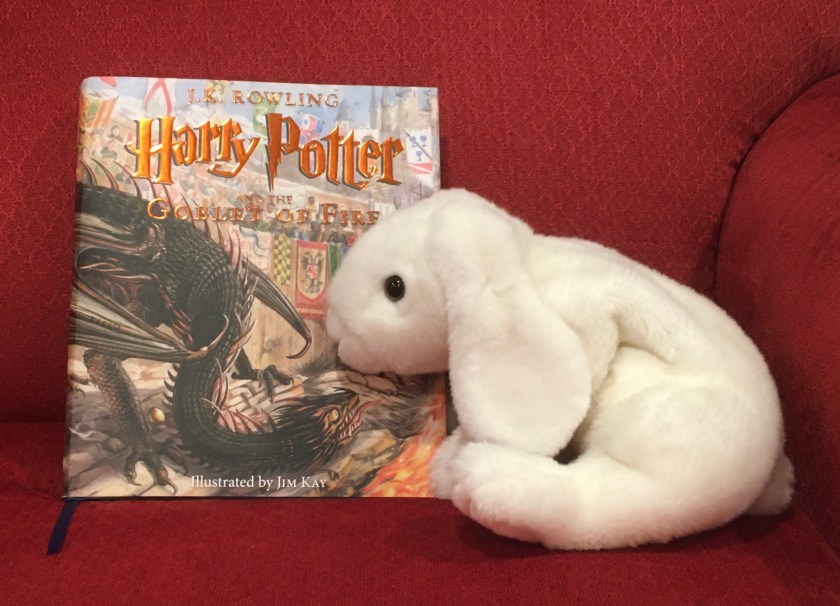
Marshmallow rates Harry Potter and the Goblet of Fire, written by J.K. Rowling and illustrated by Jim Kay 100%.

Caramel reviews Narwhal’s School of Awesomeness by Ben Clanton

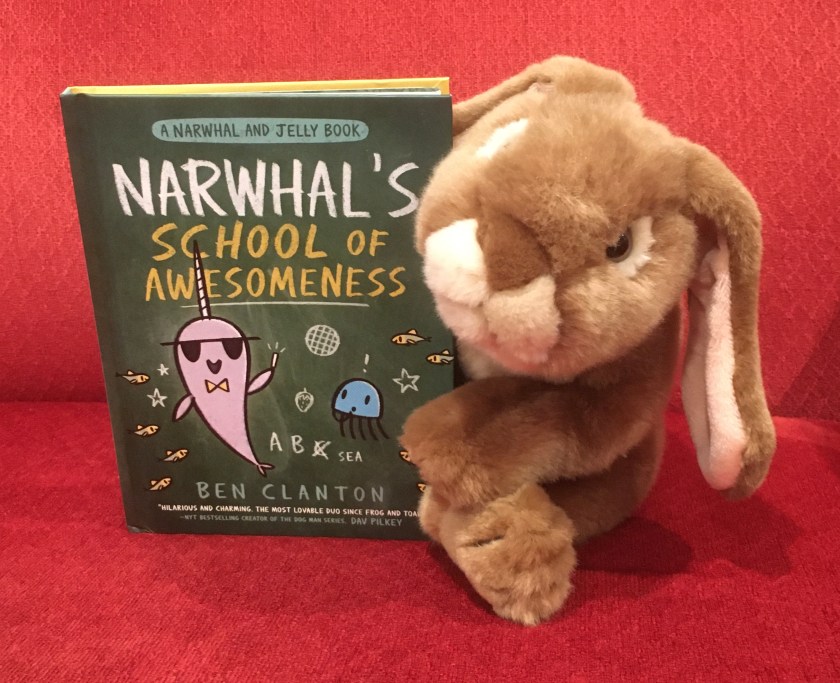
Caramel chose to talk about the first book of Ben Clanton’s Narwhal and Jelly series,  Narwhal: The Unicorn of the Sea!, in his very first review for the book bunnies blog. Then through the next few months, he reviewed Super Narwhal and Jelly JoltPeanut Butter and JellyNarwhal’s Otter Friend, and finally Happy Narwhalidays. So it was natural that when he heard about a sixth book in the series titled Narwhal’s School of Awesomeness, he thought he’d better get his paws on a copy and review it, too. This is exactly what he does in this post. As usual, Sprinkles is taking notes and asking followup questions.

Caramel reviews Narwhal's School of Awesomeness by Ben Clanton.
Caramel reviews Narwhal’s School of Awesomeness by Ben Clanton.

Sprinkles: So you must be feeling pretty good having gotten your paws on yet another Narwhal and Jelly adventure!

Caramel: Yup! It is fin-tastic to be reading about these two once again.

S: I see what you did there! Fin-tastic is one of those words Clanton uses, created by slightly changing a word to have ocean-life connotations.

C: Yep yep yep.

S: So will you tell us anything about the book?

C: Narwhal and Jelly are back and Narwhal becomes a teacher.

S: How does he do that?

C: Well, one of the fish school teachers is sick, and so he goes home, and then Narwhal takes over the school. He’s not told to do it, but he just does it himself.

S: So he just decides to be a teacher and gets going, right? That’s interesting.

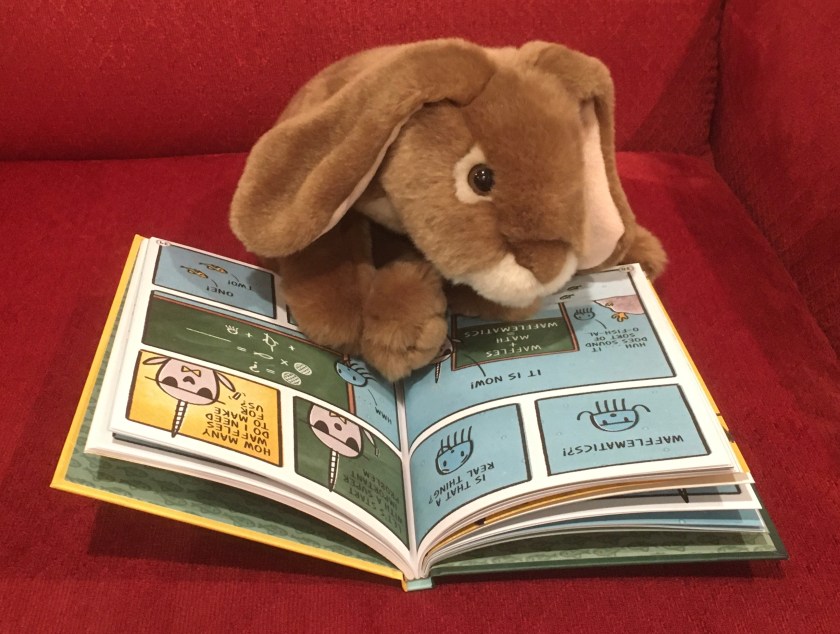
C: Yes. And what’s more interesting is what he teaches. He teaches wafflematics, which is math + waffles.

S: That sounds deliciously nerdy!

C: Yes. And there are other classes, mostly fake classes of course. Narwhal does not know a lot, because I think he is young, kind of like me, so he is making things up as he goes along.

Caramel is reading Narwhal's School of Awesomeness by Ben Clanton.
Caramel is reading Narwhal’s School of Awesomeness by Ben Clanton, when Narwhal is explaining what wafflematics is.

S: But there are still a lot of real facts in the book, right? Like in the earlier Narwhal and Jelly books?

C: Yes, and you know I love my facts.

S: I know you do. So did you learn anything new from this book?

C: Yes. Did you know what a group of snails is called?

S: No.

C: It’s called a walk. And a group of sharks is called a shiver.

S: I did not know any of those.

C: Yes, and then there is a picture of a hammerhead shark and he is really funny, talking like a pirate…

S: So the books are factful and funny again, right?

C: Yes! At some point Narwhal says “This is what I’m chalking about!” You see, talking becomes chalking because he is now a teacher?

S: Yes, I see. I’m glad you are enjoying this book just as much as you did the earlier ones.

C: <giggles> Wait, what? Sorry, I was reading the book again.

S: Okay, maybe we will end the review so you can get back to the book once more. But before that, tell me a third word to describe the book. You already have factful and funny.

C: Colorful. Because the book is very colorful. They are adorable fishies and I love them!

S: That is so cool that you liked this book so much!

C: Yes. It is o-fish-ally awesome!

S: Okay, then why don’t we wrap it up? What do you want to tell our readers?

C: Stay tuned for more book bunny reviews!

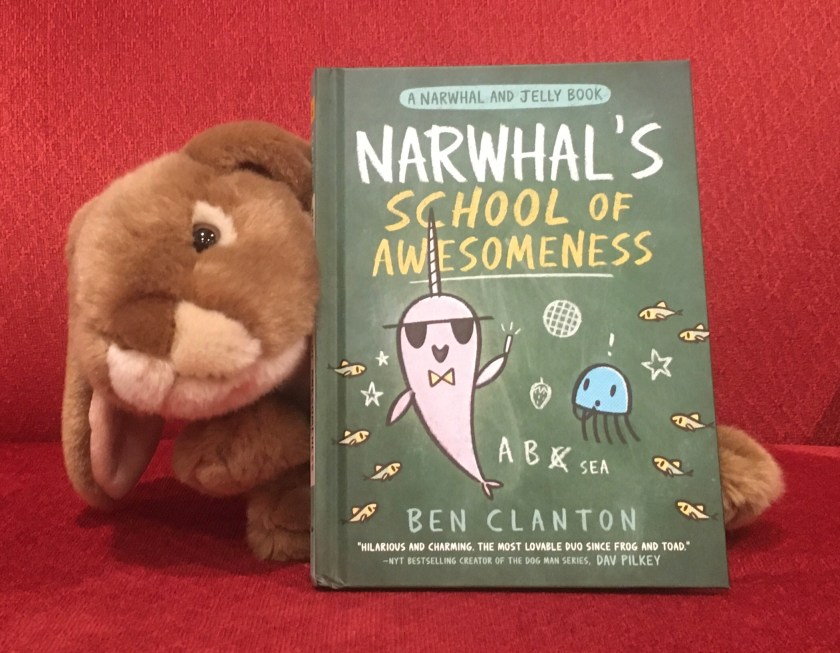
Caramel loved reading Narwhal's School of Awesomeness by Ben Clanton, and reconnecting with old friends Narwhal and Jelly.
Caramel loved reading Narwhal’s School of Awesomeness by Ben Clanton, and reconnecting with old friends Narwhal and Jelly.

Marshmallow reviews Harry Potter and the Prisoner of Azkaban by J.K. Rowling

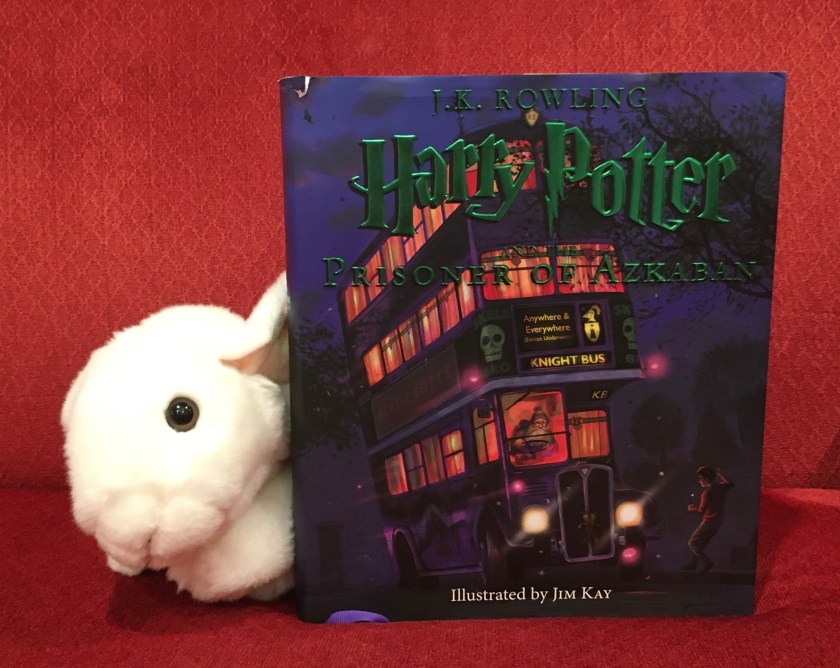
Marshmallow has been slowly going through the Harry Potter books, rereading the illustrated versions and reviewing them for the book bunnies blog. See for example her reviews of Harry Potter and the Sorcerer’s Stone and Harry Potter and the Chamber of Secrets, the first two books in the series. Today she wanted to write about the third book in the series, Harry Potter and the Prisoner of Azkaban, written by J.K. Rowling and illustrated by Jim Kay.

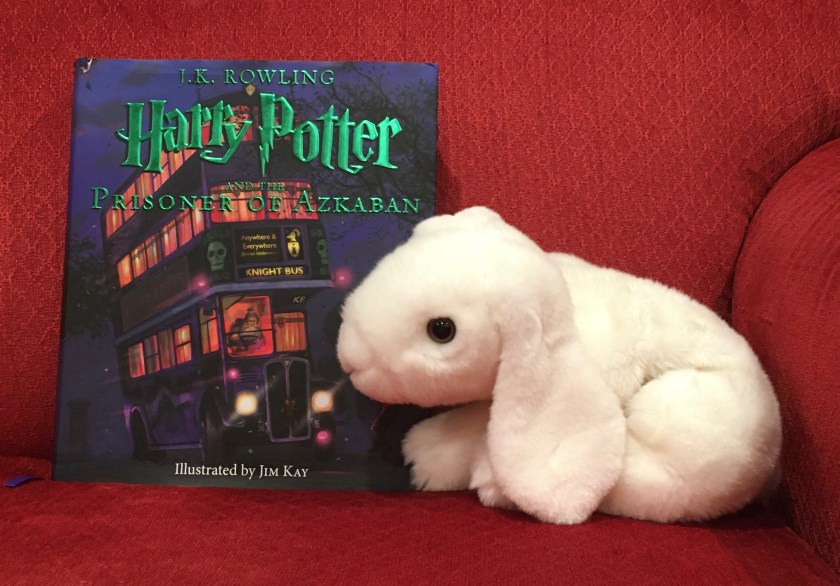
Marshmallow reviews Harry Potter and the Prisoner of Azkaban, written by J.K. Rowling and illustrated by Jim Kay.

Marshmallow’s Quick Take: If you like books about magic and school, and especially if you enjoyed the previous Harry Potter books, or any of the movies from the series, then this might be the book for you.

Marshmallow’s Summary (with Spoilers): Harry Potter, a thirteen-year-old wizard, has been attending Hogwarts School of Witchcraft and Wizardry for two years and is going to be starting his third year soon. At Hogwarts, third-years are allowed to go to Hogsmeade, a wizard town, but students must have permission from their guardians. Unfortunately, Harry’s guardians, Aunt Petunia and Uncle Vernon, don’t like anything to do with magic. They like to think of themselves as ordinary and hate anything that is not. Harry and Uncle Vernon strike a deal. If Harry behaves around Uncle Vernon’s sister Marge, who is coming to visit for a week, Uncle Vernon will sign the permission slip. Aunt Marge hates Harry and treats him terribly, like everyone else, but Harry agrees to try to behave himself, meaning no “funny stuff”. By “funny stuff”, Uncle Vernon means that Harry won’t use magic. Aunt Marge does not know that Harry is a wizard and believes that he attends St. Brutus’s Secure Centre for Incurably Criminal Boys. 

Until the last day, Harry behaves. Marge loves to criticize him for anything, but Harry endures it, until she starts insulting Harry’s parents. She says that his father was “a no-account, good-for-nothing, lazy scrounger”. Harry says that that is wrong, and Uncle Vernon tries to change the subject and tells Harry to go to his room. However Marge wants to hear what he said. They start arguing and Marge starts swelling. She inflates like a balloon, and starts rising. Harry runs away, but little does he know that he is in great danger, being alone. Even the Muggles know that there is a dangerous criminal at large, but they don’t know that he is a violent criminal who has escaped from the inescapable wizard prison of Azkaban. What’s more, he is after Harry. 

Marshmallow is reading Harry Potter and the Prisoner of Azkaban, written by J.K. Rowling and illustrated by Jim Kay.

Marshmallow’s Review: I think that this is one of the best Harry Potter books. I like The Prisoner of Azkaban’s plot, because it explains a lot about Harry’s past, and the event that made him famous in the wizarding world. There are some twists in the plot, like who the main bad guy is, and a really neat time travel trick, but I won’t spoil any more. 

I think that the characters are also well written: they are realistic and relatable. My favorite character is Hermione Granger, one of Harry’s best friends at Hogwarts. Hermione is really hard-working and smart. All of J. K. Rowling’s characters have unique and distinct personalities. 

I read the illustrated edition this time, and it has not only beautiful drawings, but also other interesting pages. Some of the pages are full with information about animals mentioned in the book. These pages also have detailed drawings of the creature being described. And on pages without illustrations, the background is a related pattern, or, on one page, the wrapper of a chocolate bar.

This book has been made into a movie which I have watched several times and I still enjoy. The trailer is below:

Harry Potter and the Prisoner of Azkaban Official Trailer #1 – (2004) from YouTube.

One of the special things about J. K. Rowling’s books is that she takes care of all of the details, which helps to create a completely believable world for Harry. Also, the details sometimes tie into the main plot, and very neatly too. All of the books in the Harry Potter series are amazing, and The Prisoner of Azkaban is no exception. 

Marshmallow’s Rating: 100%.
Marshmallow rates Harry Potter and the Prisoner of Azkaban, written by J.K. Rowling and illustrated by Jim Kay 100%.

Caramel reviews If You Give … books by Laura Numeroff and Felicia Bond

A couple weeks ago Caramel went over his How Do Dinosaurs … books and reviewed the whole series for the book bunnies blog. Today he wanted to do something similar and chose another old favorite series of his: the If You Give … series, written by Laura Numeroff and illustrated by Felicia Bond. As usual, Sprinkles is taking notes and asking followup questions.

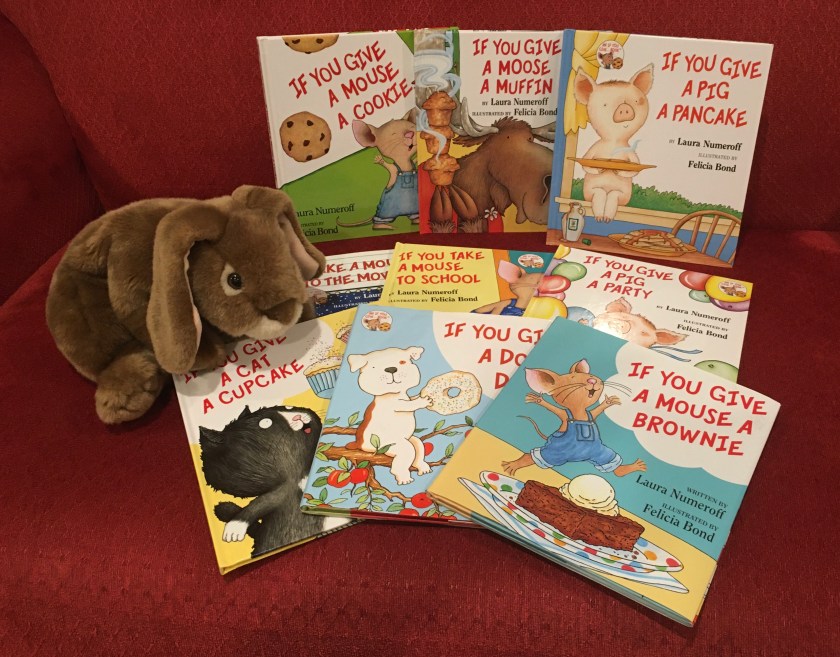
Caramel reviews If You Give a Mouse a Cookie (1985), If You Give a Moose a Muffin (1991), If You Give a Pig a Pancake (1998), If You Take a Mouse to the Movies (2000), If You Take a Mouse to School (2002), If You Give a Pig a Party (2004), If You Give a Cat a Cupcake (2008), If You Give a Dog a Donut (2011), and If You Give a Mouse a Brownie (2016), all written by Laura Numeroff and illustrated by Felicia Bond.

Sprinkles: So Caramel you wanted to talk about some of your old favorites again.

Caramel: Yup.

S: So how would you like to start this review?

C: From the beginning. With the first book. This is called If You Give A Mouse A Cookie. It’s about a mouse, a cookie, and a boy who is really nice and gives the mouse a cookie. Then the mouse asks for a glass of milk, then a straw, then a napkin, then a look in the mirror to see if he has a milk mustache…

S: Okay, I get it. So the boy gives the mouse something, and then that leads to another wish, and then pretty soon …

C: It goes all the way from a cookie to a lot of mess and lots of action, and in the end the mouse will get thirsty and want milk, and then another cookie. And you are back to the beginning of the story.

S: Ooh, that is neat. Kind of a circular story, but also seeing all sorts of consequences of just one little action.

C: Yep.

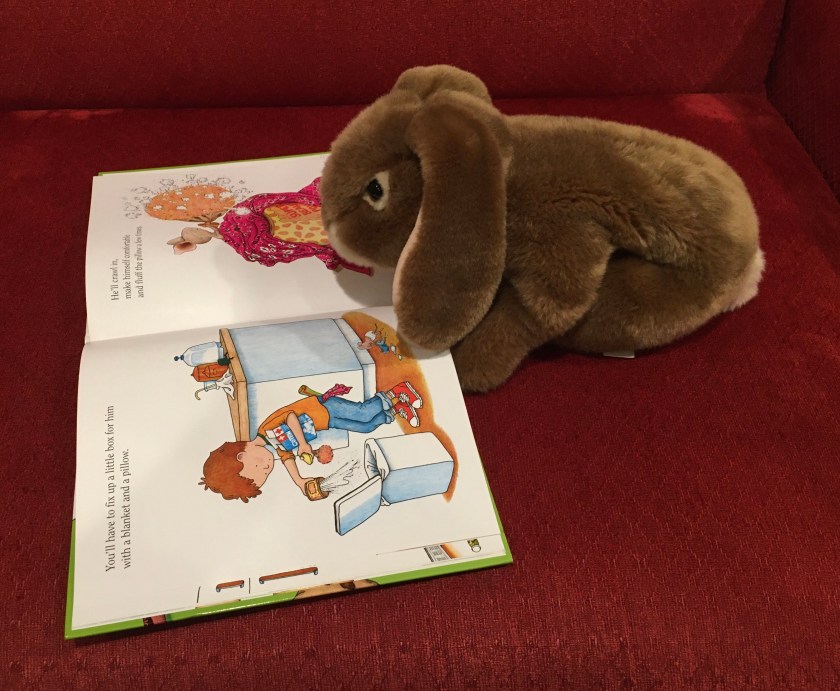
Caramel is reading  If You Give a Mouse a Cookie (1985), written by Laura Numeroff and illustrated by Felicia Bond.
Caramel is reading If You Give a Mouse a Cookie (1985), written by Laura Numeroff and illustrated by Felicia Bond.

S: So tell me more. What do you like about this book?

C: The illustrations are great! The mouse is sitting beside the milk glass in one picture, and he is so full, with a ginormous tummy. The cookie and the milk must be bigger than him all together, so no wonder he is exhausted.

S: That is funny!

C: The whole story is hilarious. I love it! And it all starts with a little boy giving a little mouse a little cookie.

S: That is really cool. Okay, so there are several other books in this series. You have read nine of them, right?

C: Yes. The second book I read is called If You Give A Moose A Muffin, and the third is If You Give A Pig A Pancake. And those books are about what the titles say. In the one about the moose, a boy gives the moose a muffin, and then a lot of things happen, including a puppet show, and blackberry jam, and so on. The one about the pig involves a girl giving a pancake to a pig, and then pancakes, a dancing pig, building a tree house, putting up wallpaper on that tree house, and many other things.

S: So a lot happens in each of the stories, when the child in question gives the animal in question something they want?

C: Yes. And in the end somehow we always come back to the beginning. So the moose ends up wanting a muffin again and the pig wants a pancake once more.

S: That is really cool. The author must be thinking very carefully and creatively about how to build that chain of events in a way that brings us all back to the beginning somehow.

C: Yes. No matter what, the books always end at the place they started. That is neat!

S: I agree.

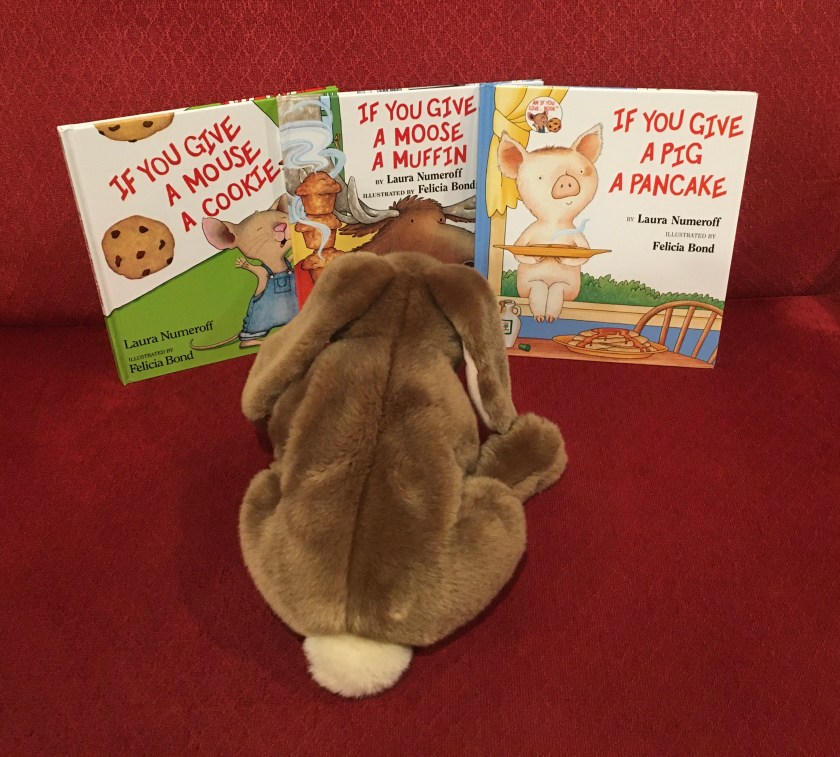
Caramel is looking at If You Give a Mouse a Cookie (1985), If You Give a Moose a Muffin (1991), and If You Give a Pig a Pancake (1998), all written by Laura Numeroff and illustrated by Felicia Bond.

S: Tell me about some of the other books.

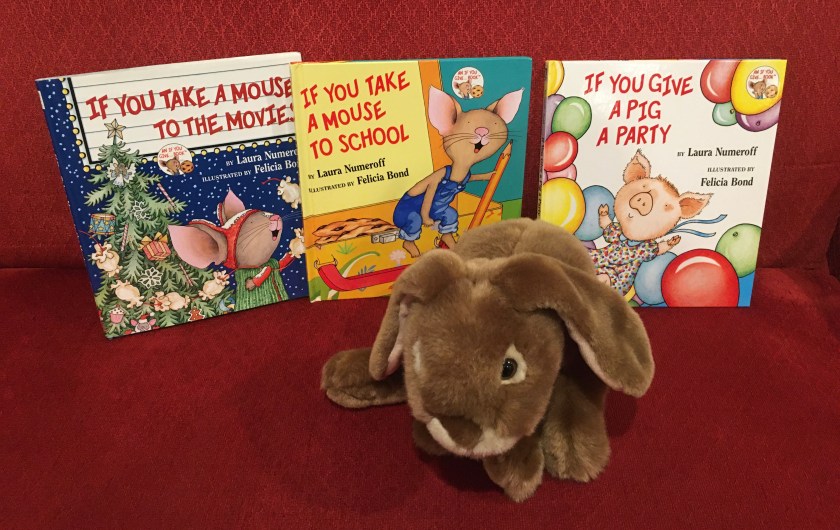
C: The next thee books are If You Take a Mouse to the Movies, If You Take a Mouse to School, and If You Give a Pig a Party. So you can already tell that one of them is about a boy taking a mouse to the movies, and it is probably the same boy from the first book, and the same mouse. And in the next book the same boy takes the same mouse to school. And a lot of fun and messy things happen at school because of that. The pig and the girl in the last book, If You Give a Pig a Party, are also the same pig and the girl from If You Give A Pig A Pancake. I like that we see the same characters.

S: Well, you couldn’t really tell they are the same if you did not have the illustrations.

C: Yes, but the pictures are the same. And so I know they are the same people and same animals. And so the pictures tell a lot of the story. I like that too.

Caramel poses in front of If You Take a Mouse to the Movies (2000), If You Take a Mouse to School (2002), and If You Give a Pig a Party (2004), all written by Laura Numeroff and illustrated by Felicia Bond.

S: But then the seventh and the eighth books introduce new animals, right?

C: Right. The seventh book is If You Give A Cat A Cupcake, and it has a cat in it. There is a girl who gives the cat a cupcake and then the cat takes off and takes a karate class, and goes on a merry-go-round and visits a science museum, and so on.

S: You like doing those things!

C: Yes. I love going to the science museum, but we have not done it for a while. And we have not been to the beach for a while either.

S: That is true. So these animals are all doing all sorts of active and fun things, right?

C: Yes, in the next book, called If You Give A Dog A Donut, there is a dog who wants a donut, and then he gets one from a boy, who is not the boy from any of the other books I think. Then the dog goes picking apples, playing baseball, doing a happy dance, and having a water fight.

S: All fun!

C: Yep. And finally the last book is the mouse again, and he wants a brownie.

S: And let me guess, it is titled If You Give A Mouse A Brownie.

C: Yep. And it starts and ends with the brownie. And it is again hilarious.

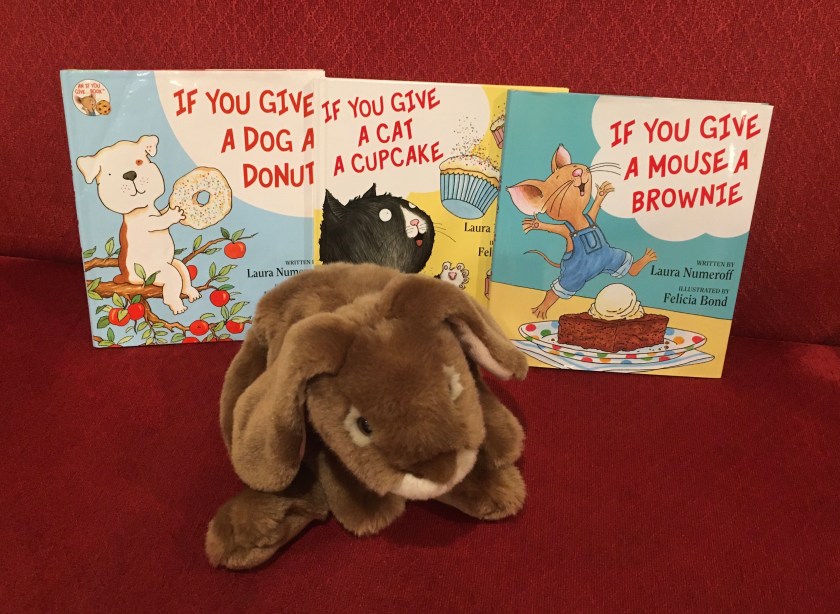
Caramel is showing the readers If You Give a Cat a Cupcake (2008), If You Give a Dog a Donut (2011), and If You Give a Mouse a Brownie (2016), all written by Laura Numeroff and illustrated by Felicia Bond.

S: So I think I know one of your three words to describe this series would be hilarious. What would be your remaining two words?

C: Circular, because they all end where they start, and great illustrations, because I love the pictures.

S: That sounds good. So apparently there are a few other books in this series, but we never read those. They do not start with “If You Give …” or “If You Take …” but the same mouse has adventures in each.

C: Oh well. At least we read all the “If You Give …” and “If You Take …” ones.

S: That’s true. And I think nine books are enough for this one review.

C: I agree.

S: So what do you want to tell our readers?

C: Stay tuned for more book bunny reviews!

Caramel has loved reading If You Give a Mouse a Cookie (1985), If You Give a Moose a Muffin (1991), If You Give a Pig a Pancake (1998), If You Take a Mouse to the Movies (2000), If You Take a Mouse to School (2002), If You Give a Pig a Party (2004), If You Give a Cat a Cupcake (2008), If You Give a Dog a Donut (2011), and If You Give a Mouse a Brownie (2016), all written by Laura Numeroff and illustrated by Felicia Bond, through the years, and recommends them to all little bunnies and their grownups who love reading with them.