Marshmallow reviews The Ballad of Songbirds and Snakes by Suzanne Collins

Today Marshmallow reviews the very first prequel to The Hunger Games trilogy by Suzanne Collins, The Ballad of Songbirds and Snakes, originally published in 2020.

[Marshmallow also reviewed The Hunger Games, Catching Fire, Mockingjay, The Hunger Games: The Illustrated Edition, and Sunrise on the Reaping.]

Marshmallow reviews The Ballad of Songbirds and Snakes by Suzanne Collins.

Marshmallow’s Quick Take: If you liked the previous Hunger Games books or are interested in beginning the series, then this is the book for you!

Marshmallow’s Summary (with Spoilers): Coriolanus Snow is better known as President Snow of Panem to most, but in this book he is little more than a student at the Academy. Though he comes from one of the most prestigious families in the Capitol, he struggles to make ends meet after the recent war.

During those Dark Days, the thirteen districts surrounding the Capitol rebelled against it—cutting off its resources to starve it into submission—and citizens of the Capitol experienced hardships that scarred all and killed many; Even though Coriolanus and his cousin Tigris survived the Dark Days (barely), they both witnessed horrific things that haunt them throughout the book.

At the beginning of the book, Coriolanus and Tigris are living with their Grandma’am in their once-luxurious apartment. Coriolanus’s parents died during the Dark Days, and their family’s lucrative munitions manufacturing business located in District 13 was destroyed when that district was obliterated by the Capitol as punishment. Even after the war ended (with a Capitol victory), the Snow family suffered. Without parents and their income, Tigris and Coriolanus are left to uphold the Snow reputation—even though they are no longer the rich family they were. Grandma’am trains Coriolanus and Tigris to maintain their dignity and they keep their economic struggles a secret, so the Snow family still seems powerful.

At his school, Coriolanus excels and hopes to be assigned as mentor to the tribute who will win the Hunger Games. One of the professors, a Professor Gaul, wants to make the Games into a spectacle and has a student paired with each tribute in an effort to help them survive or, at least, entertain Panem. Professor Gaul wants all of Panem to remember the war in this way, and she is hoping to make more people watch the Games (because many, of course, don’t love the idea of little kids killing each other).

At this time there have only been nine Hunger Games so far because the war was so recent. The Games have yet to become the extravagant extravaganzas seen in Sunrise on the Reaping or the trilogy with Katniss starting with The Hunger Games. The Capitol simply places the twenty-four children in an arena with a pile of weapons and watches them kill one another until only one remains.

While the Snow name is respected, Coriolanus does not have parents to bribe the school (while the other students do) and is assigned the worst possible tribute: the girl from District 12. This seems like an automatic loss because District 12 is full of weak, starving people, and the girls are presumed to be even weaker than the boys. However, when the Reaping occurs, Coriolanus realizes that this curse might have been a blessing in disguise; the girl, Lucy Gray Baird, becomes the most memorable tribute after some surprising events. While not physically threatening, Lucy Gray is charming and popular, both things Coriolanus can use to get her to victory. Her singing fascinates all of Panem and Coriolanus, who begins to fall for her. Luckily for him, the feeling is reciprocated. Unluckily for him and her, she is soon to be sent into the arena. And Professor Gaul is determined to make this year’s Games one that Panem will never forget. 

Marshmallow is reading The Ballad of Songbirds and Snakes by Suzanne Collins.

Marshmallow’s Review: I think that The Hunger Games trilogy and specifically this book should be made required reading for high school students. This book continues Collins’ trend of examining human instinct, morality, violence, and more.

I think The Ballad of Songbirds and Snakes can be a stand-alone if necessary or could be a great way to start reading the Hunger Games books. I wonder what it would have been like to read this book first and go through the series chronologically. Having read the other books first, I think both ways work well. However, this book stands out in its analysis of humanity because Coriolanus’s Academy setting facilitates discussions on these topics. For example, Professor Gaul has him and his classmates write essays about what they love about war. Such analyses make this a very deep and profound piece of work, something I believe could rival the works of Orwell and Huxley.

I think Collins also did an amazing job of writing this book from the perspective of a control-obsessed, self-promoting, yet initially well-intentioned young man. I knew that Snow was going to turn evil (because I knew his role in the other books), but watching the transformation was fascinatingly disturbing. He was manipulative and a bit narcissistic from the start, but watching the worst parts of him take over—especially at the end—was very strange.

The whole book is written in third person, but I read it in a flow state in which it felt in first person … until around halfway through when I felt a sense of disconnection from the character because I realized that something about him was no longer quite right. I am not sure how to explain this.

I would strongly suggest reading The Ballad of Songbirds and Snakes. I will say that it might be too dark for younger bunnies though, so I wouldn’t read it until around twelve years old—appropriately, the age when children are entered into the Reaping. I was a bit confused on the ending, but the epilogue tied everything up with a link foreshadowing what is to come in Snow’s future. 

Marshmallow’s Rating: 100%.

Marshmallow rates The Ballad of Songbirds and Snakes by Suzanne Collins 100%.

Caramel reviews Mysterious Tales of Japan by Rafe Martin

Today Caramel is talking to Sprinkles about Mysterious Tales of Japan, written by Rafe Martin and illustrated by Tatsuro Kiuchi, originally published in 1996.

Caramel reviews Mysterious Tales of Japan, written by Rafe Martin and illustrated by Tatsuro Kiuchi.

Sprinkles: So Caramel, today we are talking about Mysterious Tales of Japan, another one of those books you read for that Asian Myths and Legends summer course you took a while back. 

Caramel: Yeah, it is, I think, the last one? I already reviewed the other ones: Japanese Myths, Legends, and Folktales, Tamamo the Fox Maiden and Other Asian Stories, Chinese Myths and Legends: The Monkey King and Other Adventures, Vietnamese Children’s Favorite Stories, and Favorite Children’s Stories from China and Tibet

S: Yes, I think you are completing the set today. But this one is a bit different from the others, right? The stories are a bit spooky, I am guessing. 

C: Spooky? No, they’re not that spooky. But yes, there are ghosts and spirits and such. 

S: I see. Then please tell me a bit more about the book. 

C: It has some stories shared with some of the others, like “Ho-Ichi the Earless” and “Urashimmo Taro”, which I had already read in Tamamo the Fox Maiden and Other Asian Stories. Besides these, there are eight other stories, and I had not read those before; they were all new to me.

S: That’s cool Caramel. So ten stories and eight of them were totally new for you. Tell me a bit about the new stories. 

C: The other eight stories are “Green Willow”, “The Snow Woman”, “Kogi”, “The Crane Maiden”, “The Pine of Akoya”, “A Frog’s Gift”,  “The Boy Who Drew Cats”, and “Black Hair”. They are all about five pages or so.

Caramel is reading Mysterious Tales of Japan, written by Rafe Martin and illustrated by Tatsuro Kiuchi.

S: Okay, so tell me a bit about these stories. Any one that surprised you? 

C: No, not really; most of the stories are sort of similar to others that I read before.

S: Okay, so I guess you are getting used to Japanese folk tales and their general feel. Then, maybe tell me which was the most interesting? Or the spookiest? 

C: I think that “Ho-ichi the Earless” is the spookiest. 

S: I remember that story from the other book. It was quite weird and spooky, I agree. But that book was basically a graphic novel adaptation, so it was very visual. Left not much to your imagination. 

C: This book has pictures, too, but only one or two for each story. So you have a lot more to imagine. 

S: That can sometimes be scarier. 

C: True. Sometimes the imagining is the part where I like real books over picture books. Let me think about what I want the main character to look like. Let me think about how the house the author is describing actually looks like. And so on. And the pictures in this book are not all very detailed. They give you a feel for the story, but you still have a lot more to imagine on your own. 

S: Yes, the pictures are beautiful and evocative, but you are right, they are not very detailed. They leave much room to create in your own imagination. So for example, the two stories you had already read before in that other book: when you were reading them here, did you have some new imagery in your mind to go along with the story line? 

C: Yeah, sometimes the space not drawn is the spookiest. It definitely was like that for me for “Ho-ichi the Earless”. 

S: Cool, thanks for all this Caramel. I think we have enough for a post, so maybe this is a good time to wrap things up. 

C: Sure, why not?

S: Great! What would you like to say to our readers as your closing words? 

C: Stay tuned for more book bunny reviews!

Caramel appreciated reading Mysterious Tales of Japan, written by Rafe Martin and illustrated by Tatsuro Kiuchi, and recommends it to all other young bunnies, but maybe they should think about reading it with a grownup bunny so they don't get too scared.
Caramel appreciated reading Mysterious Tales of Japan, written by Rafe Martin and illustrated by Tatsuro Kiuchi, and recommends it to all other young bunnies, but maybe they should think about reading it with a grownup bunny so they don’t get too scared.

Midnight reviews Foundation by Isaac Asimov

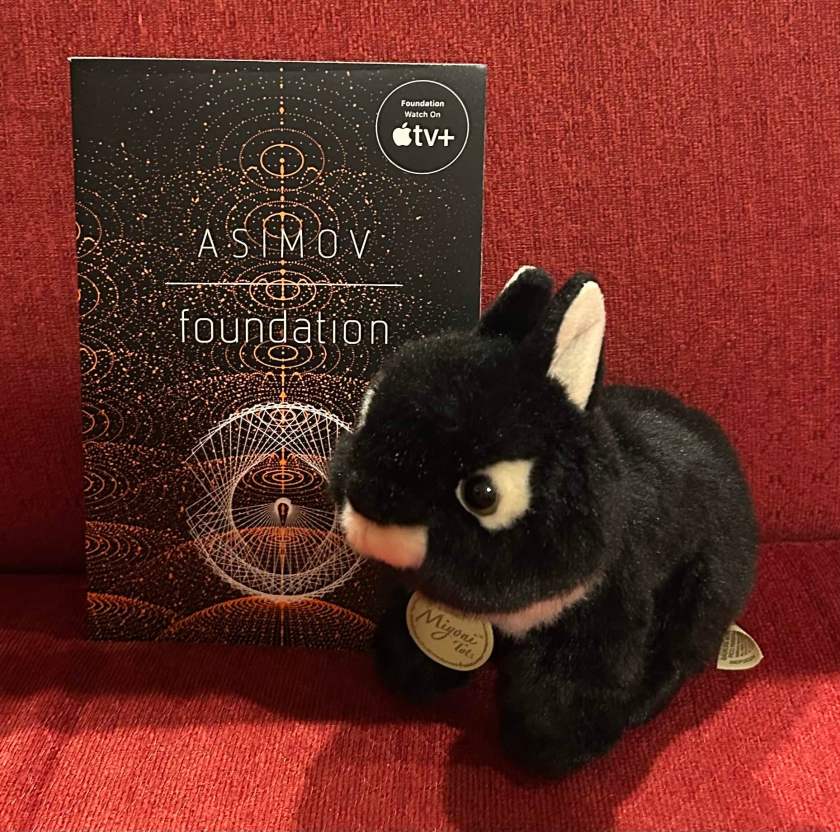
Today we have a surprise for you: The mysterious and reclusive black bunny of the family, Midnight, decided he wants to join in the book fun! So here follows the first book review by Midnight, where he talks to Sprinkles about Isaac Asimov’s classic Foundation, the first book of the famous Foundation trilogy, originally published as a stand-alone book in 1951.

Midnight reviews Foundation by Isaac Asimov.

Sprinkles: Midnight, I am so happy to welcome you to the book bunnies blog!

Midnight: It’s wonderful to be here. It’s certainly a thrill.

Sprinkles: So you chose Asimov’s Foundation as your first book. Can you tell us a bit about it?

Midnight: It’s almost like another bunny purchased it for me and suggested that I read it.

Sprinkles: Yes, that is true. I read it on my tablet via the Libby app, but then I thought you might enjoy it too.

Midnight: It is a short book about the decline and fall of the Galactic Empire.

Sprinkles: Wait, the Galactic Empire is something from Star Wars, no?

Midnight: Foundation predates Star Wars by several decades. It was written originally as a series of short stories in the 1940s, and published in science fiction magazines, until in 1951 Asimov put them together into a book. The first Star Wars movie came out in 1977.

Sprinkles: Okay, okay, of course you know the timeline really well. But then tell us a bit about this Galactic Empire. Are we talking about our own galaxy, the Milky Way?

Midnight: Yes, we are, and they keep talking about humans and no other aliens. And sadly no bunnies are mentioned. (But we can assume that they control everything from the shadows–as they do in the present.)

Sprinkles: Midnight, let us not scare our readers away with your schemes of world (or universe) domination. Let’s get back to the book. Okay, we are talking about a galactic empire in the Milky Way, so this is far into the future, right?

Midnight: Yes. The Galactic Empire has endured for about twelve thousand years and spans the entire galaxy. According to other Asimov books in the same universal timeline, the Empire was founded about ten thousand years into the future from now.

Sprinkles: That is way in the future! Kind of like Caramel’s WarHammer storyline, which was about forty thousand years into the future. That’s kind of cool!

Midnight: That’s not a question.

Sprinkles: Okay, I will try to phrase my words into questions. I did not read much about WarHammer, but I know it describes a rather dystopian future. The one Asimov describes is not as dismal, is it?

Midnight: True. The Galactic Empire seems modeled after the Roman Empire to some extent. It is ruled by a monarch from the imperial capital planet Trantor. But the empire is in a slow decline that is inexorable according to Hari Seldon, the main character in the first portion of the book.

Sprinkles: Yes, I remember the book is written in five separate sections, which must be the five stories that were published separately earlier. Seldon is the main character in the very first one, but he does appear in the later ones too, no?

Midnight: Yes, but it is probably more accurate to say his influence is felt in the later ones.

Sprinkles: Yes okay. Go on.

Midnight: So Seldon is a scholar of psychohistory, a discipline that uses mathematical tools to model psychology of large groups of people to make predictions about their collective behavior. If the sample sizes are large enough, Asimov suggests that predictions can be made with high degree of certainty. Seldon predicts the downfall of the Empire, and that the galaxy will go through a dark age that would last thirty thousand years.

Sprinkles: That would bring us to past 40K, the time of WarHammer! What an interesting coincidence! Anyways, psychohistory kind of sounds to me like using big data to predict, and we know that has worked pretty well in predicting people’s purchasing decisions and such, but it is not clear it would work for historical events. I guess that is why this is science fiction.

Midnight: Yes. And the book was written quite a bit before mathematicians began studying chaos theory, and Lorenz’s discovery of the butterfly effect in weather prediction.

Sprinkles: Yes, that is true too. Okay, coming back to this being fiction. Let us accept the premise of the book that Seldon has this theory that predicts the future of the Empire. Then what happens?

Midnight: Seldon starts a foundation on the planet Terminus, at the edge of the galaxy, recruiting a group of scholars, ostensibly to compile a great encyclopedia of all knowledge from which humanity will be able to restore the galaxy to some sense of civilization. According to the Seldon Plan, the Foundation would be able to shorten the dark age to only one thousand years.

Sprinkles: I see what you did there. The word “ostensibly” seems to have silently found its way into your sentence.

Midnight is reading Foundation by Isaac Asimov.

Sprinkles: Anyways, maybe this is enough about the plot of the book.

Midnight: Okay. What do I need to say now?

Sprinkles: Well, you can tell me what you thought of the book.

Midnight: The book takes place over many centuries, so a new cast of characters is introduced in each part of the book.

Sprinkles: The five main parts we mentioned earlier?

Midnight: Yes. But this means that characters do not necessarily have the same depth that they might in a conventional novel.

Sprinkles: Yeah, I can see that.

Midnight: And there is a lot of speaking about things as opposed to showing events take place. Asimov has a lot of big ideas, but when centuries pass every few pages, one does not feel quite as invested in the individual characters and one does not get too much of a sense of who they are as people. They are more vehicles to deliver context and story.

Sprinkles: I can see your Tolkien fan feelings coming out here. Tolkien spent a lifetime developing his world, and his characters are often much richer and deeper.

Midnight: Let’s compare this to the Silmarillion, which takes place over thousands of years and characters come in and out of the narrative over these vast time scales, kind of like in Foundation. I feel like I have a lot clearer sense of those characters than Asimov’s in this book.

Sprinkles: I have not read Silmarillion, but my guess is that Tolkien has a different style and different goals. He cares a lot more about his characters, while maybe Asimov is trying to tell us a possible future.

Midnight: I am not sure I’d say that. I think Tolkien is also retelling a vast history, and does not set out to write a character-driven drama. But somehow his characters are more complete people in my mind.

Sprinkles: Well, Midnight, then you will have to come back and review Silmarillion for us some day.

Midnight: Well, I don’t want to sound too negative about Foundation. I did find the ideas intriguing and read the next several books in the series. I found some of the characters in those books more compelling and three-dimensional.

Sprinkles: Okay, then, maybe you will also tell us about those books some day?

Midnight: Maybe. As a mysterious and reclusive bunny, I do not wish to commit to anything at this time.

Sprinkles: But that is alright. You have already shared with us some good thoughts on a classic, and that is already wonderful! I did like Foundation a lot myself, and it seems that you enjoyed it, too. So maybe this is a good place to wrap up your first review. What do you think?

Midnight: Sounds reasonable to me.

Sprinkles: The little bunnies I interview for the blog have their own closing phrases when they are ending their posts. What would you like to tell our readers as we wrap up yours?

Midnight: A bunny as sophisticated, as complicated, and as self-important as I, cannot be reduced to a simple catchphrase.

Sprinkles: I understand. But we do need to end this post. So what will you say as your last words?

Midnight: Farewell, dear reader. Until such a time as the Black Bunny sees fit to reappear.

Midnight enjoyed reading Foundation by Isaac Asimov. He also enjoyed coming out of the shadow realm where he normally resides and pontificating about the book.

Caramel reviews Favorite Children’s Stories from China and Tibet by Lotta Carswell Hume

In these past few months Caramel has reviewed several books that collect together stories from various Asian traditions: Japanese Myths, Legends, and Folktales, Tamamo the Fox Maiden and Other Asian Stories, Chinese Myths and Legends: The Monkey King and Other Adventures, and Vietnamese Children’s Favorite Stories. Today he adds to this list another book: Favorite Children’s Stories from China and Tibet, written by Lotta Carswell Hume (1876-1976), illustrated by Lo Koon-Chiu (1918–2012), and originally published in 1962. The edition Caramel read was the 2004 edition. As usual, Sprinkles is taking notes and asking questions.

Caramel reviews Favorite Children’s Stories from China and Tibet, written by Lotta Carswell Hume and illustrated by Lo Koon-Chiu.

Sprinkles: So Caramel, here we are, talking about another neat collection of stories! 

Caramel: Yes, this one has stories from China and Tibet. 

S: Tell me more.

C: Well, let me see. There are eighteen stories. Each of them is about three to seven pages long. And there are a lot of pictures. I really liked them! 

S: Yeah, I saw that there are a lot of colorful illustrations. Apparently they were made by a Chinese artist named Lo Koon-Chiu. 

C: That makes sense. Because a lot of the stories are Chinese. But the person who wrote them does not sound like a Chinese person. And I don’t know too many Tibetan names, but the author’s name does not sound Tibetan either. 

S: You are right. The author was apparently from Baltimore, USA, and then got married and moved to Asia with her husband. She lived in China and India for decades, and her children got to hear a lot of traditional Chinese stories. So this is a collection she put together to share those stories with children who would read or be read to in English. 

C: I see. Then she did not write the stories herself. That makes a lot more sense now. 

S: Yeah, I was curious too, and then looked it all up. Anyways talk a bit about the stories. Can you tell which stories are from Tibet and which are from China?

C: Yes. There is a little note under the story title for each one. So there are five stories from Tibet. The rest are from China. But they separated those, too. Some are from West China, some from Southeast China, some from Central China, and so on. 

S: Hmm, I guess that makes sense. China is a big country. Maybe they did not want to go into detail about the exact geography of China and give the province names and such. 

C: I guess. But there are a lot more stories from China, so maybe they just split the Chinese stories so they would not look too uneven. 

S: Interesting! That could be a good reason, too, Caramel.

Caramel is reading Favorite Children’s Stories from China and Tibet, written by Lotta Carswell Hume and illustrated by Lo Koon-Chiu.

S: Anyways, so why don’t you tell me more about the stories themselves? 

C: Well, there is a story like Cinderella, and it is called A Chinese Cinderella, And there is this story about a woman who is called Mrs. Number Three who is an innkeeper.

S: That is a very strange name!

C: It is not her real name, but nobody knows her real name so they call her that. But the story is really interesting. Its name is “The Magic Pancakes at the Footbridge Tavern”. So as you can imagine, there are magic pancakes! 

S: Oh, I know you love pancakes! 

C: Yeah, but these are magic and you really don’t want to eat them. 

S: Oh, that is interesting! I guess I just have to read the story to figure out what you mean. 

C: Yep. 

S: Okay, so that is two of the eighteen stories. What about the others?

C: A lot of the others are about animals. Like there is a Tibetan story about a tortoise and a monkey and another about some jackals and a tiger. And then there is another about a hungry wolf, and one about some mice. 

S: Oh, that is interesting. Kind of like fables, I am guessing. 

C: Yeah, kind of. But wait, it looks like the animal stories are almost all stories from Tibet. Some of the Chinese stories also have animals, but they also have people. 

S: Very interesting observation, Caramel.

C: And then there are two stories like the ones we talked about before about how some things came to be the way they are. There is a story about how the rooster got its red crown and another about how the deer lost its tail. They are both from China. 

S: I see. True, we did talk about such stories when you were reviewing Vietnamese Children’s Favorite Stories by Tran Thi Minh Phuoc. Apparently such stories were called “pourquoi” stories

C: Oh, yes, I remember you said that last time. 

S: Okay, so all in all it seems like you have enjoyed reading this book, right? 

C: Yep! 

S: Can you tell us if you have a favorite story? 

C: No, I liked them all. 

S: That is wonderful, Caramel. Okay, maybe this is a good time to wrap up this review. What would you like to tell our readers? 

C: Stay tuned for more book bunny reviews!

Caramel enjoyed reading Favorite Children’s Stories from China and Tibet, written by Lotta Carswell Hume and illustrated by Lo Koon-Chiu, and recommends it to all the other little bunnies who enjoy reading or hearing short stories.