Caramel reviews Tristan Strong Punches a Hole in the Sky: The Graphic Novel by Kwame Mbalia

Both of the little book bunnies love reading books by Rick Riordan, and both enjoy graphic novels. So Caramel jumped on the opportunity to read and review the graphic novel version of Kwame Mbalia’s Tristan Strong Punches a Hole in the Sky, published in 2022 as part of the “Rick Riordan Presents” series. Today he is talking to Sprinkles about this neat book.

Caramel reviews Tristan Strong Punches a Hole in the Sky: The Graphic Novel, written by Kwame Mbalia, adapted by Robert Venditti, and illustrated by Olivia Stephens.

Sprinkles: Okay, Caramel, can you tell us a bit about this book?

Caramel: Yes. The book is about a kid named Tristan Strong. Tristan’s best friend Eddie dies in a bus accident, so Tristan goes to Alabama to stay with his grandparents for a bit.

S: Okay, so what happens in Alabama?

C: In the middle of the night, a baby named Gum Baby comes into his room and steals Eddie’s journal. That was the last thing Tristan had of Eddie, so he does not want to lose it. So he pursues Gum Baby and punches something called a Bottle Tree, and so opens up a hole into another world.

S: So is that how he “punches a hole in the sky” as the title says?

C: Yes, because he punches a hole in the sky of this other world.

S: Hmm, that is really interesting! Tell me more about this other world.

C: All the African folk tales are real and they exist on that other world.

S: So it is a world of African mythologies.

C: Yes, African and African American.

S: I see. So Tristan goes into this world and …

C: So he tries to mend the world he kind of broke, but he also meets a lot of interesting characters. There is Anansi the storyteller and Nyame, the sky god. And there are folk tale heroes, like John Henry and Brer Rabbit.
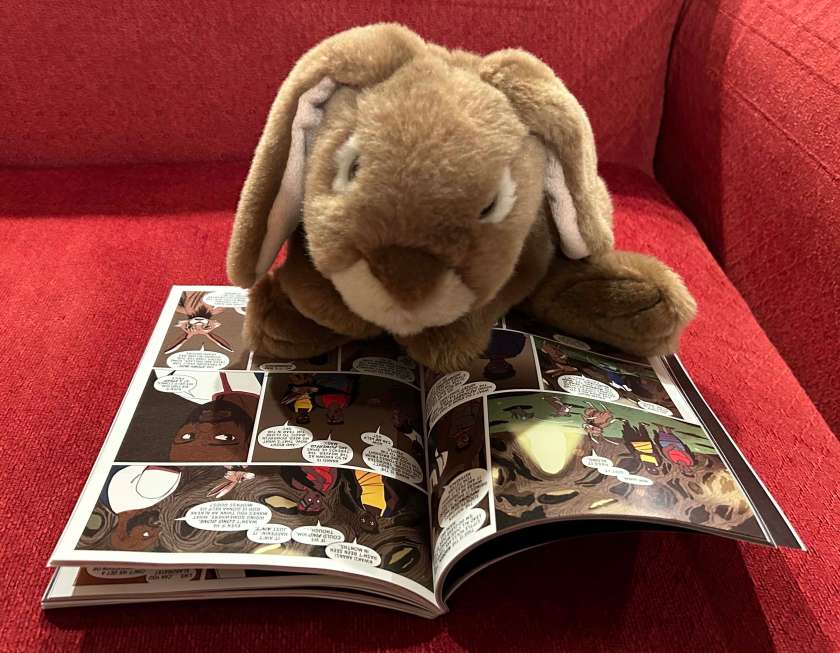
Caramel is reading Tristan Strong Punches a Hole in the Sky: The Graphic Novel, written by Kwame Mbalia, adapted by Robert Venditti, and illustrated by Olivia Stephens.

S: Some children might have read or heard about these characters before, but I think you met them only in this book, right?

C: Yes.

S: So was it a book full of strange characters you did not recognize? Or did the author and the illustrator introduce them to you effectively?

C: Yes! I think they both did an amazing job. I think I got a really good sense of them just by reading this book. Of course if I knew about them beforehand, maybe the book would be even more fun. But it was great fun all the same.

S: So I think fun would be one of your words to describe the book then?

C: Yes. I really like how it ends too. It ends with a bang, I liked it, but also they left a door open for a followup. And I think there are two more books about Tristan.

S: Yes, I saw that too. But I am not sure those are in graphic novel form. Would you like to read them?

C: Sure, I would.

S: Okay, then Caramel. Tell me how you would describe the book in three to five words.

C: Fun, funny, and action-packed.

S: I can see it! I flipped through the pages. The pictures are very dynamic and there seems to be a lot of action.

C: Yes!

S: Okay, then, let us wrap up this review so we can figure out how you can move on to the next book in the series. What would you like to tell our readers?

C: Stay tuned for more book bunny reviews!
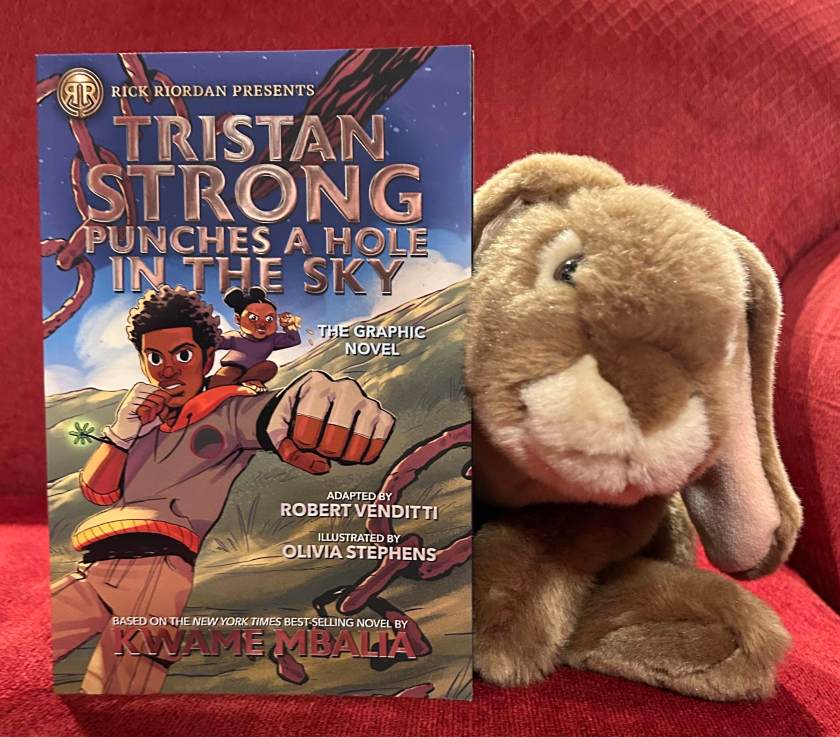
Caramel enjoyed reading Tristan Strong Punches a Hole in the Sky: The Graphic Novel, written by Kwame Mbalia, adapted by Robert Venditti, and illustrated by Olivia Stephens, and eager to read more.

Marshmallow reviews An Illustrated Book of Bad Arguments by Ali Almossawi

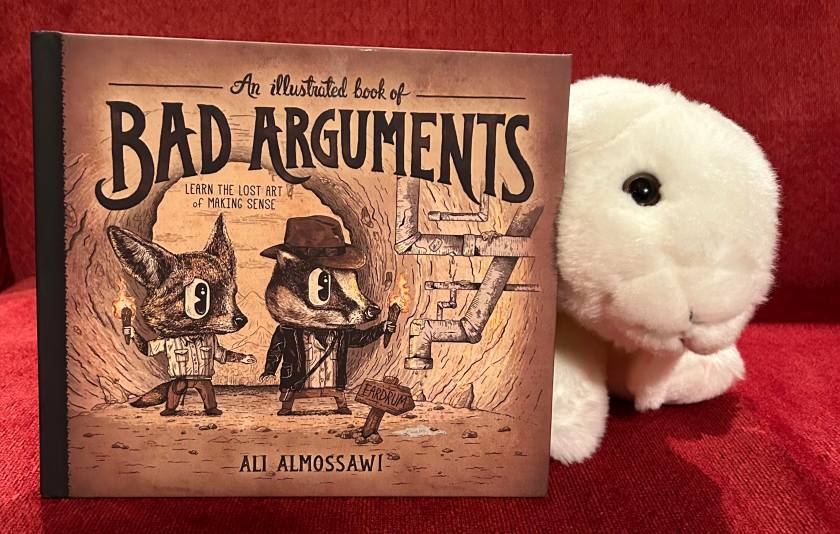
Today Marshmallow reviews a little book about big ideas: An Illustrated Book of Bad Arguments, written by Ali Almossawi and illustrated by Alejandro Giraldo, first published in 2013.

Marshmallow reviews An Illustrated Book of Bad Arguments, written by Ali Almossawi and illustrated by Alejandro Giraldo.

Marshmallow’s Quick Take: If you like nonfiction books with drawings, or if you are curious to learn more about how to make good arguments, then this might be the book for you. 

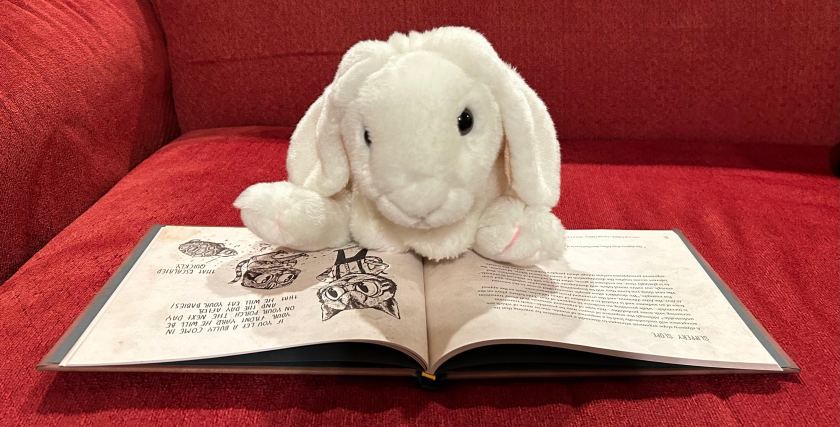
Marshmallow’s Summary (with Spoilers): This cute book covers a surprisingly serious topic in a surprisingly simple way. This is quite simply an illustrated book of different logical fallacies. (According to Wikipedia, “a fallacy is the use of invalid or otherwise faulty reasoning in the construction of an argument that may appear to be well-reasoned if unnoticed.”) Each fallacy has a couple short paragraphs of explanations and a drawing of human-like animals to demonstrate a different bad argument based on a different logical fallacy. Each description is about a page long (though keep in mind that it is with a relatively large font size on a small, square page). The drawings are big and take up another page which makes it very visually appealing to be able to see the description on the left page with the image on the right. The images are hand-drawn (I think) and are in black and white.

Marshmallow is reading An Illustrated Book of Bad Arguments, written by Ali Almossawi and illustrated by Alejandro Giraldo.

Marshmallow’s Review: An Illustrated Book of Bad Arguments by Ali Almossawi is extremely well written and extremely easy to understand and read. Younger bunnies could comprehend practically all of the book’s content (since the examples are fairly basic). Yet, this book conveys an important message: Bad arguments are disturbingly common, in daily life and on the larger scale.

Be it political or personal, people are constantly making bad arguments based on logical fallacies to sway others. And unfortunately, this approach often works. Having a good understanding of how to evaluate arguments based on logical reasoning is a necessity in a world overwhelmed with poor arguments and fallacies meant to deceive.

I think this book is a good read for bunnies of all ages because of the simple but useful explanations and descriptions of each logical fallacy. The illustrating artist, Alejandro Giraldo, has a clear, consistent style which draws you in (forgive the pun).

Overall, this is a very neat and clean book that is entertaining and informative to read. It can help develop skills that all bunnies will likely need to use for their whole lives. I think it can also be useful if you yourself are writing arguments. It helps you recognize some of your own argumentative mistakes so that you can make better claims. As a bunny who is into Speech and Debate, I know that this is a very useful skill. But for all students in general who need to learn to write so they can defend their beliefs and ideas, this book is a great source to improve their ability to refute and strengthen arguments.

In summary, An Illustrated Book of Bad Arguments is a comprehensive guide to living in a world where the truth is not always clear. But this illustrated book of bad arguments makes things clearer, and if I haven’t proven this to you yet, then I guess I must be using some sort of logical fallacy. And the only way for you to find out whether I have is to read this book!

Marshmallow’s Rating: 100%.

Marshmallow rates An Illustrated Book of Bad Arguments, written by Ali Almossawi and illustrated by Alejandro Giraldo, 100%.

Caramel reviews Spy School Goes North by Stuart Gibbs

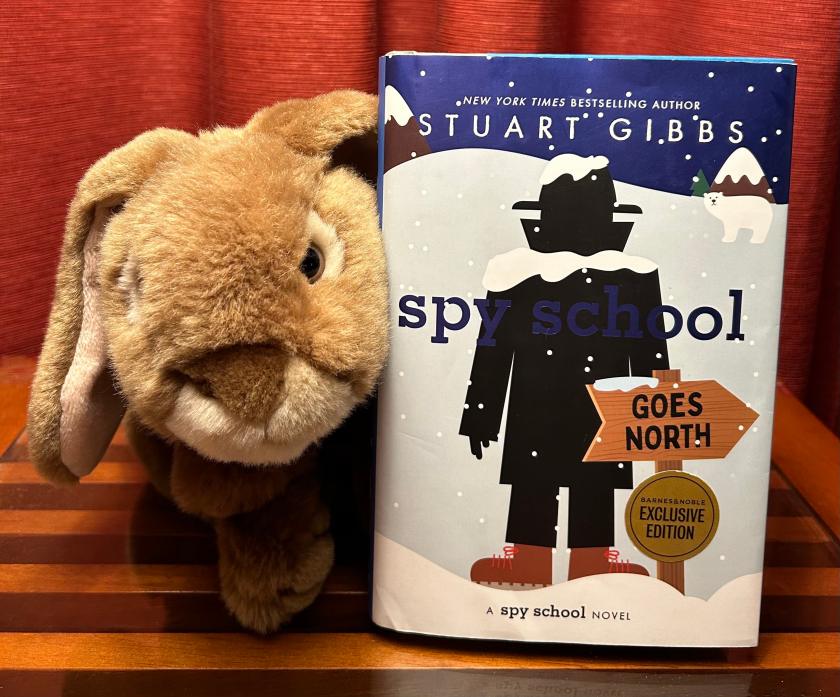
Today, Caramel is finally ready to talk about the eleventh and currently last book in Stuart Gibbs’ Spy School series: Spy School Goes North, first published in 2023. As usual Sprinkles is taking notes and asking questions.

[Before diving into this review, readers might like to check out Caramel’s reviews of the earlier books in the series: Spy School, Spy Camp, Evil Spy School, Spy Ski School, Spy School: Secret Service, Spy School Goes South, Spy School: British Invasion, Spy School Revolution, Spy School At Sea, Spy School: Project X.]

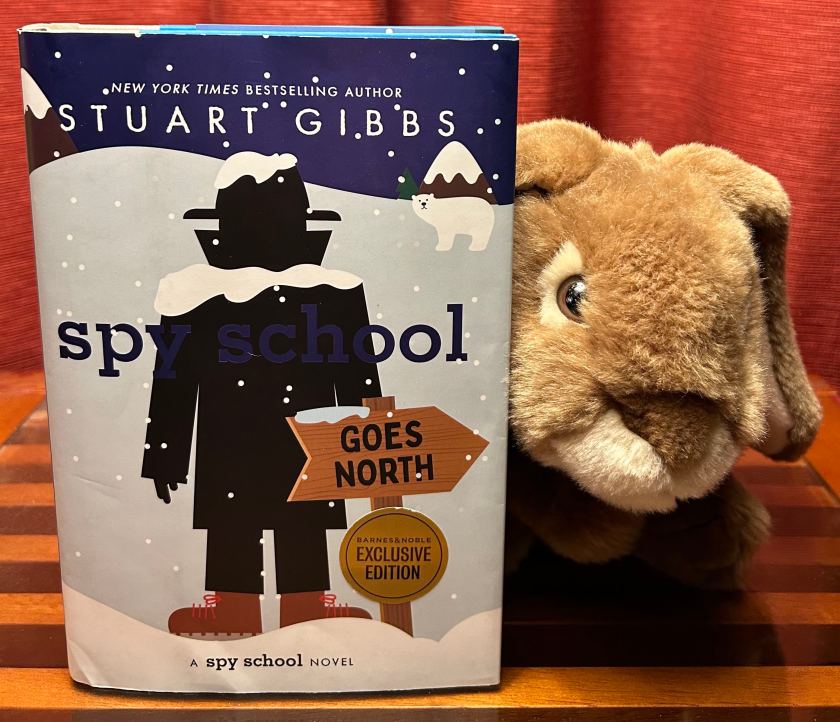
Caramel reviews Spy School Goes North by Stuart Gibbs.

Sprinkles: So, Caramel, we are finally at the last book of the series, right?

Caramel: Hopefully not for long.

S: I know you want the author to write more books in this series, but for now, this is the eleventh and last book.

C: Yes, unfortunately.

S: But do not sound so glum. The book is good, no?

C: Yes, of course. But I wish it never ended. I wish there was another one.

S: I can see that. And maybe there will be a twelfth book soon. But let us focus on this book right now. So what is this book about?

C: Ben and his friends including Cyrus Hale, who is Erica’s grandpa and a very good spy, are all training up north in Alaska.

S: Oh, so that is the going north part. I was wondering if it would be Canada.

C: Nope. It is not Canada. It starts in Alaska and then it goes over to Russia.

S: I see.

C: So a Russian spy kidnaps Cyrus, and Ben and his friends have to save him. And along the way there is a lot of spy stuff about U.S. and Russia.

S: I see. I wonder if it is historically accurate at all.

C: Well, Alaska was owned by the Russians, and the United States bought it from them, so that part is accurate. I don’t know about the spy stuff of course. They do mention KGB, the Soviet secret service.

Caramel is reading Spy School Goes North by Stuart Gibbs.

S: So is Ben finally dating Erica in this book?

C: Yep. I think they are boyfriend and girlfriend at this point.

S: I see. Does that make the book too mushy?

C: No. It is just as funny as before. For example, Ben does not speak Russian well and there is a lot of funny misunderstanding and miscommunication with the Russian spy. Obfuscate the jitterbug, for example.

S: I am not sure what that means.

C: Neither is Ben. And I am quite sure that was not what the Russian guy was trying to say.

S: I can see how that can be hilarious in some contents, but aren’t they all in mortal danger?

C: Yes, but I read enough Spy School books to know that Ben and friends will get out of this alive. So I can just enjoy the book.

S: Makes sense to me. Do you think these books are getting somewhat too similar or formulaic?

C: No. I mean yes, in each book Ben is facing mortal danger and in each book he figures out some way out of it. But other than that, I think Stuart Gibbs keeps us on our toes, he always comes up with new ways to make things exciting and fun.

S: That is good. So you still like this series?

C: Yes!

S: Okay, so if you were to describe this book using three to five words, what would they be?

C: Funny page turner, as always. That’s five words.

S: Yes, that will do nicely.

C: So can we wrap this up so I can begin to reread the book?

S: Sure Caramel. Let us do that. What do you want to tell our readers as we end this review?

C: Stay tuned for more book bunny reviews!

Caramel loved reading Spy School Goes North by Stuart Gibbs and now does not know what to do with himself as there is as of yet not a twelfth book in the series.

Marshmallow reviews Emily Wilde’s Encyclopaedia of Faeries by Heather Fawcett

Today Marshmallow reviews Emily Wilde’s Encyclopaedia of Faeries by Heather Fawcett, published in 2023.

Marshmallow reviews Emily Wilde’s Encyclopaedia of Faeries by Heather Fawcett.

Marshmallow’s Quick Take: If you like books about faeries and magic, or if you enjoy stories set in a different time period, then this might be the book for you. 

Marshmallow’s Summary (with Spoilers): Despite being the youngest tenured professor at Cambridge, Emily Wilde is a rather curmudgeonly scholar. Her world is much like ours was during the 1800s, with one small difference: faeries are real. Emily Wilde studies these faeries and has spent many years of her life working on an encyclopedia about faeries from all over the world. The last area to finish is a small town, far up north, named Hrafnsvik. There, Emily is going to gather the evidence she needs to wrap up writing the world’s first encyclopedia about faeries.

Emily doesn’t particularly care for the townsfolk; she’s not a people person. She would rather sit alone, surrounded by books, than suffer through awkward social interactions. All she needs and wants is to complete her study of the natural fae of Hrafnsvik. Unfortunately, the arrival of Wendell Bambleby throws a wrench in her plan.

Emily’s relationship with Wendell is complicated. He annoys her for reasons she can’t explain, despite him never doing anything to upset her. Rather, Wendell is constantly trying to befriend Emily, who has no intention or use for friends. Additionally, Emily doesn’t trust Wendell. And she’s not going to let him impede her investigation of the faeries in the forest and the faery in a seemingly haunted house.

If there is one thing that is clear in this story world, it is that these faeries are not benevolent or friendly. Instead, they view humans as pets at best, and at worst, as worthless creatures to torture and torment. But Emily isn’t scared. With her knowledge and skills in the field of fae, her trusty dog Shadow, the occasional help of the villagers, and her annoying companion Wendell, Emily is ready to venture into the unknown. 

Marshmallow is reading Emily Wilde’s Encyclopaedia of Faeries by Heather Fawcett.

Marshmallow’s Review: I think Emily Wilde’s Encyclopaedia of Faeries was a very intriguing book. I really liked the world-building. In particular I liked how the author built a world much like the 1800s, but added a sprinkle of fae magic. The surroundings felt very authentic and real, and the similarities with our world made the story more credible.

I think the characters were also interesting. The main character is a little bizarre, but seeing this world through her eyes added a lot to the story. The book is written as if it is the personal diary of Emily Wilde. The author includes many references to other scholars’ academic papers and past research on faeries (which, I think, are all fictional). That was cool and helped build on and add to the world the story is written in.

The author speaks through a very analytical and academic voice and uses a lot of big words. I would say that I have a fairly wide vocabulary, but some of these words stumped me, so I would suggest having a dictionary handy. However, these words are not frequent enough to impede the reader’s comprehension of the text.

I was a little confused on some parts of the plot and some of the narrative threads. However, I think everything all came together at the end in a cohesive and satisfying way. The story is overall quite fantastical and yet fulfilling.

Even though Emily Wilde’s Encyclopaedia of Faeries does not end in a cliffhanger, there is apparently a second book with Emily and Wendell in it, and I am looking forward to reading it. If it is anywhere close to this one, I am sure I will enjoy it too.

Marshmallow’s Rating: 95%. 

Marshmallow rates Emily Wilde’s Encyclopaedia of Faeries by Heather Fawcett 95%.