Caramel reviews Buns Gone Bad by Anna Humphrey and Irma Kniivila

Today Caramel reviews Buns Gone Bad, by Anna Humphrey and Irma Kniivila, the first book in a new graphic novel series called Fluffle Bunnies, coming out later this month. As usual, Sprinkles is taking notes and asking questions.

The book bunnies received this book as an advance review copy.
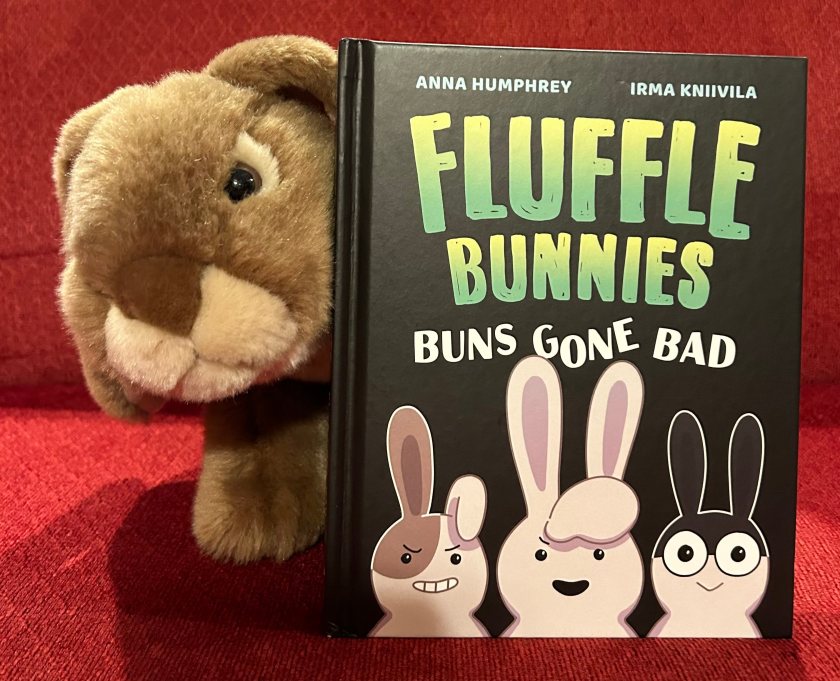
Caramel reviews Buns Gone Bad, written by Anna Humphrey and illustrated by Irma Kniivila.

Sprinkles: So Caramel, you got yourself a new graphic novel series.

Caramel: Yep.

S: Why don’t you start by introducing us to the Fluffle Bunnies, who are apparently going to go bad in this book?

C: These are three little bunnies. They are called Biggie, Boingy, and Flop, and they are really nice and cuddly. But then they decide to be TUFF bunnies.

S: Tell me more. What does that mean?

C: That means that they turn evil.

S: Wait, evil? I had thought this would be kind of like the Bad Guys books. So they would be bad in some ways but actually be cute deep inside.

C: This is kind of the opposite of the Bad Guys books actually. These guys start as cute little bunnies and then they go rotten. In Bad Guys, it’s the opposite; they are bad guys who turn good.

S: Well, I like cute little bunnies, and even mischievous little bunnies, after all, you are one. But evil ones? I am not sure that I like that…

C: Well, they are not really evil. So what happens is that their mother leaves for a trip, so the little bunnies are left defenseless, so the other animals try to take advantage of them, and so the little bunnies decide to toughen up. So they are not really evil, but they are tough. I said that before. They want to be TUFF. I guess they don’t know how to spell tough. Unlike me.

S: I see. So then they are not bad bunnies; they just learn to stand up for themselves.

C: Kinda. But they go a bit beyond just that. They take over the park. They go a little bit too far, maybe.
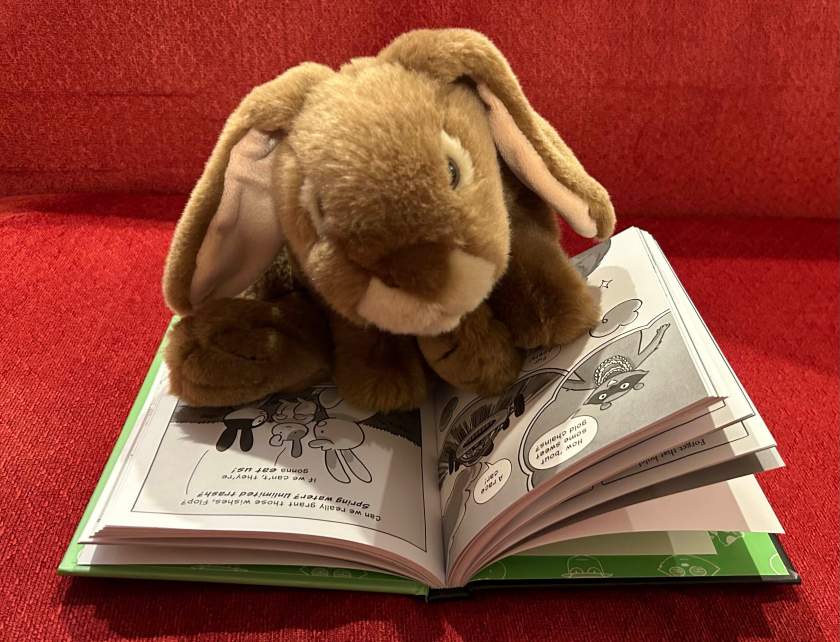
Caramel is reading Buns Gone Bad, written by Anna Humphrey and illustrated by Irma Kniivila.

S: That is interesting. And kind of funny, I must admit. Three little bunnies taking over a park.

C: It is funny, but it is also fun. Think of it Sprinkles; you, me and Marshmallow having our own park. Wouldn’t it be awesome? Of course the three bunnies in the book are all siblings. And you are our mommy. And you have not left home to go to Brazil to learn jujitsu.

S: Well, learning jujitsu could be really awesome. And Brazil is the heart of Brazilian jujitsu so that makes sense. Remember, years ago, you and Marshmallow tried to learn Brazilian jujitsu?

C: Yes, and that was a lot of fun. So maybe, I can understand the mommy bunny. But the three little bunnies go a little cuckoo when she leaves, so maybe she should have taken them along.. Oh well. If she did take them along, this book would not be written, and I would not have had all the fun I had reading it.

S: So you enjoyed the book then?

C: Yes. It is really funny. The way the bunnies take over is really hilarious.

S: And how about the pictures? They look like they are all black and white. Or rather all grayscale. That is, there are different shades of gray, but no other colors.

C: Yes. But that’s fine. The bunnies are very funny all the same.

S: So would you read more adventures of the Fluffle Bunnies? This is the first book of a series apparently.

C: Yes. I would. But this is a very new book, so I am afraid a second book might not come out too soon.

S: I guess we will just have to wait.

C: Yes, unfortunately. I really do not like waiting.

S: I know Caramel, but sometimes waiting is worth it.

C: Yes I guess.

S: So if you were to describe the book in three to five words…

C: Funny page-turner about three scrappy bunnies. Here I am using the “North American informal” meaning of the word “scrappy”. Like in the musical Hamilton. That’s where I heard it first.

S: I guess it is good we looked that word up together, Caramel. We also looked up the word “fluffle” right?

C: Yes, it means a group of bunnies. I really like it!

S: Me too. Okay, so let us wrap up this review then. What would you like to tell our readers?

C: Stay tuned for more book bunny reviews!

Caramel loved reading Buns Gone Bad, written by Anna Humphrey and illustrated by Irma Kniivila, and he can hardly wait for a second book in the series so he can read more about these "scrappy" little bunnies.
Caramel loved reading Buns Gone Bad, written by Anna Humphrey and illustrated by Irma Kniivila, and he can hardly wait for a second book in the series so he can read more about these “scrappy” little bunnies.

Marshmallow reviews The Bluest Eye by Toni Morrison

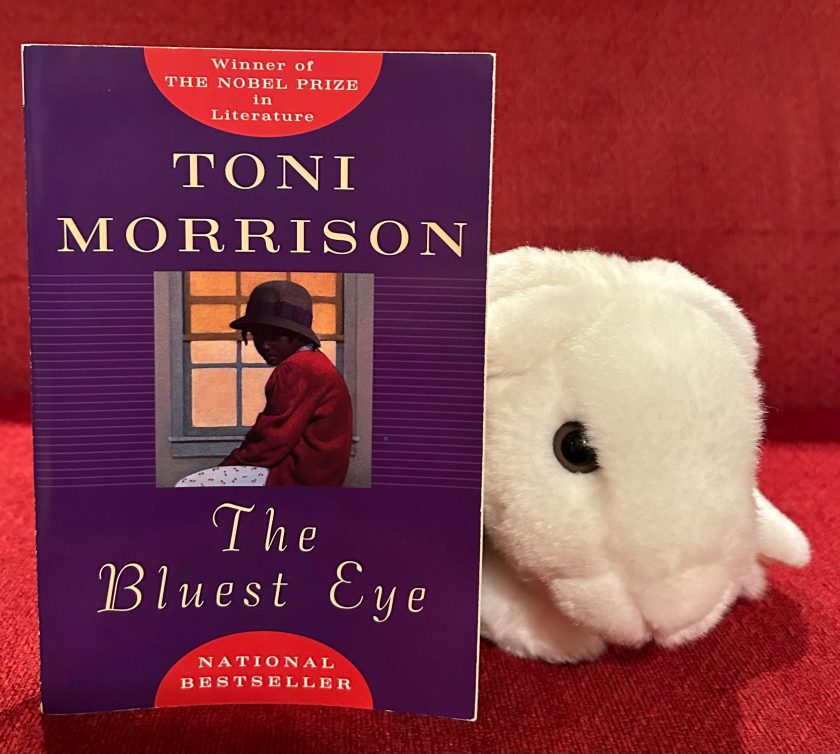
Today Marshmallow reviews The Bluest Eye by Toni Morrison, first published in 1970. Sprinkles is taking notes and asking questions.

Marshmallow reviews The Bluest Eye by Toni Morrison.

Sprinkles: So Marshmallow, you always start your book reviews with what you call a quick overview. Can you give us one for this book, too?

Marshmallow: If you want to read about three young black girls growing up after the Great Depression and amidst internalized and externalized racism, then this is the book for you.

S: Okay, I think that is a good start. So tell us a bit more. Who are the three girls?

M: The main character is eleven-year-old Pecola Breedlove, and she is a foster sister to the other two girls, Claudia and Frieda MacTeer, who are nine and ten, and live with their parents. Pecola and Claudia are close, and a lot of the book is told from Claudia’s perspective. But we also have flashbacks and so on to events in Pecola’s life that Claudia could not have witnessed.

S: Okay, so tell me more. Why is the title The Bluest Eye?

M: Because Pecola wants to have the bluest eyes in the world. She thinks that she is ugly because a lot of people tell her she is, and she thinks that if she had blue eyes, she would be beautiful too.

S: I see. That must be very hard for a young girl of course.

M: That is not all that is hard in her life though. Her parents are both alive but they are not able to take good care of her. Her father is abusive and violent. Her mother does not support and protect her. The MacTeers on the other hand are a more supportive family for their children and Pecola, too, at least most of the time.

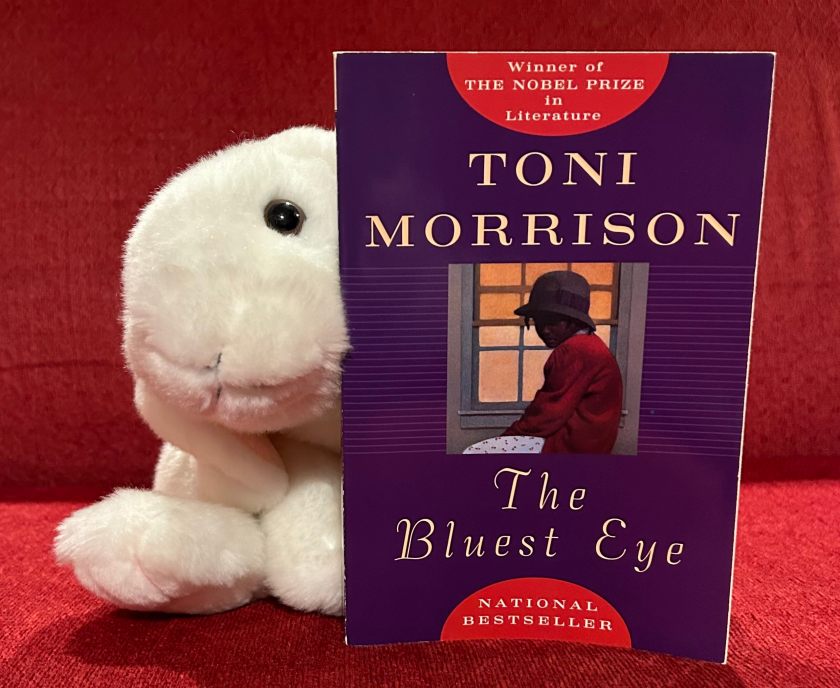
Marshmallow is reading The Bluest Eye by Toni Morrison.

S: I know this book has been banned in some school districts. Do you know why?

M: I think it is mainly because of two very sexually explicit scenes, which are also violent and abusive. And there are other parts where children are sexualized, and so on.

S: Hmm, I can see how those types of scenes would make a lot of people concerned about a book, especially for younger folks. How did you handle them?

M: I think the book is really hard to read, emotionally. When I was reading the book, I had to put it down several times. That is why it took me a really long time to read the book even though it is not very long and the author’s voice is fluid and captivating.

S: And yet you persisted and finished the book.

M: Yes, because I know it is an important book, and I know the author is trying to tell us something important.

S: What do you think she is trying to tell us?

M: I think she is trying to portray the chaos and the evil that results from racism. She says: “I felt compelled to write this mostly because in the 1960s, black male authors published powerful, aggressive, revolutionary fiction or nonfiction, and they had positive racially uplifting rhetoric with them that were stimulating and I thought they would skip over something and thought no one would remember that it wasn’t always beautiful.” So even though black people survived and often thrived despite the terrible oppression of racism they had to face, there were also people who did not survive, who were broken, and Toni Morrison wanted to make sure that we would not forget that.

S: I can see why you persevered Marshmallow. Sometimes we need to read difficult and heart-wrenching text to make sure we do not forget. But from what I am hearing you say, this book is probably not appropriate for young bunnies even though the main characters are young themselves.

M: Yes, definitely. I don’t think Caramel should read it yet for example. But for bunnies who are older and a bit more mature, it might be more appropriate.

S: You have read and reviewed Chains, Forge, and Ashes, the three books of the Seeds of America series, which were also about racism, or maybe more accurately, slavery. I think those books were also hard to read in some ways, but this one seems like it was a lot more challenging.

M: Yes. Possibly because in those books, even though there is a lot of pain and heartbreak, the main characters eventually overcome some of their challenges, and there is some sense of triumph, kind of like the writings Toni Morrison is referring to in the quote above. But in The Bluest Eye, both the life and the identity of Pecola are shattered. She does not survive her challenges. There is no redemption, only pain. Okay, there is some beauty too, in the book; there is solid love and affection, in the lives of Claudia and her family. But what happens to Pecola is traumatizing, and she does not survive the trauma.

S: I get that Marshmallow. Thank you for sharing your thoughts on this book. So do you have some last words to say about it?

M: I think this could be a good book to read for bunnies who are willing to face the full ugliness of racism and how it hurts people’s self-worth.

S: Thank you. So let us wrap this up then. What do you want to tell our readers?

M: Stay tuned for more amazing reviews from the book bunnies!

Marshmallow appreciated reading The Bluest Eye by Toni Morrison, though she thinks that it might be appropriate for only older bunnies.

Caramel reviews Homer Price by Robert McCloskey

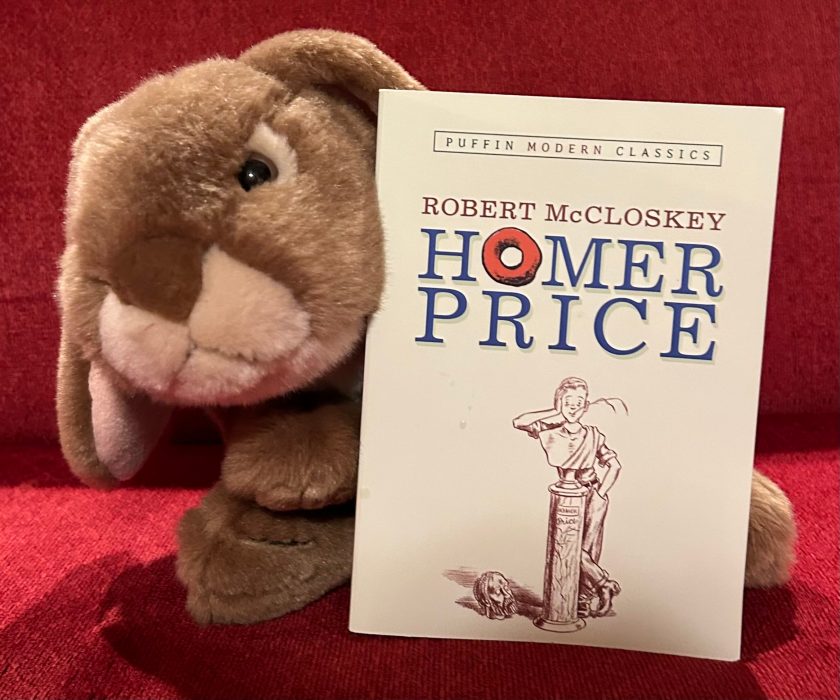
Today Caramel reviews Homer Price, a book by Robert McCloskey first published in 1943. As usual, Sprinkles is taking notes and asking questions.

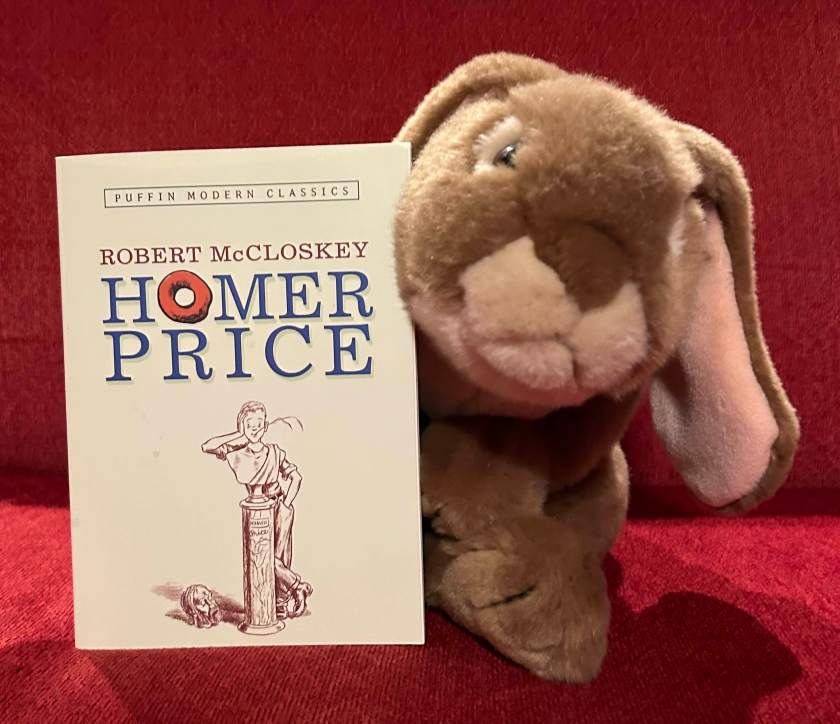
Caramel reviews Homer Price by Robert McCloskey.

Sprinkles: So Caramel, tell me about this book.

Caramel: This book is about a kid named Homer Price. Homer does many different things, like helping his uncle in the lunch room, which I think is essentially a restaurant, and building radios. This one is actually cool.

S: So Homer is a curious kid, and the book is about his adventures?

C: Yes. Or you could say his misadventures. A lot of unfortunate things happen. But in the end, he always comes out on top.

S: So you must like that, right? You like happy-ending books.

C: Yep. And Homer is a good kid. He is lucky but also pretty clever. And he likes to help other people.

S: Sounds a bit like you, Caramel.

C: Well, I don’t know how to build radios.

S: I bet you would like to give it a try.

C: Yes, I think I would.

S: Well, the summer is here, and school will be out soon, so maybe we can look into that.

C: I’d like that!

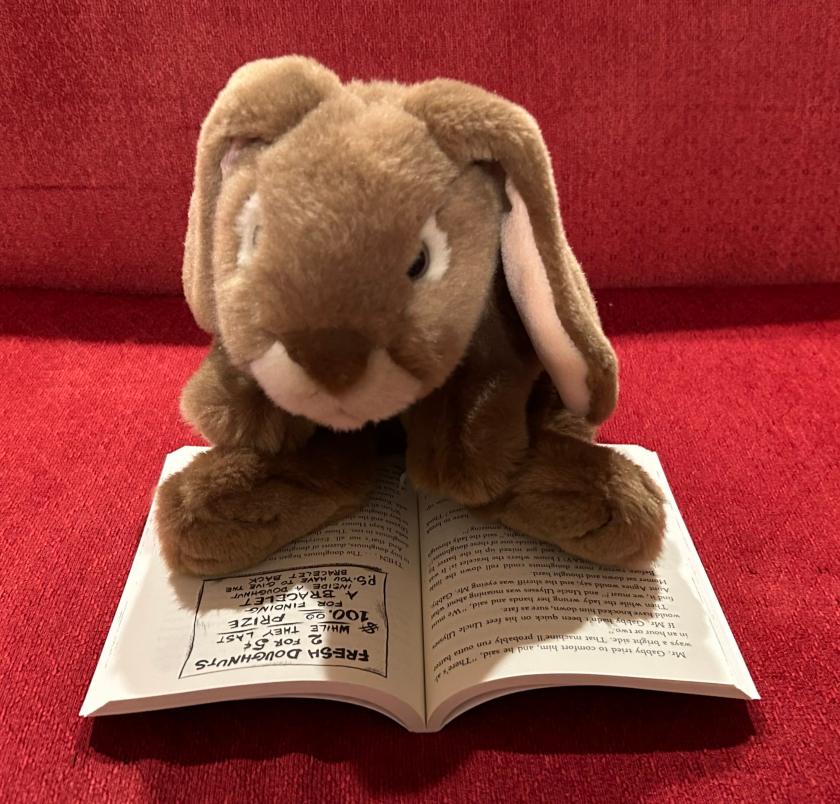
Caramel is reading Homer Price by Robert McCloskey.

S: Okay, so tell me a bit more about the book.

C: There are six chapters in the book. Homer has a different adventure in each. The chapter titles are “The Case of the Sensational Scent”, “The Case of the Cosmic Comic”, “The Doughnuts”, “Mystery Yarn”, “Nothing New Under the Sun (Hardly)”, and “Wheels of Progress”. I think I like “The Doughnuts” the most.

S: Tell me more.

C: I think it is the funniest part of the book. There is this machine that makes doughnuts, and something goes wrong, and it does not stop, so it keeps making doughnuts nonstop.

S: So there is an unending supply of doughnuts? That does not seem like a terrible situation!

C: I like donuts too, but I guess you could have too many doughnuts. Anyways eventually it stops, so they have to figure out a way to sell all the doughnuts.

S: What was funny about the chapter?

C: How they panic about the unstopping doughnut machine! That was very funny. And there are pictures here and there in the book. The ones in this chapter are pretty funny. And you can see the doughnuts all over the place!

S: I see. I thought you might also enjoy the Cosmic Comic one.

C: Yes, I did. In that chapter, Homer and his friend Freddy go to meet Freddy’s favorite comic book superhero. And hilarity ensues.

S: That is a funny way of saying things Caramel! But so the book sounds like it is light and light-hearted.

C: Yes.

S: You know that this book was written quite a while ago, right? Does it show its age?

C: Not really. I mean there are no computers and cell phones around but otherwise the stories just sound like they could happen today too. Though a $100-award back then would probably be much bigger than it is today. That is from “The Doughnuts”.

S: I see. Okay, so if you were to describe this book in three to five words …

C: Hilarious, timeless adventures of a clever little boy.

S: That will do! So let us wrap this up then. What would you like to tell our readers?

C: Stay tuned for more book bunny reviews!
Caramel enjoyed reading Homer Price by Robert McCloskey and learning about Homer's quirky adventures.
Caramel enjoyed reading Homer Price by Robert McCloskey and learning about Homer’s quirky adventures.

Marshmallow reviews Little Fires Everywhere by Celeste Ng

Today Marshmallow reviews Little Fires Everywhere, a 2017 novel by Celeste Ng, which has been turned into a one-season TV series in 2020.

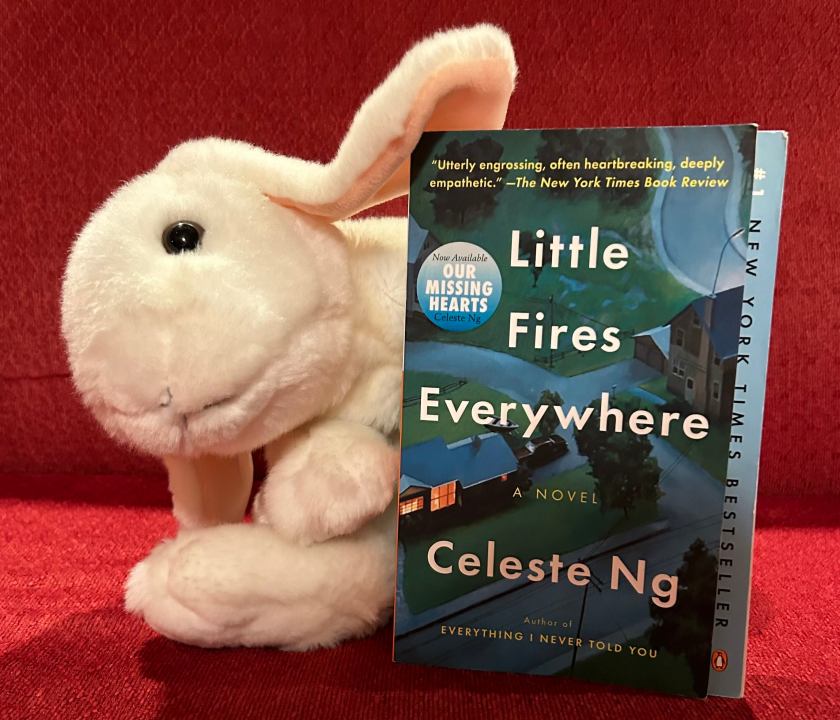
Marshmallow reviews Little Fires Everywhere by Celeste Ng.

Marshmallow’s Quick Take: If you like books about family (specifically the relationship between a mother and their children) and racial differences, then this is the book for you.

Marshmallow’s Summary (with Spoilers): Pearl Warren has lived her whole life moving from one place to another. Her mother Mia is a photographer, an artist who finishes one project, sells it, and then decides to move on. To support herself and Pearl, she works odd jobs at restaurants or shops. But after a close brush with Pearl’s pneumonia, Mia decides that a nomadic life isn’t good enough for her developing daughter who is missing out on a normal life. So they settle down in Shaker Heights, the first, fully planned community in America.

In Shaker Heights, the houses are all color coordinated and regulated to be perfectly in order. But it’s not just the houses that are picture perfect. Every person in Shaker Heights is born with a set plan: success, planned success at that. The epitome, the poster child of this planning approach is Elena Richardson. Born in Shaker Heights, she followed her plan to the smallest detail: high school, college, job, marriage, children. Now wealthy, living with a husband, four children, and two houses, she generously rents her extra house to those she feels deserve a better chance, a chance to live in Shaker Heights. Shaker Heights’ schools and environment is expensive but full of opportunity, a place that many wouldn’t be able to afford. So out of Mrs. Richardson’s generosity, Mia and Pearl are able to move into a house, permanently, Mia promises.

The Richardson family has four children, all of whom fascinate Pearl. The oldest daughter (a senior), Lexie, is confident and mature in a way Pearl wishes to be able to emulate. The oldest son (one year older than Pearl and a junior) is named Trip. Trip is athletic and very popular with girls, including Pearl. The younger son (a sophomore, the same age as Pearl) named Moody befriends Pearl and invites her to the fascinating Richardson house. The first three Richardson children match Elena’s plan, but the youngest child, Izzy (a freshman), doesn’t fit in and doesn’t seem to want to fit in. She is rebellious and contends with her mother to frustrate her. But when Izzy meets Mia and her art, she becomes almost obsessed with Pearl and her mother’s lifestyle. 

In the opposite fashion, Pearl becomes obsessed with the Richardsons and their entrancing life. But with a growing, intensifying crush on Trip and a budding friendship with Lexie, her original friend in the Richardson family (Moody) becomes a little neglected. Eventually, Trip reciprocates her feelings and they engage in sexual relationships. Meanwhile, Lexie gets pregnant with her boyfriend. But in Shaker Heights, where greatness is a given, pregnancy is not tolerated in teenagers. So when she gets an abortion, out of embarrassment, she puts her name down as Pearl. 

At the same time, Elena’s old friend Linda McCullough (who also returned to Shaker Heights after college) is having issues of her own. Mrs. McCullough and her husband have been trying to have children for fourteen years while Elena was giving birth to four children at one-year intervals. So when Mrs. McCullough is informed there is a baby they can adopt, she is overjoyed. The baby was dropped off at the fire station in a cardboard box with blankets. The baby’s mother is unknown and anonymous. So when her new baby’s first birthday (still during the adoption process) comes around, she invites her old friend Elena. Mia hears about the McCulloughs’ new baby and is shocked to realize that one of her coworkers at a Chinese restaurant is the baby’s mother. Bebe Chow is a Chinese immigrant whose boyfriend abandoned her after learning that she was pregnant. She worked to support her child, but, in a moment of desperation, she left her baby at the fire station. Afterwards, she desperately tried to get her baby back for a year. Now that she knows where her baby is, Bebe goes to the press, following Mia’s advice. This becomes a huge news story dividing people into camps, and the coverage eventually earns Bebe visitation rights and a lawyer.

The situation is very difficult. The McCulloughs genuinely love the baby with all of their hearts, especially after spending fourteen years waiting for one. However, Bebe really wants her baby now, having only left her due to extreme poverty and depression. Now, she has a more stable job and wants to take care of her baby. Also, her lawyer says that as a Chinese baby, Bebe’s baby won’t be connected to her heritage unless she is raised by her Chinese mother. 

So in summary, Shaker Heights was perfectly planned, but with the arrival of Mia and Pearl, chaos ensues. Nothing will be the same again. 

Marshmallow is reading Little Fires Everywhere by Celeste Ng.

Marshmallow’s Review: I really liked this book. I did have very high expectations; Celeste Ng’s other book, Our Missing Hearts, is one of my favorites ever. Celeste Ng’s writing is unique in a way I can’t describe with words. Something about her writing puts her on another level. She writes so simply, yet provides overwhelming detail: clear and concise. So I really wanted to read another book written by her.

And Little Fires Everywhere is definitely not a disappointment. The world the author creates is realistic yet retains an air of fantasy in a way. The storyline is unique and different from most books. Just like in Our Missing Hearts, Ng always gives convincing and deep backstories and context before extending the plot further.

The storyline is rich and complex, but easily understandable. There is some inappropriate content for younger bunnies. Underage characters do engage in sexual activity, however, there is no explicit, overly detailed scenes (unlike the, cough, Shatter Me series, cough cough 🤨). Teenage pregnancy is mentioned, as is abortion. The topic of motherhood and what it means to be a mother is a pervasive theme throughout the book. The relationship between parent and child is explored deeply through the lives of several different characters. The topics in the book (specifically the conflict between the McCulloughs and Bebe) are complicated and cannot be answered in a simple manner. The book also seems to have a message about the value and limitations of planning. Celeste Ng seems to imply that some parts of life cannot and should not be planned.

I think this was a fascinating, deep, and interesting book that had an impact on me, emotionally and intellectually. Of course, some content might make it better for older bunnies, perhaps 14 and up. And the ending, for me, was not satisfying, but it fit the style of Celeste Ng (which again, I don’t know how to describe). Overall, I would definitely recommend this book to all bunnies. 

Marshmallow’s Rating: 100%

Marshmallow rates Little Fires Everywhere by Celeste Ng 100%.