Marshmallow reviews The Phantom Tollbooth by Norton Juster

Today Marshmallow writes about The Phantom Tollbooth, written by Norton Juster and illustrated by Jules Feiffer. Marshmallow read the 50th Anniversary Edition of this 1961 classic.

Marshmallow reviews The Phantom Tollbooth, written by Norton Juster and illustrated by Jules Feiffer.

Marshmallow’s Quick Take: If you enjoy reading classics or appreciate books that make you think, then this might be the book for you. 

Marshmallow’s Summary (with Spoilers): Milo is a boy who doesn’t want to do anything. He wants to be in school when he isn’t; when he is in school, he wants to be out of it. Then one day, he receives a large package. Inside is a small tollbooth. As he has nothing to do, he starts to play with the tollbooth and finds himself in a strange land when he drives his toy car through it. Luckily, the tollbooth came with a map of this place, and he was driving around in a small motorized car.

As he drives around in this new land, he goes to many strange places. In one place, he becomes friends with a literal watchdog, Tock, who is a dog with a clock on his side. He goes to the kingdom of Dictionopolis where he meets strange people and learns that Rhyme and Reason, two princesses, have been locked away in a Castle in the Air, because the king of Dictionopolis, Azaz the Unabridged, and the king of Digitopolis, the Mathemagician, who also happens to be Azaz’s brother, disliked one of their verdicts. The Princess of Pure Reason and the Princess of Sweet Rhyme were asked by Azaz the Unabridged and the Mathemagician whether numbers or letters were more important. When Rhyme and Reason said that both were equally important, the two kings banished the princesses.

Milo and Tock, accompanied by the Humbug, who was assigned to be their guide by Azaz, must go and rescue the two princesses. But unfortunately, demons and monsters guard the Castle in the Air. Milo, Tock, and the Humbug will need to journey across the “Land Beyond”, the name of the place Milo is in, to return Rhyme and Reason to their land. 

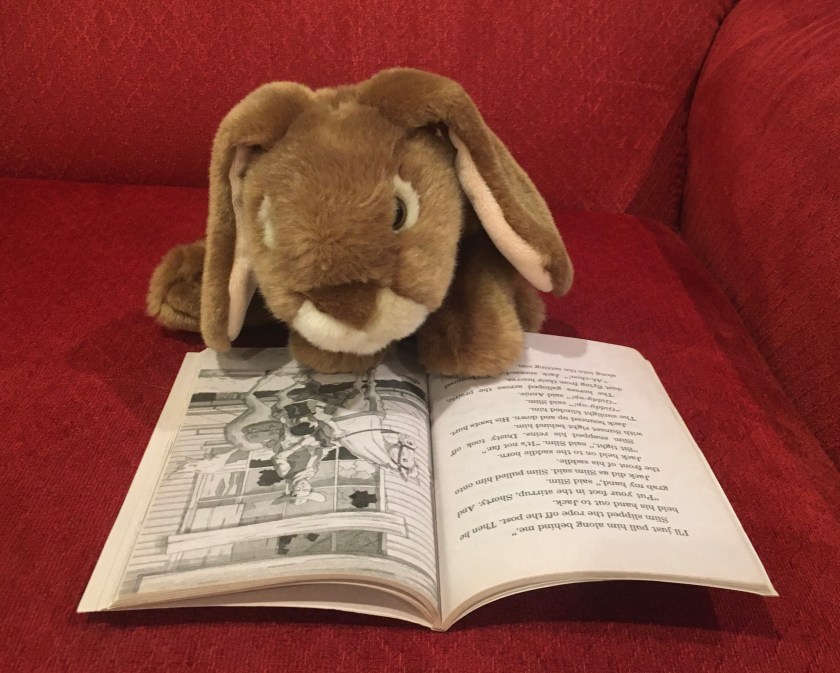
Marshmallow is reading The Phantom Tollbooth, written by Norton Juster and illustrated by Jules Feiffer.

Marshmallow’s Review: The Phantom Tollbooth is a great read, especially if you like language and wordplay. I really like how the author Norton Juster plays with words, like how one character is a watchdog, that means he is a dog with a watch in its side. Another character, the Which, is sort of like a witch, her real name being Faintly Macabre, meaning faintly gruesome, grim, morbid, hideous, or horrific.

I think that the wordplay must be a very big part of why this book is so widely read. Another reason might be because it is good for all ages, not too complicated or scary, though some of the wordplay might not make sense for younger readers. (I did not get most of them when I read it years ago.) I would highly recommend this book to everyone. In fact, I think I will suggest Caramel to read it too, soon. 

Marshmallow’s Rating: 100%.

Marshmallow rates The Phantom Tollbooth, written by Norton Juster and illustrated by Jules Feiffer, 100%.

Caramel reviews The Science of Scabs and Pus: The Sticky Truth About Blood by Ian Graham

A few weeks ago, Caramel got his paws on a set of four books about the human body, each focusing on one major system. Last week he reviewed the first one he read in the series: The Science of Snot and Phlegm: The Slimy Truth about Breathing written by Fiona MacDonald. Today he reviews the next one: The Science of Scabs and Pus: The Sticky Truth About Blood, written by Ian Graham. As usual, Sprinkles is taking notes and asking questions.
Caramel reviews The Science of Scabs and Pus: The Sticky Truth About Blood by Ian Graham.

Sprinkles: Please tell us about this book Caramel. What is it about?

Caramel: It is about scabs and pus, as you can tell from the title. And those are pretty interesting I think. It also talks about the heart and the blood system. They are not the same thing as scabs and pus but definitely useful.

S: Why do you think they are in the same book? The subtitle of the book is “The Sticky Truth About Blood”. And so it makes sense that it would be about blood and the heart and the circulatory system in general. How do scabs and pus come in?

C: Scabs happen when you have a cut or a wound and the scab is made by your blood cells to stop the bleeding. And underneath the scab, the skin tries to heal itself.

S: So scabs are made by your blood! That is cool, isn’t it?

C: I guess so. It is interesting. But pus on the other hand is pretty disgusting.

S: Okay, tell me about that. What is pus?

C: Pus is made up of dead blood cells, white blood cells and bacteria.

S: Are all of them dead?

C: Yep. Or almost dead.

S: So what is the point of it?

C: To get rid of the bacteria so you don’t get infected. You have pus come out of the wound.

S: So the body is trying to clean itself?

C: Yes. But it also means that your wound is not clean. It is a sign of infection.

S: That sounds bad.

C: Yes. Very bad.

Caramel is reading about the heart in The Science of Scabs and Pus: The Sticky Truth About Blood by Ian Graham.

S: A while ago you reviewed another book about the circulatory system. Do you remember?

C: Yes! It was from the Survive! series: Survive! Inside the Human Body: The Circulatory System.

S: So you already know quite a lot about the circulatory system. Did you learn new things from this book?

C: Yes! There is a lot of new information here. I learned some new things about the heart which I did not know before. There is also a whole two-page section on hemophilia and another two pages on leukemia. I did not know about those.

S: Hmm, so what are they?

C: They are both types of blood diseases. Hemophilia is when the person cannot make scabs. Their blood does not clot. And did you know that boys and men are more likely to get hemophilia than girls and women?

S: Yes, I knew that I think. It has something to do with the X chromosome. Most girls and women have two X chromosomes so they are less likely to inherit an X chromosome that gives them the disease. But most boys and men have only one X chromosome, so if that one has the mutation causing the disease, then the person gets it.

C: That is a bit confusing.

S: Yes, I agree. And then there is leukemia. What can you tell me about that?

C: Leukemia is when the bone marrow makes white blood cells that don’t work properly. The word “leukemia” comes from the words for white and blood. I did not know that before.

S: I didn’t know that either. And you know about white blood cells, too?

C: Yes. I learned about them from watching Cells at Work!

S: Yes, that show was quite interesting and taught us a lot, didn’t it?

C: Yes, though it was a bit too violent. The white blood cells and all the other immune cells sliced and diced enemies and it was a little too much.

S: I agree. But we still learned a lot. Okay, let us wrap up this review with your three words for the book.

C: Informative, colorful, and interesting.

S: Those are all good words Caramel! So you would recommend this to other little bunnies interested in learning about scabs and pus?

C: Yes, definitely.

S: And what else would you recommend our readers do?

C: Stay tuned for more book bunny reviews!

Caramel enjoyed reading The Science of Scabs and Pus: The Sticky Truth About Blood by Ian Graham, and is looking forward to reading the next book in the series.

Marshmallow reviews The Secret Sheriff of Sixth Grade by Jordan Sonnenblick

Marshmallow and Caramel have reviewed several books about school life for this blog before. Today Marshmallow wanted to talk about another book about school life: The Secret Sheriff of Sixth Grade by Jordan Sonnenblick. Sprinkles is taking notes and asking questions.

Marshmallow reviews The Secret Sheriff of Sixth Grade by Jordan Sonnenblick.

Sprinkles: So Marshmallow let us start with a quick summary. Can you tell us what this book is about?

Marshmallow: This book is about a kid named Maverick. He is short and people mistreat him at school. He also has some family problems. But when he starts sixth grade, he decides to try and change things. He decides to protect others who are mistreated.

S: That sounds really nice. He is not being treated well himself so he knows it feels terrible. So he decides to stand up for others so they won’t feel so lonely.

M: Yes.

S: So how does it go for him? Can he actually help other people?

M: He ends up being able to help, but at the start, he is always getting in trouble. He tries to stand up for others, but usually those people are not very appreciative or grateful. And there is really a lot going on at home. His mom is single and keeps making poor choices for boyfriends. They hit her and she is not always able to stand up to them and Maverick sees this and feels terrible that he is unable to protect his mom.

S: Yes, Maverick’s life is really hard, right? His mom is also always either working very hard at an unstable job or is out of work. Mom and son love each other and are usually kind to one another, but the home is not safe or comfortable.

M: Maverick does not have too many adults to trust, but he does have his aunt, and then eventually he finds another trusted grownup at school. I’m not telling who because I don’t want to give away all the details.

S: I agree. I think this gives people a good sense of the type of book this is.

M: Yes. Except that the book is also really really funny.

S: Yes, I will agree with that too. I was really really sad at some point while reading and then the next sentence made me laugh out loud. Maverick is a sincere, modest, and hilarious narrator.

M: That is true. His voice reminds me a bit of Percy Jackson.

S: How so?

M: They have the same sense of humor I think.

S: I guess so. I think they both are good at self-deprecating humor. And Percy has a lot of difficulties to fit in at school before he figures out he is a demigod. So maybe there is that too. Both Percy and Maverick are kids who did not start out life with things going easy for them.

M: Yes. I think so.

Marshmallow is reading The Secret Sheriff of Sixth Grade by Jordan Sonnenblick.

S: So what else would you like to say about this book? Did you enjoy reading it?

M: I enjoyed reading it, but I do think it is for older bunnies. Maverick’s life is very hard, and some kids might not be mature enough to read about domestic abuse and alcoholism and such.

S: Of course there are a lot of kids who have to live with these things, so for those kids, there is no way to avoid learning about them at any age.

M: That is true. I think maybe for those kids the book might also be good. There are good things that happen in the book too, and some of the difficulties are overcome.

S: So maybe for kids whose lives are difficult in these ways and in other ways, too, this might be a good book because it shows them that other people also suffer, and maybe kindness, Maverick’s way of trying to handle life, is still an option.

M: Yes.

S: The assistant principal at Maverick’s school has a little reminder in his office, a sentence on his wall:

“Be kind, for everyone you meet is fighting a hard battle.”

page 67

I think it is a good summary of the main message of this book.

M: I think so too.

S: It seems that the author was inspired by a real person while writing this book. There are so many people who have really difficult lives, yet they never lose their kindness. It is hard but those people do it. This book is a good reminder.

M: Yes.

S: So let us wrap things up. How would you rate this book Marshmallow?

M: Hmm, let me see. It gets a bit hard to read sometimes, because it is so sad sometimes. But it is a good book overall. So I rate it 95%.

Marshmallow rates The Secret Sheriff of Sixth Grade by Jordan Sonnenblick 95%.

Caramel reviews The Science of Snot and Phlegm: The Slimy Truth about Breathing by Fiona MacDonald

Recently Caramel got his paws on a set of four books about the human body, each focusing on one major system. Today he reviews the first one he read in the series: The Science of Snot and Phlegm: The Slimy Truth about Breathing written by Fiona MacDonald. As usual, Sprinkles is taking notes and asking questions.

Caramel reviews The Science of Snot and Phlegm: The Slimy Truth about Breathing by Fiona MacDonald.

Sprinkles: Tell me about this book Caramel.

Caramel: This book is about snot and phlegm. As you could tell from the title.

S: Hmm, sounds fascinating. Do you know the difference between them? It seems everywhere in the book they are used together, like “snot and phlegm”.

C: Snot and phlegm are both mucus, and the difference is that phlegm is in the chest and throat and snot is in the nose.

S: Do they ever define them?

C: They only define them in the glossary I think. So phlegm is “thick mucus from the chest often containing dead white blood cells, bacteria and sailva.” And snot is “mucus from the nose.”

S: What else is in the glossary?

C: Adenoids, allergens, allergies, alveoli, arteries, asthma, bacteria, and …

S: Okay, that is enough I think.

C: No wait! I wasn’t finished!

S: But we got the point, don’t you think?

C: Too bad.

S: But we should talk more about the book itself. We can go over the glossary again together later.

C: Okay.

S: So tell me more about this book.

C: Okay. Here are the chapter names. Introduction. The Breath of Life. Protect and Survive. Why Do Noses Run? Sinuses, Tonsils, and Adenoids. The Cold Virus. What is Hay Fever? Too Much! Why Do We Cough? What Are Bronchitis and Pneumonia? Breathless. No Airway! Breathe Easy. And then there is the glossary and the index.

S: Those sound interesting! So why do we cough?

C: Let’s consult the book. Page 20. Coughing is our diaphragm pushing out air from our lungs fast. It is supposed to clear the airways.

S: What does that mean?

C: The windpipe. The breathing tube connecting your lungs to your nose and mouth.

Caramel is reading about runny noses in The Science of Snot and Phlegm: The Slimy Truth about Breathing by Fiona MacDonald.

C: So this book is not only about snot and phlegm.

S: What else is there?

C: Heartburns. A heartburn is when your stomach acid goes up your throat and hurts it.

S: How is that related to your respiratory system?

C: I have no idea. Hmm, okay, apparently “a cough can also be caused by digestive difficulties.” And that is where the book talks about heartburn.

S: I see. So basically the book has some information about the respiratory system, and then some other interesting things that are closely related.

C: Yes.

S: You have read and reviewed another series of books about the human body, do you remember?

C: Yes! The Survive series. We talked about  Survive: The Digestive System and Survive: The Circulatory System and then Survive! Inside the Human Body: The Nervous System, all by Hyun-Dong Han. The second book talked about the heart, and arteries, and blood and a bit about breathing.

S: But it was not really about respiration, right?

C: Yes. That is true. That book was mainly about the circulatory system.

S: So did you learn anything new from this book?

C: Yeah. A lot. I learned about allergens for example. And the cold virus. There are many viruses that make people sick. Over three hundred that make you catch a cold.

S: Yes, that is exceptionally relevant today when we are dealing with a pandemic caused by what we think is a respiratory virus.

C: Yes. COVID-19.

S: Okay Caramel. Let us wrap up this review. What three words would you use to describe this book?

C: Helpful, interesting, colorful.

S: Okay, I think these are good descriptors. And what will you tell our readers?

C: Stay tuned for more book bunny reviews!

Caramel enjoyed reading The Science of Snot and Phlegm: The Slimy Truth about Breathing by Fiona MacDonald, and is looking forward to reading and reviewing the remaining books in the same series.