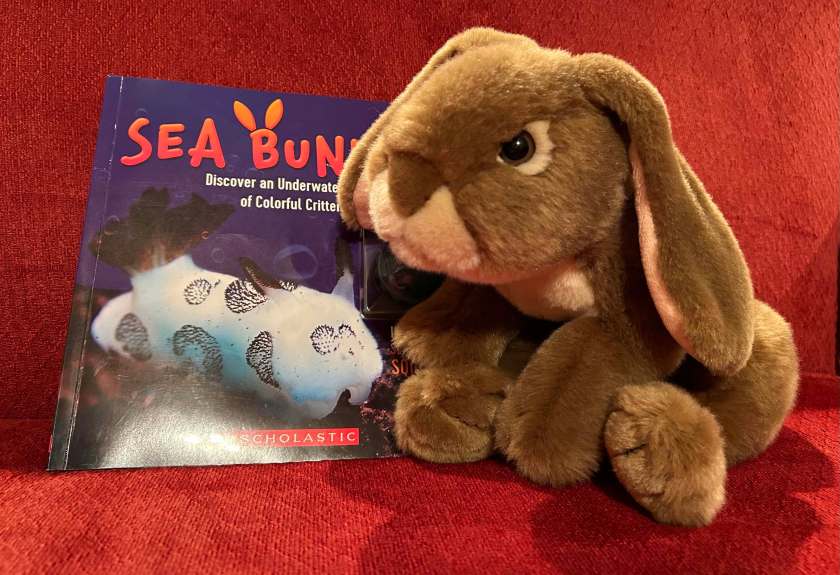
Caramel loves books with facts. He also loves soft squishy toys. So he could not help but get exceptionally excited when he visited the book fair in his school and he saw Sea Bunnies, a 2021 book by Kelly Hargrave. The book was colorful and full of interesting facts, and on top of all that goodness, it came with a new squishy friend! So of course today Caramel is talking about Sea Bunnies. As usual, Sprinkles is taking notes and asking questions.
Caramel reviews Sea Bunnies by Kelly Hargrave.
Sprinkles: So Caramel, you saw this book and had to read it!
Caramel: Yes! Can you imagine me passing by a book about our distant relatives? They are called sea bunnies, so they must be related to us somehow, right?
S: Hmm, i’m not so sure. Guinea pigs are not really related to pigs. So what are these sea bunnies? Are they mammals like regular bunnies are?
C: Well, not really. They are sea slugs.
S: Hmm, so they are not really bunnies after all.
C: No, but they have antennas that look like bunny ears, so people call them sea bunnies. And they are cute! Though maybe not as cute as most bunnies. Still they can be our friends.
S: Especially your new squishy friend, right?
C: Yes! My squishy friend is very cute. He might actually be cuter than the real sea bunnies, but that’s alright I think.
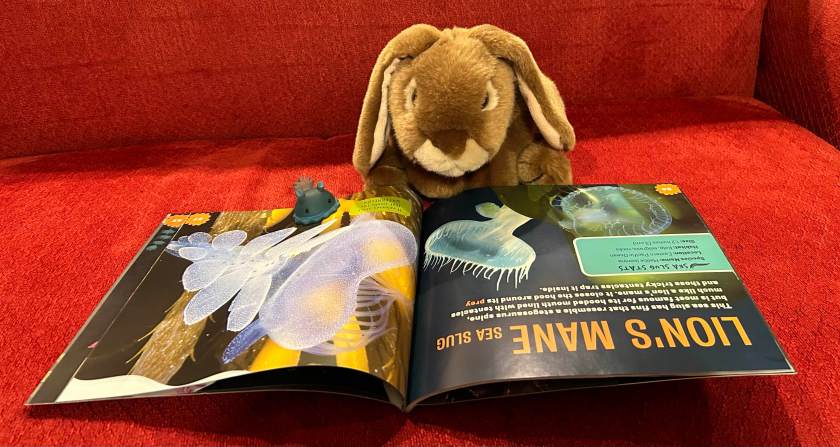
Caramel and his new squishy friend are reading Sea Bunnies by Kelly Hargrave.
S: So let us get back to the book. Tell us a bit about it please.
C: The book has fifty pages. On each two-page spread, you learn about a new type of sea slug or sea bunny. There are about thirty different types they talk about. For example, there is one they call a Ninja Sea Slug. Then there is a sea angel. There is a leaf sheep. And so on.
S: So they all have interesting names!
C: Yes, in the beginning the author says “each sea slug featured in this book has been given an awesome nickname.” And they are awesome nicknames!
S: I agree. They are all pretty imaginative and evocative nanes.
C: Those would be some words I could use to describe the book!
S: I guess so. But I’d also assume you would want to say “colorful” and “fact-full”, right?
C: Yes! The book is very colorful and full of facts!
S: Any facts that were new for you?
C: Of course! I didn’t even know that there was an animal called a sea bunny, to start with. So yes.
S: True, the name was new, but what else did you learn about these creatures?
C: They have tentacles, and some have wing-like extensions. Some glow in the dark. Some are pink and have toxins. They can be all sorts of colors. There are over two thousand different types of sea slugs!
S: Those are all very interesting facts Caramel! I’m glad you read this book.
C: Me, too! And I’m glad I have a new squishy friend!
S: I know. Okay, this is probably a good time to wrap up the review so you can continue to play with him. What would you like to tell our readers?
C: Stay tuned for more book bunny adventures!
Caramel and his new squishy friend strongly recommend reading Sea Bunnies by Kelly Hargrave and learning more about these amazing creatures. And of course who doesn’t want another squishy friend?
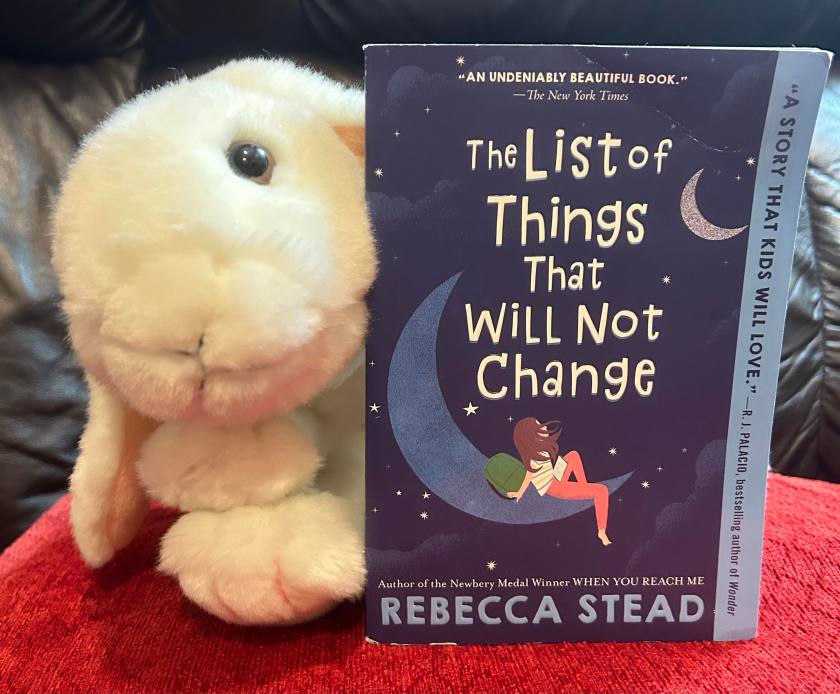
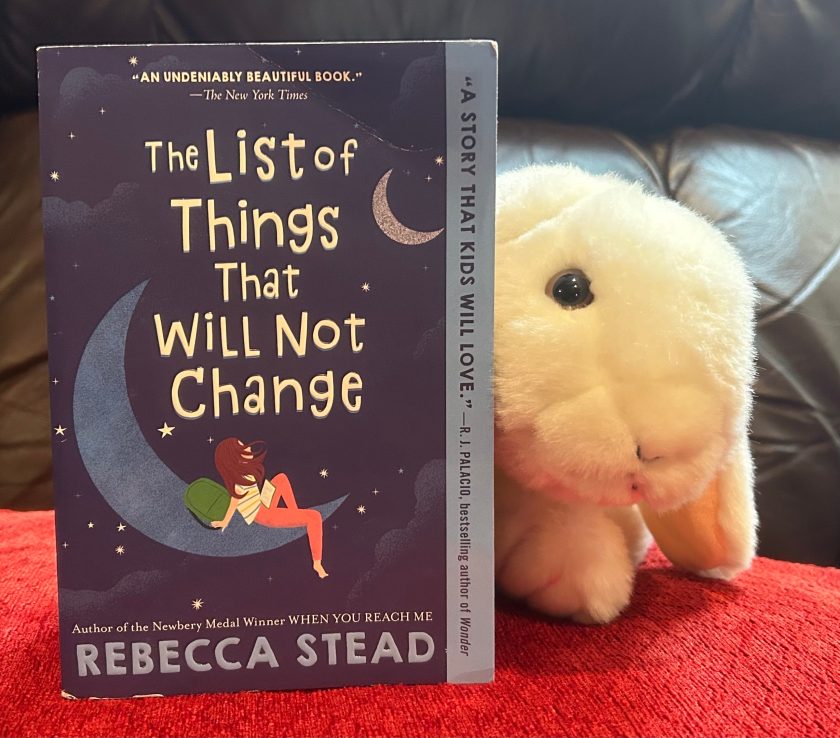
Marshmallow has already reviewed When You Reach Me (2009) and Goodbye Stranger (2015) by Rebecca Stead. Today she reviews Stead’s newest novel, published in 2020: The List of Things That Will Not Change.
Marshmallow reviews The List of Things That Will Not Change by Rebecca Stead.
Marshmallow’s Quick Take: If you like books about family and you want to read about how different characters tackle change, then this might be the book for you.
Marshmallow’s Summary (with Spoilers): When Bea’s parents tell her that they are getting divorced, they give her a green notebook. In it is a list of things that won’t change, even though almost everything else might:
Mom loves you more than anything, always.
Dad loves you more than anything, always.
Mom and Dad love each other but in a different way.
You will always have a home with each of us.
Your homes will never be far apart.
We are still a family but in a different way.
Her parents’ divorce is amicable; the reason for the divorce is that Bea’s father is gay.
After the divorce, Bea’s life splits in two different parts, sometimes living with her mother and sometimes with her father. Later, her father gets engaged with another man, Jesse. Bea really likes Jesse and looks forward to him becoming a part of the family. Not to mention that Jesse has a daughter Bea’s age named Sonia, and Bea has always wanted a sister.
But Bea has other issues to face. She has eczema which is annoying to her, and she goes to therapy to deal with her stress. Everything is now different, but Bea keeps herself up by talking with her friends and family, who are always there to support her. Bea and her family will struggle to reach their happy ending.
Marshmallow is reading The List of Things That Will Not Change by Rebecca Stead.
Marshmallow’s Review: I found this a touching book. Bea is very thoughtful, and this book really highlights and goes into her thoughts and feelings. It was sad to see how some of the folks in the book mistreated Bea’s father and his new partner because of their sexual orientation.
The List of Things That Will Not Change was extremely realistic and felt very down to earth when I was reading it. Every character was unique and well thought-out, and the narrative and tone of the book felt very genuine. That said, I don’t quite think the end was one hundred percent fulfilling, but it was definitely satisfactory. However, I did like how all the loose parts were tied up in the end. I also found it interesting how not everything was perfect in the end but it was realistic. (I’m not going to say much more!)
The List of Things That Will Not Change would be appropriate for all ages, presuming that the person would understand the plot, which I felt was easy enough to understand, though it had some extra nuances for an older reader who would see all the threads from beginning to end.
Bea’s relationship with Sonia might remind some readers of a book I reviewed a while ago: To Night Owl From Dogfish by Holly Goldberg Sloan and Meg Wolitzer. There are indeed some similarities but also a lot of differences. Bea’s health issues reminded me a bit of Guts by Raina Telgemeier, another book I reviewed for the blog. And compared with the other books I have read of Rebecca Stead, the tone and voice of this book was very similar. The setting and tone were more reminiscent of When You Reach Me, but the realism was quite like that of Goodbye Stranger. But The List of Things That Will Not Change has definitely a unique and original story, and I really enjoyed reading it; I think most bunnies would, too.
Marshmallow’s Rating: 95%.
Marshmallow rates The List of Things That Will Not Change by Rebecca Stead 95%.
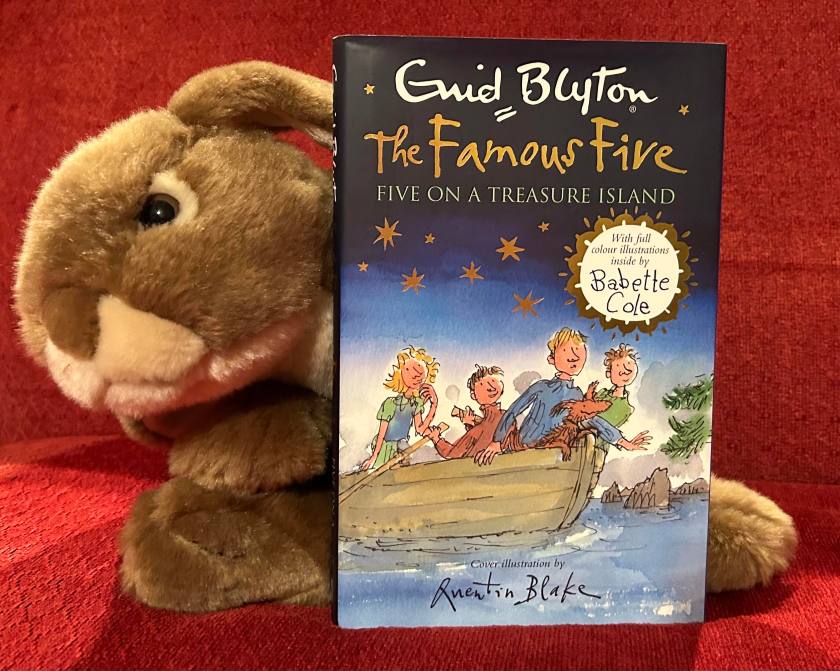
This past month, Sprinkles was excited to introduce Caramel to one of her favorite series from her childhood, the Famous Five, the classic children’s adventure book series written by the prolific British author Enid Blyton about four children and their dog Timothy. Today, Caramel shares his thoughts on Five on a Treasure Island, the first book about these five characters, published first in 1942, exactly eighty years ago. The book bunnies read the beautiful color edition from 2015 with illustrations by Babette Cole and Quentin Blake.
Caramel reviews Five on a Treasure Island, written by Enid Blyton and illustrated by Babette Cole and Quentin Blake.
Sprinkles: So Caramel, I was so happy to read this book together with you!
Caramel: Yes. We read a chapter a night, more or less, and it was sometimes not easy to wait the whole day for the next chapter.
S: I know, right? Some of the events get you nervous and make you want to know what will happen next, and quickly.
C: I thought you had read this book before Sprinkles? Didn’t you remember what would happen?
S: Well, yes, I did read it, but many many years ago, and I knew of course that the kids would come out of their adventures safe and sound, but I did not remember at all how that would come to be.
C: Especially when they got locked up in the dungeon —
S: Wait! Let us not give away too many details. But maybe it would be a good idea to start from the beginning with the plot of the book so our readers can get a good idea abut what it is all about.
C: Okay. So there are three kids, Julian, Dick, and Anne, and they are siblings. They go visit their cousin George. Actually she is named Georgina, but she wants to be called George.
S: I see. This reminds me that a couple years ago, Marshmallow reviewed a book titled George, about a transgender child and her struggle to be accepted as who she is. People called her George but she wanted to be called Melissa. And it is important to call people by the name they would prefer, right?
C: Obviously. It is only the kind thing to do. And if you don’t they will be upset.
S: So yes, let us call the fourth character in our book George. But the book title promises us five characters. Who is the fifth one?
C: Tim, who is a dog. He is George’s dog, pretty much, though her family does not want her to keep Tim, so she has another boy take care of him most of the time.
S: Okay, these five remind me of Scooby Doo and the five characters there. Did you know that some folks think that people who created Scooby Doo were inspired by the Famous Five?
C: I had not thought about that! But that is kind of neat! I like Scooby Doo! So this is really interesting. I can even see some resemblances…
S: Hmm, we can speculate, of course. But let us get back to the book. Alright, so we now know who the famous five are. What is the treasure island about? Tell us more about the story.
C: George does not seem too nice at the beginning, but eventually, they become close. The three siblings learn about the nearby Kirrin Island, George says it is hers, and then the kids think that there may be some treasure hidden somewhere on the island. They figure out that there are supposed to be many “ingots of gold” there, according to a very old map.
S: And so the four kids and Tim the dog go and try to find the treasure, right?
C: Yes. And of course they get into trouble. There is someone who wants to buy the island and get the treasure for himself.
S: Yes, so there is some tension about this guy, who does not seem to be an exceptionally nice person.
C: Yes, he locks them up in the dungeon of the dilapidated castle.
S: Wow Caramel, that is a big word! But you are also giving away some of the major plot twists! So maybe it is time to stop talking about the plot.
C: Okay.
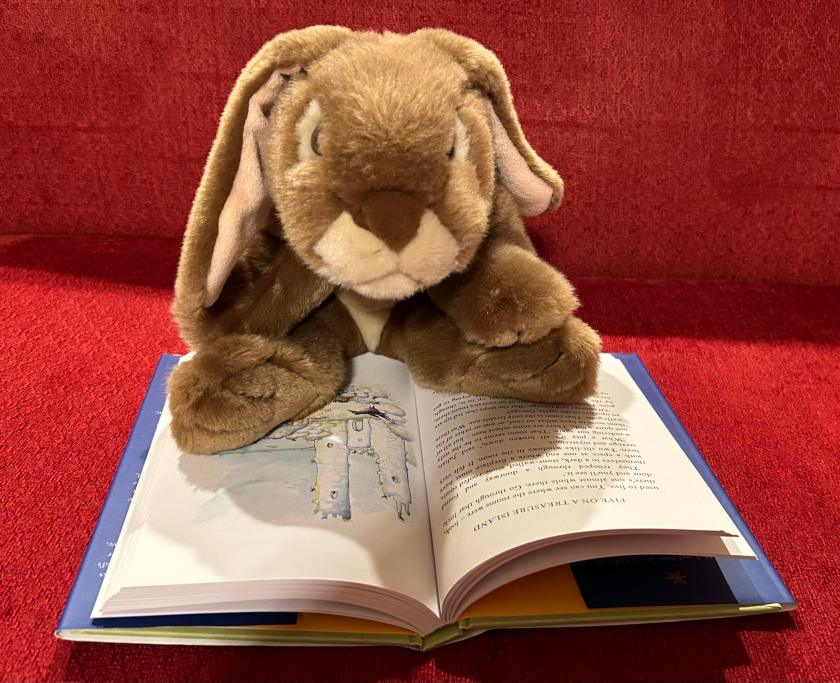
Caramel is reading Five on a Treasure Island, written by Enid Blyton and illustrated by Babette Cole and Quentin Blake.
S: How about talking about the main themes of the book next? Do you remember what is a theme in a book?
C: It is a main idea, or it can be a moral of the story sometimes.
S: Yes, that is right, Caramel. So what ideas or themes do you think would be the main themes of Five on a Treasure Island?
C: I think friendship is one. George is not used to having friends, she is used to being alone, on her own all the time. But then she becomes good friends with the three kids, and she realizes how much better life is with friends.
S: Right! You would agree, right?
C: Yes, of course. Life is much better with friends!
S: Okay, other than friendship, can you think of another theme?
C: Maybe cooperation and team work? Because the children solve the mystery together and then save one another.
S: I think that makes sense! Those are two good themes for this book. Hmm, let me ask you a couple other questions before we wrap things up, Caramel. First of all, I told you this is a pretty old book. It might be the oldest book you have read before now.
S: You are right, that book was older. But this one is pretty old too. And I wanted to ask you if you could tell. Did you think the book aged well? Or did you think it was very dated?
C: Well, I think the boy name Dick is not as common these days. And the kids sometimes use words strangely. For example Dick says “Rather!” and “Blow!” when he is excited and they say George’s mom is a “brick” and they mean she is awesome! So those were some interesting words, and made me think the book is from a different time. Or different place. Because different versions of English seem to have different idioms and slang words.
S: That’s right Caramel, that is a very good observation. Those words were unfamiliar in those uses for me too. But perhaps they used to be more common in 1940s in Britain. They did feel strange to us in the 2020s of course!
C: Right. And Anne was a bit too much of a crybaby, and seemed like what girls were supposed to be like and so George did not want to be a girl like that. She wanted to run and swim and do all the things that were supposed to be boy things. But today boys and girls can do all sorts of things. So that is also a bit different.
S: I agree Caramel. Those are good observations. Would you say that the book was fun to read though?
C: Yes, it was a lot of fun to read. And I think even younger bunnies, much younger than myself, could enjoy it if their grownups read it to them.
S: Again, I agree Caramel. And I am so happy you read this book and enjoyed it. Okay, one last question: What did you think about the illustrations? This was a special color illustration edition. And the illustrators are pretty established in their craft. Did you find them engaging?
C: Yes. They were very colorful. And there is one picture where they had a lot of bunnies watching the kids. That is my favorite. It is drawn almost from the bunnies’ point of view.
S: So it is perfect for us book bunnies.
C: Yep. That is why I posed for my photo above with that page open.
S: I love that Caramel! Okay, time to wrap this up then. What will you tell our readers now?
C: Stay tuned for more book bunny adventures!
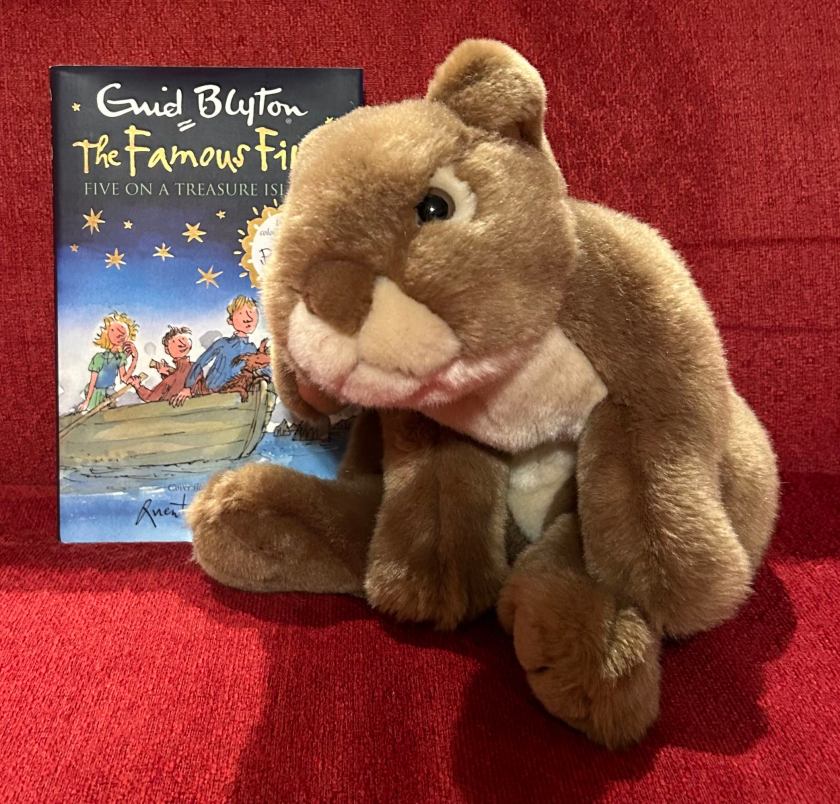
Caramel enjoyed reading Five on a Treasure Island, written by Enid Blyton and illustrated by Babette Cole and Quentin Blake, and is curious to learn more about the five friends and their other adventures.
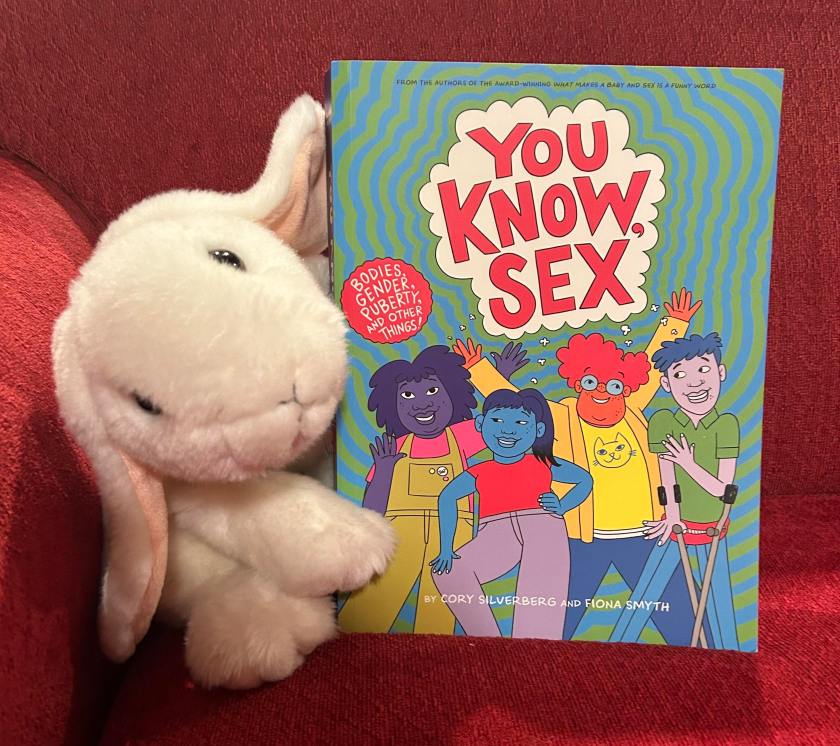
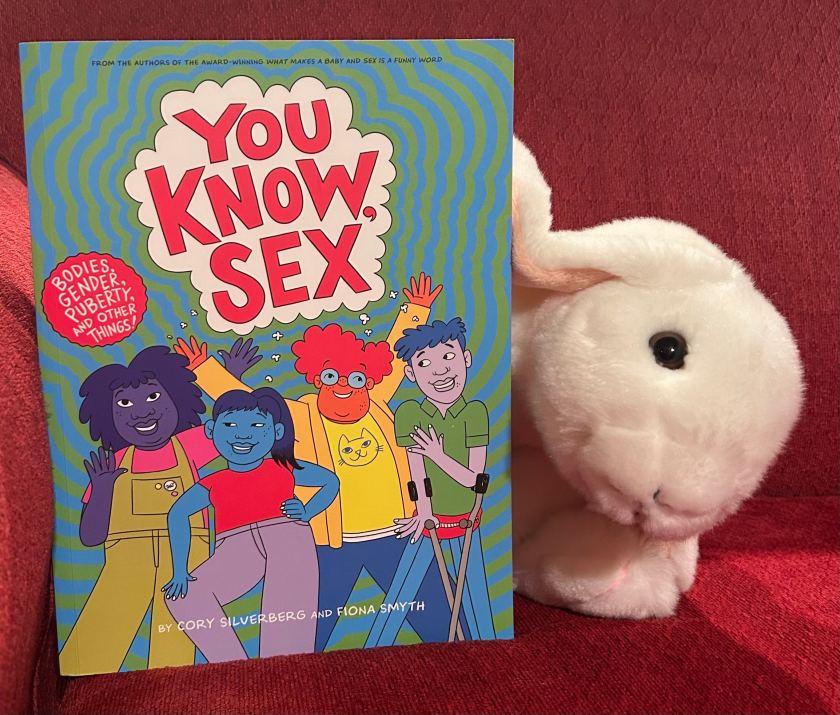
Marshmallow is reading about growing up and this week she wanted to talk about a recent book she read about puberty, growing up, and sex written for young people who are around her age: You Know, Sex: Bodies, Gender, Puberty, and Other Things by Cory Silverberg and Fiona Smyth. Sprinkles is taking notes and asking questions.
Marshmallow reviews You Know, Sex: Bodies, Gender, Puberty, and Other Things by Cory Silverberg and Fiona Smyth.
Sprinkles: First of all, as we begin this review, I want to thank you for reading this book, Marshmallow. After reviewing a collection of books about where babies come from, I had intended to write a post about a handful of books about puberty next. And one of the books I chose was this one, a huge, 432-page tome written in graphic novel form. But when I began to read it, I realized that my personal discomfort with the form (due to my poor eyesight) would mean I would probably not be able to give it its full due. So thank you for helping me out and checking the book out on your own.
Marshmallow: Well, that’s alright, Sprinkles. It was an interesting read.
S: That’s good to know. Can you tell us a bit about the specifics of the book?
M: Sure. You already said it is big, and has 432 pages. And you said it is written as a graphic novel.
S: The two who wrote this book also were the writer and the illustrator of What Makes A Baby?, one of the books I read for that review of books about where babies come from. And the pictures have the exact same style.
M: Yes, there are people with many different skin colors, like orange and purple and green and blue, and many different shapes and sizes.
S: Does that work well?
M: Yes, it is interesting. I think the people all look quite unique.
S: Well, I guess that makes the book more realistic, right? We are all quite different from one another.
M: Yes.
S: So tell us more about the book.
M: There are eleven chapters. They are titled: What is Sex? Bodies, Gender, Puberty, Feelings, Consent, Talking, Relationships, Reproduction, Touching, and Safety.
S: So the book covers a lot of ground.
M: Yup. It is also very contemporary.
S: What do you mean by that?
M: It has some ideas which I think are contemporary. They talk about gender identity and sexual orientation, transgender and non-binary people, and people having relationships with multiple partners.
S: The last one does not sound too contemporary to me. Polygamy and polyamory have been around for a long time. They have not always been accepted or legal though. I guess the authors are trying to teach the reader to be open minded about different arrangements.
M: I am not sure all readers would be too open to all of these ideas at this point.
S: I agree with that. Actually I too find some of these ideas challenging, especially polygamy. Though rabbits are typically not monogamous, according to Wikipedia, “scientific studies classify the human mating system as primarily monogamous, with the cultural practice of polygamy in the minority”. In any case, it is good to learn about how different people can relate with others.
M: Well, the book does not talk so much about polygamy as polyamory. But yes, it is good to learn about these different things.
Marshmallow is reading You Know, Sex: Bodies, Gender, Puberty, and Other Things by Cory Silverberg and Fiona Smyth.
S: They also talk about the changes a young bunny goes through in puberty, and more generally about biology and mechanics of sexual reproduction, right?
M: Well, yes. There are also very vivid depictions of things. They make an effort to show all kinds of things, so that the reader does not end up assuming that a body part has to look in one specific way. And they show people doing all kinds of different things together or alone.
S: I did look through the pages a lot, too, and I’d say there really are a lot of illustrations that some parents may not be comfortable with.
M: The self-discovery and self-exploration parts might also be kind of touchy topics for some folks, I’d imagine.
S: I did see a section on pornography, and that too is a very challenging topic. Perhaps grownup bunnies should read this book together with their young ones when they feel like the conversations about the various themes and issues that come up will be constructive.
M: I’d agree with that.
S: What were some of the other topics in the book? What topics did you find were most important?
M: They talk a lot about relationships, and I thought it was useful to learn about that. They talk about consent and power in relationships, and sometimes how people talk about being with people as a competition.
S: Yes, I did see that page about how sometimes people talk about “scoring” and the book instead encourages young people to think about “trust, respect, justice, joy, and choice”.
M: Yes, I did find those parts useful. All in all, it is an interesting and useful book, but I think grownups should probably check it out before sharing with their little ones.
S: Agreed. So what would you tell our readers as we wrap up this review?
M: Stay tuned for more amazing book bunny reviews!
Marshmallow appreciated reading You Know, Sex: Bodies, Gender, Puberty, and Other Things by Cory Silverberg and Fiona Smyth, and she thinks all growing bunnies should read a book along these lines; she also suggests grownups check it out before sharing with their little ones.



 BookBunnies