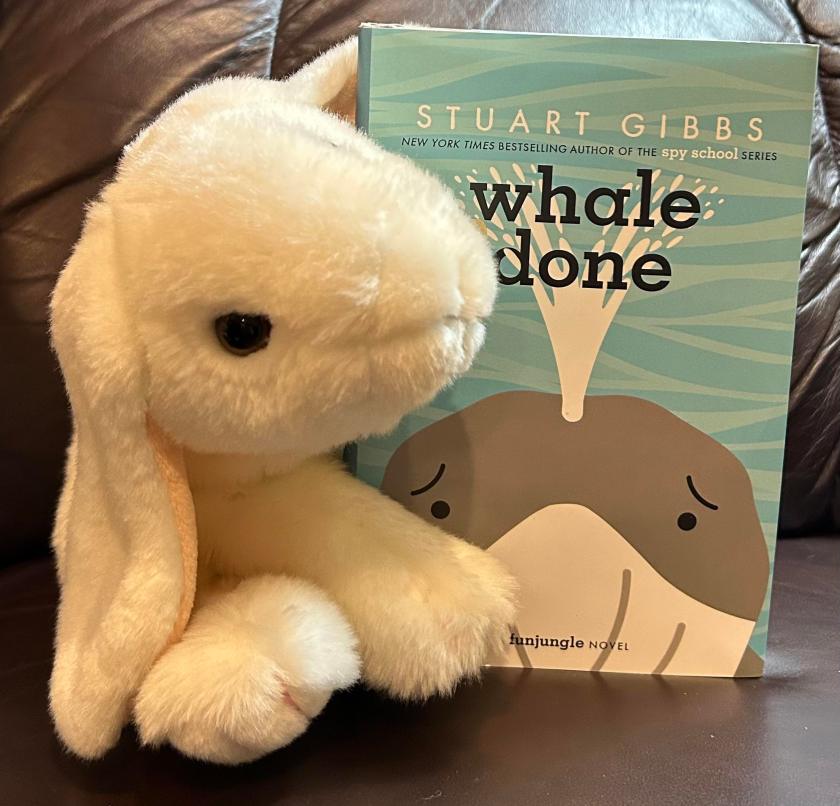
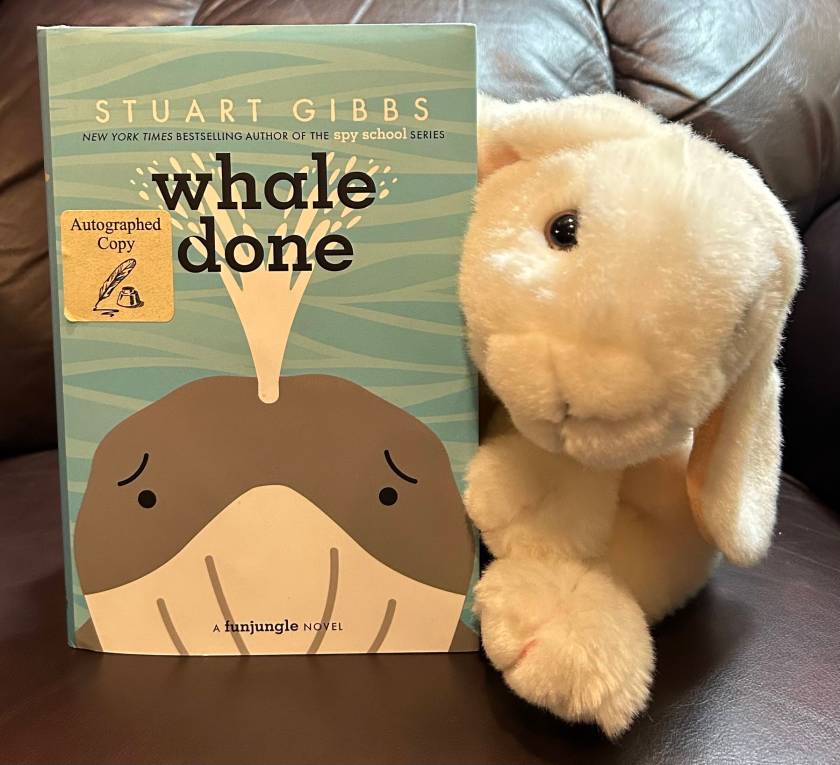
This past week, author Stuart Gibbs visited Caramel’s school, and the book bunnies were able to receive two autographed books. One of these was Whale Done, the eighth book in the FunJungle series, published earlier this year. Marshmallow is a big fan of the FunJungle books, and she has already read and reviewed all of the previous seven for the book bunnies blog. So it was natural that she would be the one to jump on this book when it first arrived at the book bunnies’ home and dive right in. Below she shares some of her thoughts about the book.
Marshmallow’s Quick Take: If you like books about animals and mysteries, or if you have enjoyed other books by Stuart Gibbs, then this might be the book for you. Of course, it would be best if you have also read some of the other FunJungle books before reading this one.
Marshmallow’s Summary (with Spoilers): Teddy Fitzroy, who is now fourteen years old, lives with his parents at FunJungle (a huge zoo, similar to a hybrid of Disneyland and the San Diego Zoo) until a kangaroo burns down their home. This leads to Teddy eventually accepting an invitation to go to Malibu Beach in California with his girlfriend, her mother, and Doc, FunJungle’s vet. (Meanwhile, his mom is staying in her office and his father is traveling for work).
Teddy’s girlfriend, Summer McCracken, is the daughter of J.J. McCracken, the billionaire who owns FunJungle, and Kandace McCracken, a famous model. While in Malibu, they learn about a beached whale in front of a neighborhood of mansions owned by rich aristocrats, celebrities, and athletes. Teddy, Summer, and Doc are staying in this area in a house with a friend of Kandace, who also happens to be a model.
While on the beach, they meet Cass, who works for the NOAA (National Oceanic and Atmospheric Administration). Cass is preparing to perform an autopsy on the beached whale to find the cause of its death, when all of a sudden, the whale is blown up with dynamite. Two delinquents (who have extremely rich parents) are found to be guilty. But Teddy, Summer, and Doc think there is more to the story. Sand appears to be stolen from the beaches, but officials don’t believe the concerned surfers who report this, leaving Teddy and Summer to play detectives once more and try to unravel the complicated mystery about the whale’s death as well as the missing sand.
On top of all this, Teddy and Summer’s relationship becomes strained as events unfold.
Marshmallow is looking happily at the autographed title page of Whale Done by Stuart Gibbs.
Marshmallow’s Review: I have really liked all of the other FunJungle books and find Whale Done to be a meaningful and thoughtful addition to the series. I liked how the author brings up serious issues like plastic pollution and manages to keep the mystery, suspense, and humor (his trademarks in the other books of this series) sharp and on point. The characters go through some interesting changes and moments, but I can’t go into too much detail without spoiling all of it.
This book is appropriate for all ages, but I would recommend reading the previous books in the FunJungle series before reading this one because otherwise the characters and some of the references to past events will not be as meaningful. But in summary, I really enjoyed Whale Done, I would recommend it to anyone and everyone, and I hope Stuart Gibbs will write another FunJungle book some day!
Marshmallow’s Rating: 100%.
Marshmallow rates Whale Done by Stuart Gibbs 100%.
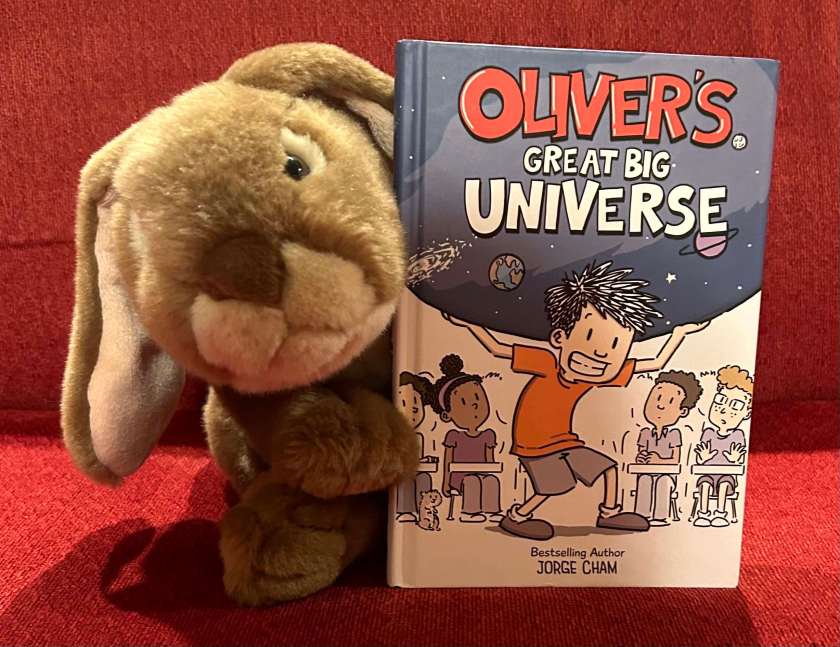
Caramel loves science and all sorts of factful books and documentaries. Today he is talking to Sprinkles about Oliver’s Great Big Universe by Jorge Cham, just published a couple weeks ago.
Caramel reviews Oliver’s Great Big Universe by Jorge Cham.
Sprinkles: So Caramel, tell us a bit about this book.
Caramel: This book is about a kid named Oliver. He is eleven and is starting middle school. He really likes science.
S: Kind of like you then, right?
C: Yes.
S: So is he anxious about starting a new school?
C: Yes he is. But he really really likes science, and he keeps talking about things he is learning. He talks about the universe, for example.
S: Tell me a fact he talks about that you did not know before.
C: He says the sun is squish-ploding.
S: What does that mean?
C: Essentially it means that the sun is squished by its huge gravity and then it explodes.
S: It keeps doing this?
C: Yes.
S: I wonder what the technical term for it is. Squish-ploding does not sound terribly technical. Anyways, what else did you learn?
C: If you lived in Mercury, you would be able to celebrate your birthday every three months!
S: I see. It is because the planet Mercury rotates around the sun much faster than our planet Earth?
C: Yep. Much faster.
Caramel is reading Oliver’s Great Big Universe by Jorge Cham.
S: Okay, so I am guessing you like this book because it is full of facts.
C: Yes.
S: But it is not just a book of facts, is it? It is also about Oliver and how he is adjusting to his new school.
C: Yes.
S: Do you like Oliver?
C: Yes, he is cool. He knows a lot of scientific facts. In fact he wants to become an astrophysicist.
S: That is cool. So besides the science facts, is Oliver’s own story interesting, too?
C: Yes. He makes a friend eventually.
S: So I am guessing that this means the book has a happy ending.
C: Yep. Another reason why I liked the book!
S: I see. So if you were to describe the book in three words or so, how would you do that?
C: Factful, hilarious, science fun.
S: I think those work! So do you think any bunny could read this book and enjoy it?
C: I think so. There are many many funny pictures on each page, and I think the science is fun, but getting to know Oliver is really funny, too.
S: Yes, the author is the creator of a very successful web comic called Piled Higher and Deeper (also called PhD Comics). He was working on his doctoral degree at Stanford University when he began to publish these comic strips about graduate student life. Some of them are more like inside jokes than others, but a lot of them are really really hilarious.
C: I didn’t know that! But I can see he knows how to draw very funny things.
S: So I was curious about this book and now I know it is good. Thank you for sharing your thoughts about it. I will definitely want to read it myself too.
C: You should Sprinkles. I think you will really like it too.
S: I bet. So let us wrap up this review so I can grab the book from your paws and get started. What do you want to tell our readers?
C: Stay tuned for more book bunny reviews!
Caramel enjoyed reading Oliver’s Great Big Universe by Jorge Cham and recommends it to all young bunnies who are curious about the world (and the universe!) around them.
Sprinkles has recently seen the one-woman play Diving Into Math with Emmy Noether, performed expertly by Anita Zieher. When she saw the play, she was in the middle of writing a joint review of two recent biographies on Emmy Noether for the newsletter of the Association for Women in Mathematics: Proving it Her Way: Emmy Noether, A Life in Mathematics, by David E. Rowe and Mechthild Koreuber, and Emmy Noether – Mathematician Extraordinaire by David E. Rowe, published in 2020 and 2021, respectively. The play impacted her deeply, and so she began to wonder if there were any good books about Emmy Noether written for children. This post is the outcome of her resulting explorations.
Today I am writing to share with you some of my thoughts on reading two children’s books about Emmy Noether (1882-1935), who just happens to be one of the greatest mathematicians of the twentieth century. After having reviewed a whole bunch of children’s books about Ada Lovelace, I expected that Noether’s life must also have been depicted in several children’s books, given the importance of her work to modern mathematics and physics.
Emmy Noether’s life is also intrinsically interesting: though filled with sorrows and frustrations, and all sorts of challenges due to her gender (being a woman) and ethnicity (being a German Jew during the rise of Nazism before World War II), Noether’s life was also jam-packed with good friendships, great creative accomplishments, and according to the one-woman play Diving into Math with Emmy Noether performed by Anita Zieher, plenty of delicious pudding. [In case you are interested, here is a trailer for the play:
Trailer for Diving into Math with Emmy Noether, via YouTube.]
Especially after seeing Diving Into Math, I was convinced that Noether’s story would be appealing not only to an adult general audience of curious readers but also to a great many young readers. So I began to look around for books intended for a young audience.
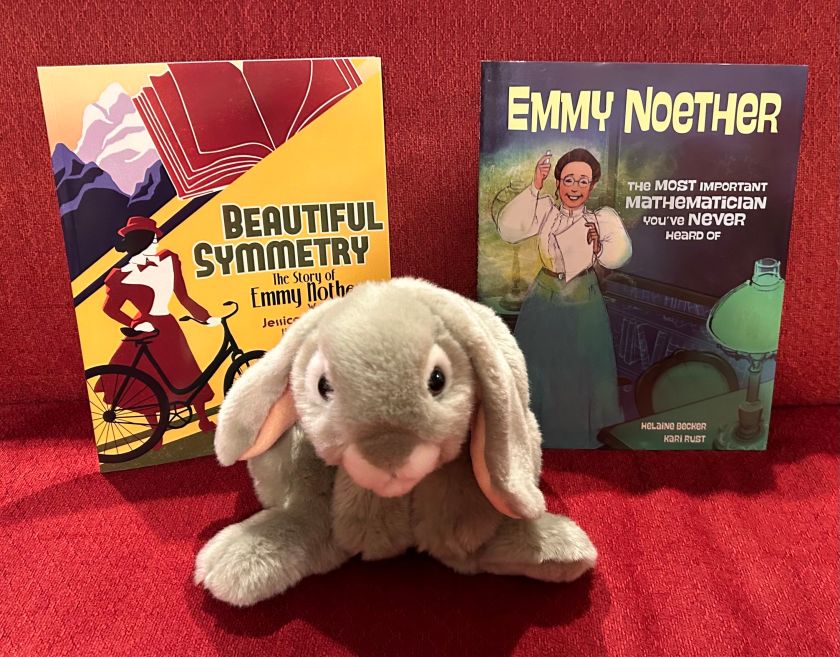
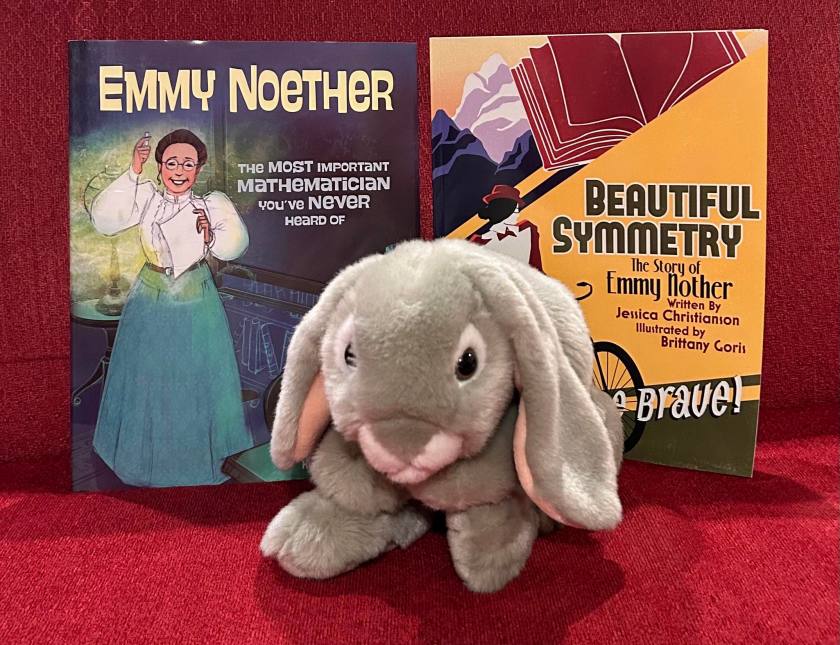
Surprisingly I could find only two books: Beautiful Symmetry: The Story of Emmy Noether, written by Jessica Christianson and illustrated by Brittany Goris, and Emmy Noether: The Most Important Mathematician You’ve Never Heard Of, written by Helaine Becker and illustrated by Kari Rust. Both books are interesting and could be appealing to young readers, though I believe they have somewhat different strengths.
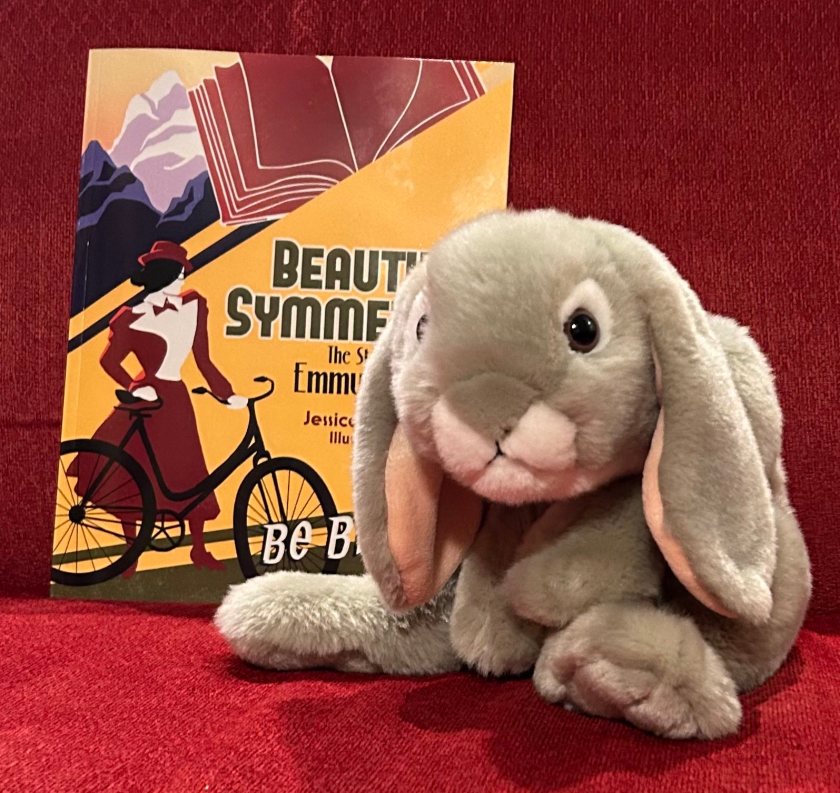
Sprinkles is posing with Beautiful Symmetry: The Story of Emmy Noether, written by Jessica Christianson and illustrated by Brittany Goris.
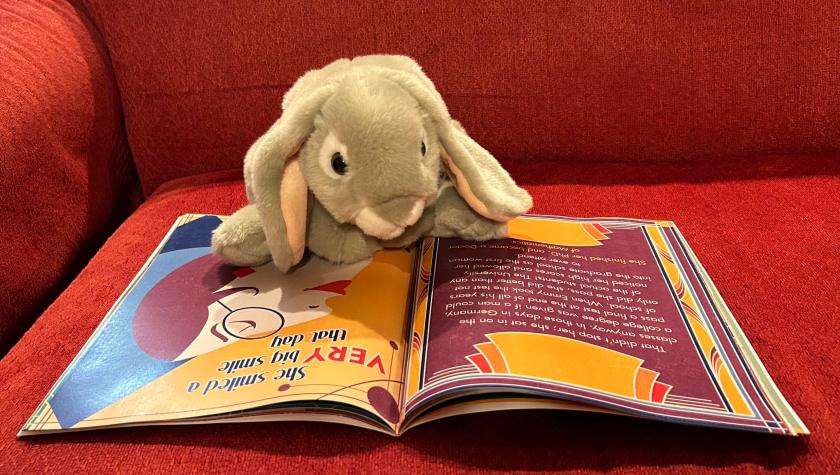
The first of the pair, Beautiful Symmetry: The Story of Emmy Noether, written by Jessica Christianson and illustrated by Brittany Goris, was published in 2017. In softcover paperback, the book is large format. The bold, striking page design which alternately reminded me of political posters and The Powerpuff Girls, and the large font used throughout might make the book more appealing to younger bunnies. The story of Emmy Noether’s life is told in the book in broad strokes, and that might also help with the younger crowd.
Beautiful Symmetry is visually very appealing and symmetry abounds throughout the book, adding to the theme and encouraging the reader to associate Noether’s life and accomplishments with the visual experience of symmetry. The end of the book has a short section on Emmy Noether’s mathematical work as well as a few simple math puzzles for the young readers who might want to explore math on their own a bit now that they have presumably gotten all inspired by the story they just read. I liked and appreciated each of these features.
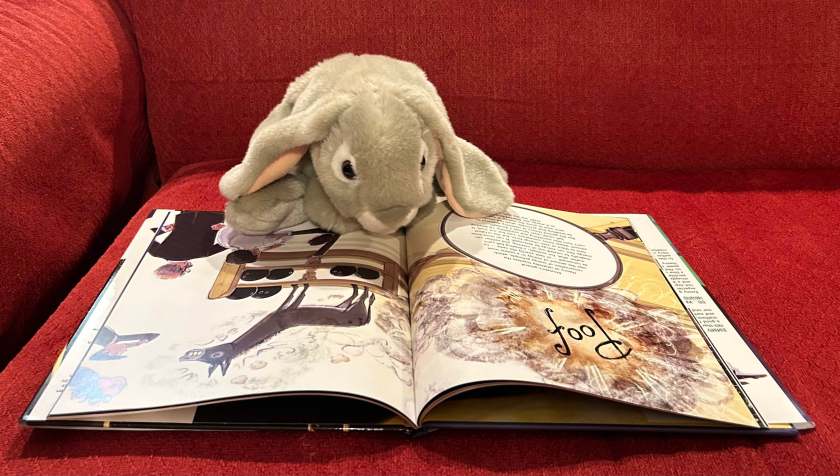
Sprinkles is reading Beautiful Symmetry: The Story of Emmy Noether, written by Jessica Christianson and illustrated by Brittany Goris.
Unfortunately, one occasionally finds a few factual errors here and there. For example, it was not a simple university official but the great mathematician David Hilbert who defended Emmy Noether in Göttingen, and he did not mention a locker room; rather he said “After all, we are a university, not a bathhouse.” (Well, he said it in German, so his exact words were “Meine Herren, der Senat ist doch keine Badeanstalt.”) Here is another example: Emmy Noether eventually did find a position at Bryn Mawr College, but despite what we read in Beautiful Symmetry, she never became the math department head there. (For more on Noether’s time at Bryn Mawr, see, for example, “A Refugee Scholar from Nazi Germany: Emmy Noether and Bryn Mawr College” by Qinna Shen.) These and a couple other small errors (including an embarrassing typo on the front cover) make me a bit wary to encourage readers to use this book as a reference for a book report.
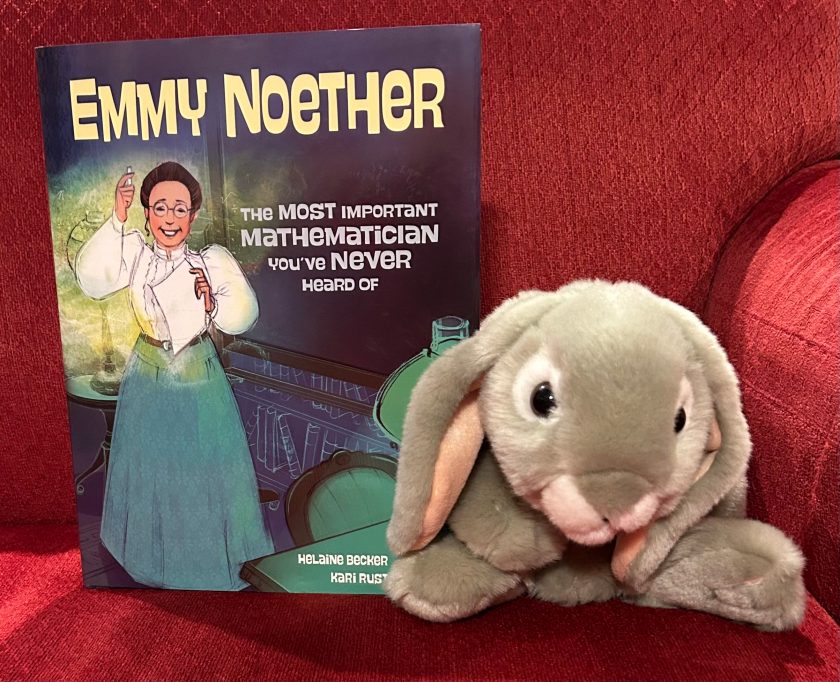
For a book report, a much better reference would be Emmy Noether: The Most Important Mathematician You’ve Never Heard Of, written by Helaine Becker and illustrated by Kari Rust, and published in 2020. This book is well researched and according to the acknowledgments, had some fact-checking assistance from the Perimeter Institute. So in terms of facts, including the math and physics connections of Noether’s work, this book is a lot more reliable.
Sprinkles is posing with Emmy Noether: The Most Important Mathematician You’ve Never Heard Of, written by Helaine Becker and illustrated by Kari Rust.
Emmy Noether: The Most Important Mathematician You’ve Never Heard Of was published in 2020, and the title is reminiscent of a 2012 New York Times article on Noether, “The Mighty Mathematician You’ve Never Heard Of” by Natalie Angier. But that essay, though very well written, made an unfounded claim that Noether published articles using men’s names. (Beautiful Symmetry also makes this unfounded claim, so perhaps Angier’s article led to some misunderstandings that were propagated. See this discussion for more details on the claim.) Becker’s book does not fall into such oversimplifications. And the story of Emmy Noether does not need such tropes. It is fascinating on its own with no need for embellishments.
Rust’s illustrations are cute and sharp at the same time, and the cartoonish detractors of Noether are shown humorously while the severity of Noether’s challenges is not minimized. The math and physics connections of her work are explained with precise terms in what is still a totally comprehensible language, and the illustrations support these descriptions. The book manages to distill into simple language some relatively abstract and advanced mathematical ideas, and somehow still retains a entertaining quality. The reader cannot help but root for Emmy, and laugh triumphantly each time she embarrasses her detractors.
Sprinkles is reading Emmy Noether: The Most Important Mathematician You’ve Never Heard Of, written by Helaine Becker and illustrated by Kari Rust.
All in all, I enjoyed reading Emmy Noether: The Most Important Mathematician You’ve Never Heard Of, and would definitely recommend it to any young person interested in learning about what a mathematician does. Similarly the book would work well to introduce young bunnies to a most creative and impactful woman scientist, whose name is unfortunately not as well known as some others. There is a significant amount of math in the book, too, for those who want it, though the reader who does not want to dive too deep into those pools can easily avoid the more technical bits (left to a separate section at the very end) and enjoy and appreciate the rest of Emmy Noether’s story completely.
To be honest, I did enjoy reading both books, and despite the factual errors of Beautiful Symmetry, I would recommend either book to young readers. If one is looking for complete factual accuracy of course, I’d suggest sticking with The Most Important Mathematician You’ve Never Heard Of, or perhaps even jumping over to the other side and looking into some of the more standard biographies, written for adult consumption. Proving It Her Way by David E. Rowe was published in 2020 to accompany the play Diving into Math with Emmy Noether I started this review with. Rowe is a historian of mathematics, but this book was intended for a general audience. As such, I think it could be a great next step for anyone interested in learning more about this creative mind who found so much joy in mathematics, abstract ideas, and good intellectual companions.
Sprinkles encourages all young bunnies to learn more about Emmy Noether by exploring one of the two children’s books about Emmy Noether she reviewed here: Beautiful Symmetry: The Story of Emmy Noether, written by Jessica Christianson and illustrated by Brittany Goris, and Emmy Noether: The Most Important Mathematician You’ve Never Heard Of, written by Helaine Becker and illustrated by Kari Rust.
Last year Caramel reviewed The Wild Robot and The Wild Robot Escapes by Peter Brown, and ended his review of the second book wishing that “maybe there will be more stories about Roz or other friendly robots”. His hopes have come true, and today Caramel talks about The Wild Robot Protects, the third book about the Wild Robot, Roz, and her friends, published just this past week. As usual, Sprinkles is asking questions and taking notes.
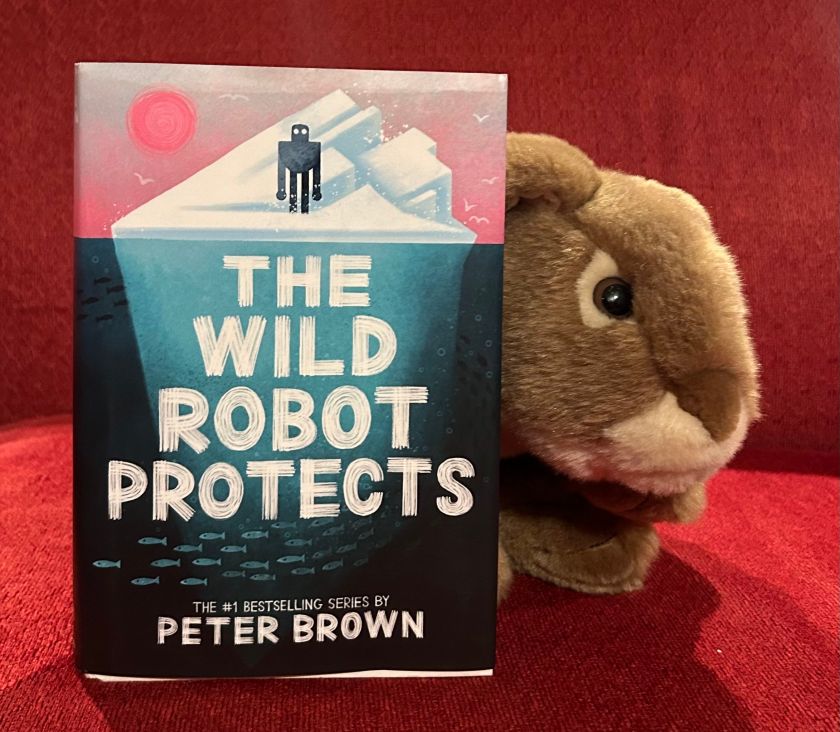
Caramel reviews The Wild Robot Protects by Peter Brown.
Sprinkles: So you were surprised when you got this book in the mail, right, Caramel?
Caramel: Yes. Very happily surprised. I did not know there would be a third book about Roz, but I definitely very much wanted there to be.
S: So it was a good surprise. I like those! So let us talk about it then. Can you tell us a bit about what this book is about?
C: This book is about Roz, the Wild Robot.
S: Why is she called that? Can you remind our readers?
C: Because she speaks with animals and is friends with them.
S: Does she communicate with humans too?
C: She can, but she tends to hang out with animals more than humans. Because the humans called her defective and wanted to destroy her.
S: So she ran away?
C: No. In the beginning, in The Wild Robot, she had been on a boat that crashed and the box she was in floated to an island. Otters activated her by mistake, and then she began to communicate and make friends with the animals on the island.
S: I see. I think I remember now. So what happens in this book?
C: A seal comes to land and warns them about a “poison tide”.
S: So a tide is coming that will be carrying poison?
C: That is what everyone ends up believing so all birds leave the island except the flock of geese, an owl, and a vulture.
S: Hmm, it sounds like we are going into a lot of detail here. So let us move up a bit in perspective. So the book is about the Wild Robot trying to protect her animal friends from this tide?
C: Yep.
Caramel is reading The Wild Robot Protects by Peter Brown.
S: I think you really liked the first two books about Roz and her friends, and it was not only because you love robots and animals but also because the books were happy, right?
C: Yup, and they made me happy.
S: So how about this one? Would you say that The Wild Robot Protects is a happy book? Did it also make you happy?
C: It made me happy, yes, but it is not a totally happy book actually. It makes a good point about climate change.
S: Hmm, So I am guessing the poison tide is related to climate change.
C: Not quite, but at some point, Roz says “Can you believe that I have to convince humans why their own environment is important?”
S: I see. So the book is not directly about climate change, but it makes the case that environment is important to our well-being.
C: Yes. I think I said that too.
S: Yes, I just rephrased what you said. So all in all, you loved the chance to read more about Roz and her friends, right?
C: Yes. And while we were looking up the publication date of the book, we saw that there might be an animated movie about Roz some day. I was very very excited! I said, this I gotta see!
S: Yes, I would like to see it too. So let us wrap things up. Can you describe the book in about three words?
C: Amazing robot friend.
S: I like that! Okay, thank you Caramel for sharing your thoughts on this book. What would you like to tell our readers as we end this review?
C: Stay tuned for more book bunny reviews!
Caramel loved reading The Wild Robot Protects by Peter Brown and hopes once more that there will be more adventures for Roz and her friends to come.





 BookBunnies