Marshmallow reviews Sapiens – A Graphic History: The Birth of Humankind by Yuval Noah Harari, David Vandermeulen, and Daniel Casanave

Today Marshmallow reviews Sapiens – A Graphic History: The Birth of Humankind, the first volume, published in 2020, of the multi-volume graphic novelization of Yuval Noah Harari’s 2011 book Sapiens – A Brief History of Humankind. Sprinkles is taking notes and asking questions.
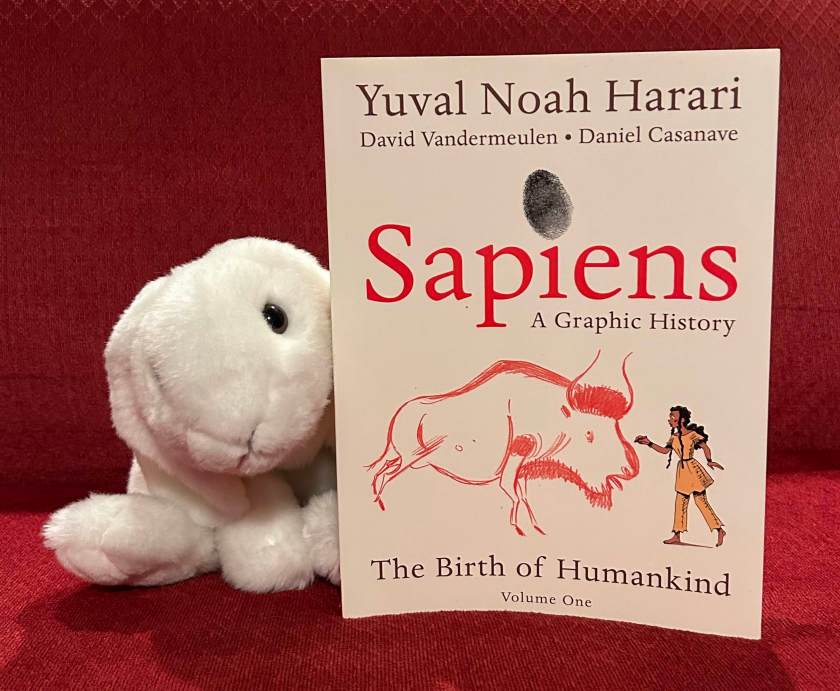
Marshmallow reviews Sapiens - A Graphic History: The Birth of Humankind by Yuval Noah Harari, David Vandermeulen, and Daniel Casanave.
Marshmallow reviews Sapiens – A Graphic History: The Birth of Humankind by Yuval Noah Harari, David Vandermeulen, and Daniel Casanave.

Sprinkles: I know you enjoy graphic novels, just like Caramel does, so I was not too surprised when you decided to pick up this book.

Marshmallow: Yep, and I actually enjoyed reading it too. And I think that, if you like books that ask deep questions or investigate human history, then this is the book for you! 

S: Hmm, I see what you did there. You begin all your reviews with this kind of an invitation. I think it works well here too! So what is this book about?

M: It is basically about the entire history of humanity’s origins.

S: That sounds ambitious!

M: It is. So I think this will take him four or five volumes, but he is trying to tell in graphic novel form what he writes in his original book from 2011. It’s pretty novel I’d say.

S: I see. Tell me more.

M: So in this book, human evolution is portrayed as a reality TV show. And mass extinction becomes a crime investigation. We follow the author Yuval and his niece Zoe as they investigate the meaning of labels like “species” and “genus” with Professor Saraswati. Each character is drawn as a little caricature. Then we see Yuval and Zoe watching “The Greatest Show on Earth!”, or “Evolution!” This leads to an investigation of why and how the species of Homo Sapiens dominates the Earth today. After all, there were several other species in the human genus. 

S: I can see that you are using some big words, maybe from your biology class?

M: Well, not quite. The book uses them, so I think it makes sense for me to use them too.

S: Makes sense to me.
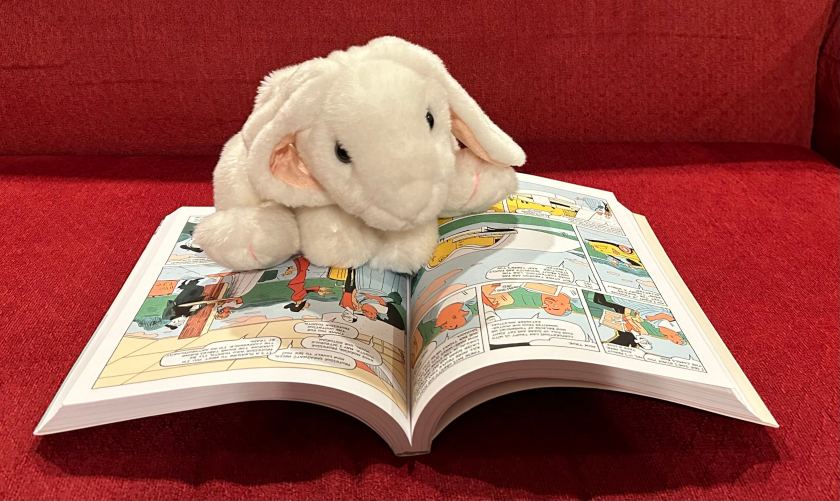
Marshmallow is reading Sapiens - A Graphic History: The Birth of Humankind by Yuval Noah Harari, David Vandermeulen, and Daniel Casanave.
Marshmallow is reading Sapiens – A Graphic History: The Birth of Humankind by Yuval Noah Harari, David Vandermeulen, and Daniel Casanave.

S: So I know that after reading this book, you also followed up with some reviews of it to see how it was received.

M: Yes. Because the author intends to share some possibly controversial ideas about the history of humanity, there was a lot I did not know about in the book, so it was really interesting to read. But I wanted to know if what he was saying was really correct. This is a graphic novel after all, and though some graphic novels have extensive footnotes and such, this one has none, and it has no references. So I wanted to check to see what others who know more about the topic thought.

S: So what did you find out?

M: Well, our readers can start by checking the Wikipedia article on the original book. The original book sold really well and got a lot of great reviews from well-known and highly regarded people. But it seems like some of the more scientific takes on the book are not as complimentary. A lot of them do like it actually, but there are some folks that say that there is not that much that is new in the book and whatever is new and original is not accurate.

S: I see. Now it is not terrible if there is nothing new for scientists, because no matter what they all know, their knowledge is not always accessible to the general audience.

M: Exactly. The graphic novel format is a really good way to reach a lot more people. So some apparently called it “infotainment,” but maybe that is actually not a terrible thing. I think the Lucy & Andy Neanderthal series that I read and reviewed is also kind of infotainment but I still found it extremely educational.

S: I agree with you there. Those books are a lot of fun and teach you a lot too.

M: Even our reviews are probably infotainment – fun yet informative, I hope. The accuracy concern is more difficult to dismiss though. Not being a scientist, I am not great at gauging that. So my advice for curious bunnies is to read this because it is a great story, and you will learn a lot, but still take it with a grain of salt, because if some parts of it feel really out there, maybe they are. So it might be worth double-checking things out on your own.

S: I think that is a very prudent and thoughtful recommendation, Marshmallow.

M: I’m a very prudent and thoughtful bunny. And now we are both using big words!

S: Yep, it must be this book!

M: We must be smarter or something! Maybe we are evolving.

S: Okay, okay, hold it there. Maybe this is a good place to end this review. So if you were to rate this book what would your rating be?

M: I really really enjoyed it, and I’d say 100% but then again the accuracy question makes me say 95%.

S: That’s fair. Okay, thanks for your neat review, Marshmallow. What would you like to tell our readers as we wrap it up?

M: Stay tuned for more amazing reviews from the book bunnies!
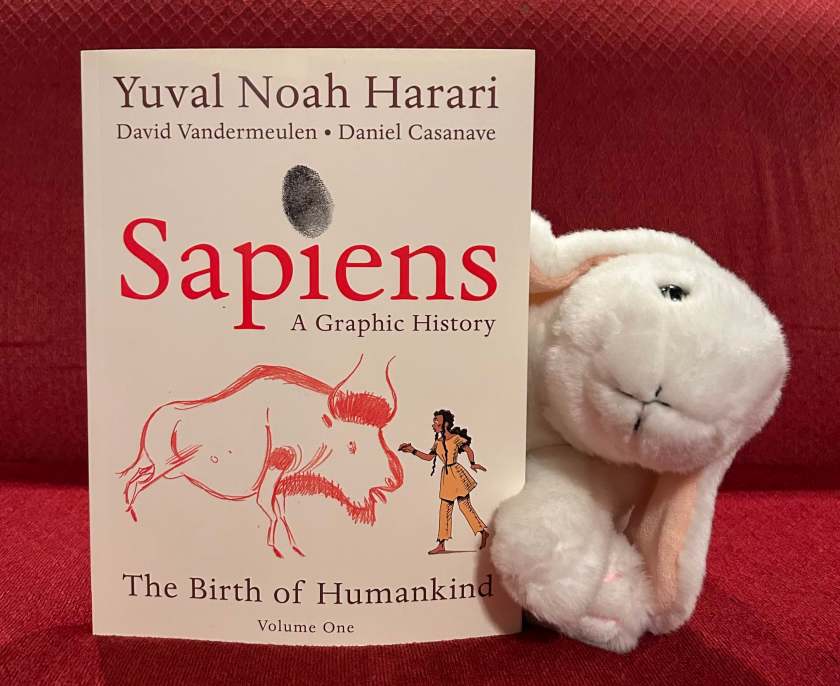
Marshmallow rates Sapiens - A Graphic History: The Birth of Humankind, by Yuval Noah Harari, David Vandermeulen, and Daniel Casanave, 95%.
Marshmallow rates Sapiens – A Graphic History: The Birth of Humankind, by Yuval Noah Harari, David Vandermeulen, and Daniel Casanave, 95%.

Caramel reviews Closet of Dreams by Mark Ukra and Tara Mesalik MacMahon

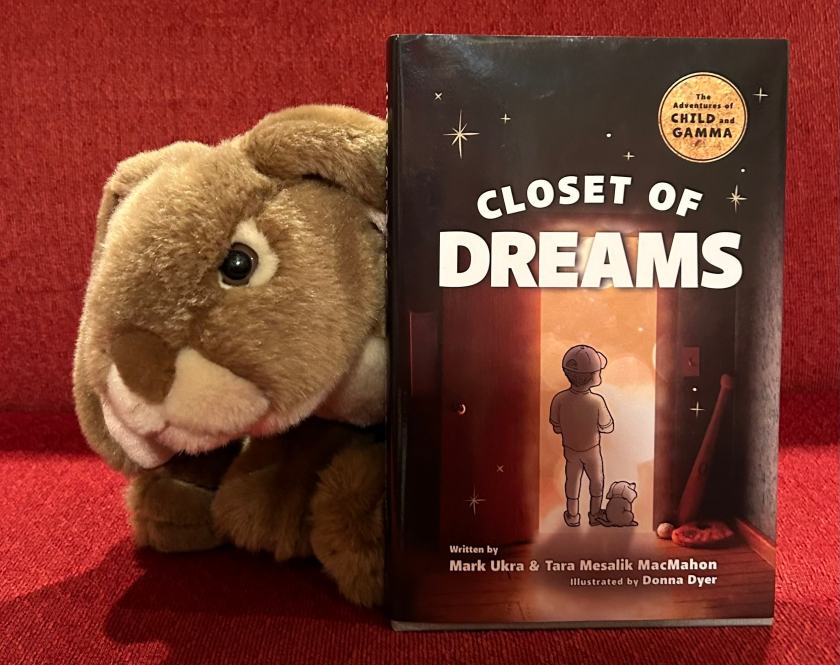
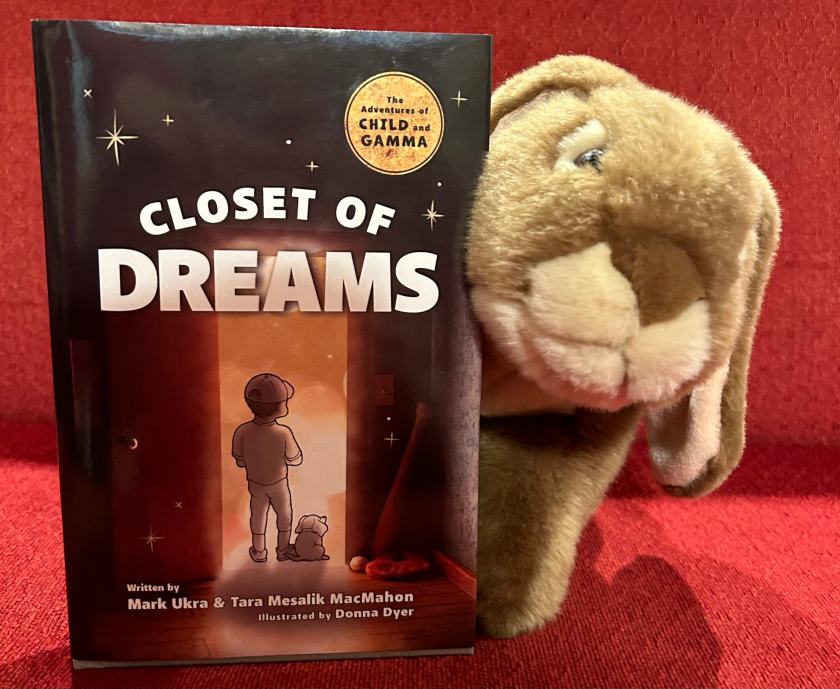
Today Caramel reviews Closet of Dreams, a 2024 book written by Mark Ukra and Tara Mesalik MacMahon and illustrated by Donna Dyer. As usual, Sprinkles is taking notes and asking questions.

The book bunnies received this book as a review copy.

Caramel reviews Closet of Dreams, written by Mark Ukra and Tara Mesalik MacMahon and illustrated by Donna Dyer.

Sprinkles: So Caramel, can you start by telling us a bit about this book?

Caramel: This book is about a kid named Child. Strange name, right?

S: Yes, quite.

C: But I guess the book Marshmallow reviewed this past Saturday has a main character who is a bunny named Funnybunny, so maybe it is not that weird.

S: Alright, then.

C: Okay, so there is this kid named Child, and he lives with his grandma. He calls her Gamma. I am not sure if that is her real name or if that is what Child used to call her when he was little and could not say Grandma.

S: Your conjecture makes sense to me Caramel.

C: Okay, so this Child loves baseball. And he wants to try out for little league. And he has some friends at school but there are also some bullies at school and he is really scared of them.

S: Well, bullying is serious so I can understand why he would be scared.

C: So whenever Child is scared, he goes into the closet in their house and can calm down and feel safe.

S: And that is the Closet of Dreams from the title of the book?

C: Yes. And he sleeps there sometimes and has some good dreams that comfort and encourage him.

S: I see.

Caramel is reading Closet of Dreams, written by Mark Ukra and Tara Mesalik MacMahon and illustrated by Donna Dyer.

S: So I will admit that I read this book too. And it was quite interesting, but also kind of unexpected.

C: You mean, the book sounds like it is all about real things, but then some really unreal things also happen, right?

S: Exactly. There is a quote at the back cover of the book: “a charming mix of both the everyday and the fantastical.” I think that description fits the book well.

C: I think so. But I did like the fantastical part a lot.

S: I know you would. You love talking animals!

C: Well, that is what we are, so of course! And by the way, you are giving away some of the plot!

S: Okay, okay, you are right. I think I will stop talking about the plot now. So tell me about how the reading went.

C: I read it quite quickly. It is for younger bunnies, so the writing is easy to read. There are almost thirty chapters, and each is only a couple pages long. And there are lots of pictures in the book too.

S: What did you think of the pictures?

C: I liked them. They were not in color, but they were still good.

S. The authors are working on a sequel, apparently. Are you curious about reading that too?

C: Yes. They talk about some baby elephant in the book but it goes nowhere in this book. But apparently that will come up in the next book. So I want to read that. And by the way, we still did not read or review The One and Only Ruby, which is also about a baby elephant, and it is supposed to be a sequel to The One and Only Bob by Katherine Applegate. So we also need to read that.

S: Yep. You are right. So this is probably a good time to wrap up this review. What would you like to tell our readers?

C: Stay tuned for more book bunny reviews!

Caramel enjoyed reading Closet of Dreams, written by Mark Ukra and Tara Mesalik MacMahon and illustrated by Donna Dyer, and is curious about the second book the authors are writing about Child and Gamma.

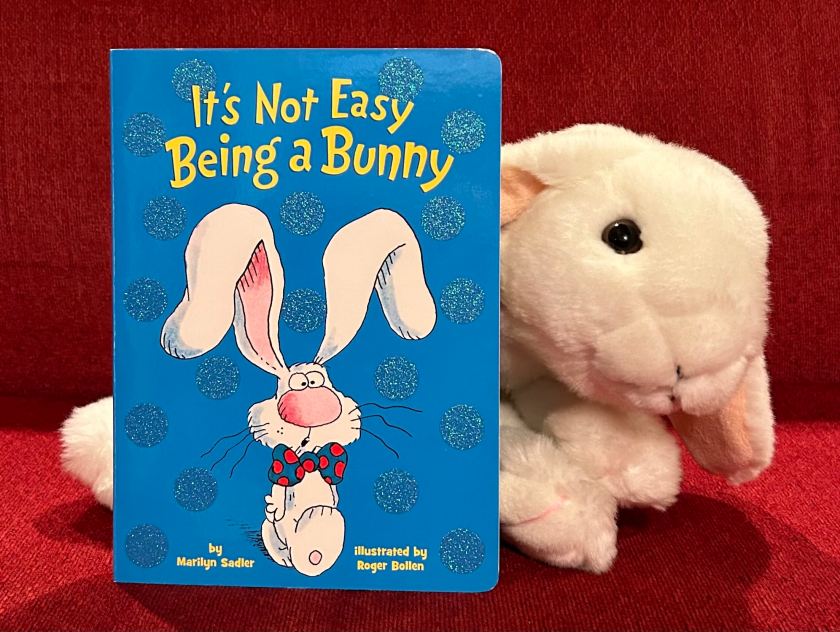
Marshmallow reviews It’s Not Easy Being a Bunny by Marilyn Sadler

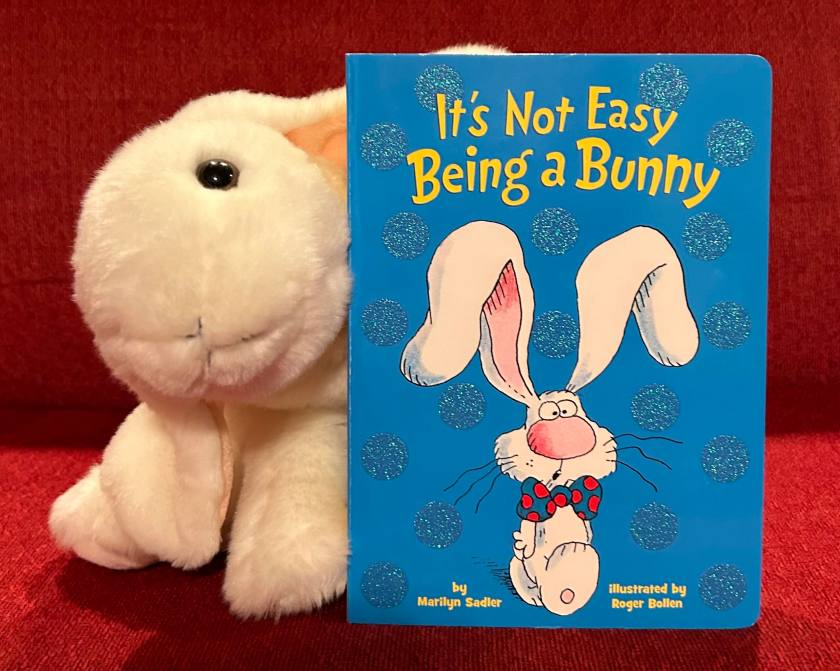
Tomorrow, many people around the world will celebrate Easter. Marshmallow wanted to commemorate this holiday with a cute book about bunnies, so today she is reviewing It’s Not Easy Being a Bunny, a little book written by Marilyn Sadler, illustrated by Roger Bollen, and originally published in 1983. Sprinkles is taking notes and asking questions.

 Marshmallow reviews It's Not Easy Being a Bunny, written by Marilyn Sadler and illustrated by Roger Bollen.
Marshmallow reviews It’s Not Easy Being a Bunny, written by Marilyn Sadler and illustrated by Roger Bollen.

Sprinkles: So Marshmallow, we are talking about a picture book today.

Marshmallow: Yes. I thought it would be appropriate given that this weekend a lot of people are talking about bunnies and egg hunts and such.

S: I agree. This is a sweet book, so why don’t you tell us what it is about?

M: First of all, I should say that the book is not about Easter at all. But it is a book about a bunny, a bunny named P.J. Funnybunny.

S: That is a funny name for a bunny.

M: Yes, it is not as cool as my name, but it is a funny one. It is definitely fun to say. It just rolls off your tongue.

S: Agreed. So tell us a bit more about P.J. Funnybunny.

M: P.J. is not very happy at the beginning of the book. He does not like the cooked carrots his mommy gives him. So he runs away from home to try and not be a bunny anymore.

S: Aw, that is so sad! A little bunny running away from home…

M: Let me just say that it does not work out great.

S: Well, how could it? But what do you mean? Does he get hurt?

M: No, not really. But he does meet some different animals and he tries to join them. But in the end, he decides that maybe being a bunny is not so bad.

 Marshmallow is reading It's Not Easy Being a Bunny, written by Marilyn Sadler and illustrated by Roger Bollen.
Marshmallow is reading It’s Not Easy Being a Bunny, written by Marilyn Sadler and illustrated by Roger Bollen.

S: Do you like being a bunny Marshmallow?

M: Well, most of the time. I’m one of the lucky ones though. According to the Humane Society of the United States, “[m]ore than half the world’s wild rabbit species, such as South African riverine rabbits, are endangered or threatened. Domestic bunny species, like Angora or New Zealand White, are subject to the abuses of cosmetics testing, the pet trade and the fur industry.”

S: You are right Marshmallow. Sometimes it can be rough to be a bunny.

M: But at least P.J.’s story ends well. He figures out that he belongs with his family and goes back.

S: Yes, it is in the end a sweet story of coming back home and appreciating it more, maybe for the first time, right?

M: Yes. I think it would be really nice for little bunnies and their grownups to snuggle together and read this book.

S: I agree. I know you are all grown up and stuff, but maybe we can do that too?

M: I think I would like that.

S: Okay, then. Maybe this is a good time to wrap up this review. What would you like to tell our readers?

M: Stay tuned for more amazing reviews from the book bunnies!
Marshmallow recommends It's Not Easy Being a Bunny, written by Marilyn Sadler and illustrated by Roger Bollen, to all the little bunnies around the world and their grownups.
Marshmallow recommends It’s Not Easy Being a Bunny, written by Marilyn Sadler and illustrated by Roger Bollen, to all the little bunnies around the world and their grownups.

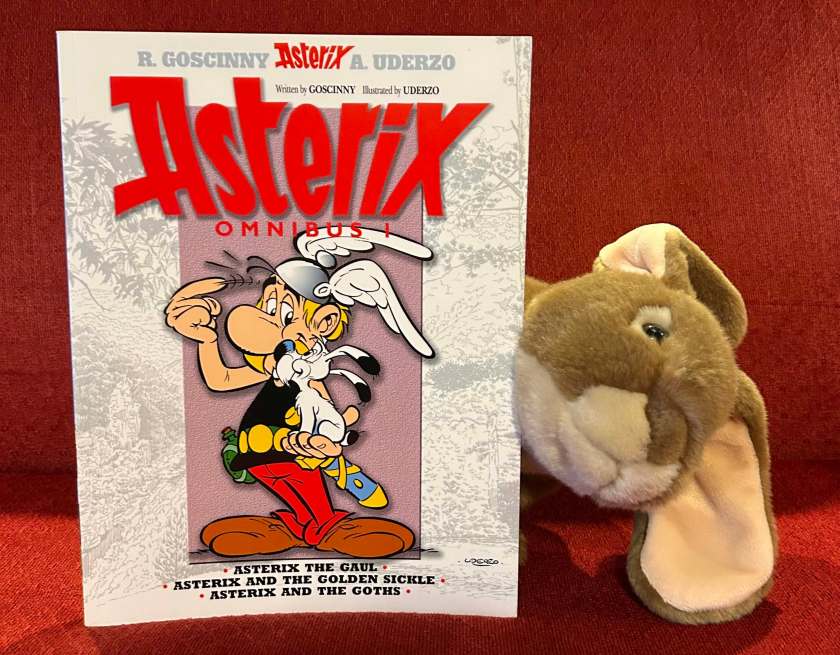
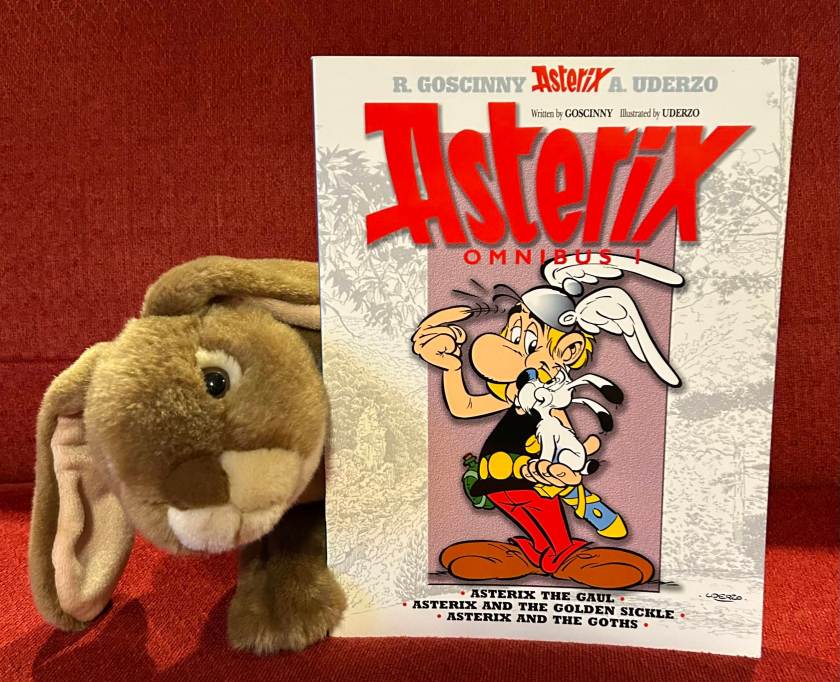
Caramel reviews Asterix Omnibus 1 by Rene Goscinny and Albert Uderzo

Today Caramel talks about Asterix Omnibus 1, written by Rene Goscinny and illustrated by Albert Uderzo, the 2011 edition that brings together the very first three adventures of Asterix the Gaul. As usual, Sprinkles is taking notes and asking questions.

Caramel reviews Asterix Omnibus 1, written by Rene Goscinny and illustrated by Albert Uderzo.

Sprinkles: So Caramel, you finally discovered our Asterix collection.

Caramel: Yes.

S: And it seems like you have enjoyed reading them.

C: Yes. That’s why I wanted to talk about this one today.

S: Okay, so let us start. What is this book in your paws?

C: This is a collection of three stories about Asterix the Gaul and his friends.

S: Okay, so maybe you can tell us a bit about Asterix.

C: He is a Gaul, living in the Roman times. Apparently his village is the only village in Gaul that is not yet captured by the Romans. And they keep driving the Romans mad by being independent and so on. In these three stories we also get to meet the people from the village. There is Asterix’s best friend Obelix, and there is the village chief, Vitalstatistics, and the village potion maker druid, Getafix.

S: Those are some ridiculous names! I am guessing they are not in the original French. Anyways, continue please.

C: Okay. So Getafix makes a magic potion that makes the person who drinks it very very strong, and that is how the village has been able to defend itself against the Romans. And Obelix is very strong always, because apparently he fell into the potion cauldron when he was a baby. Anyways, the three stories are about them having some fun adventures.

S: So this is supposed to be in the ancient past, right?

C: Yep. So apparently Gaul is a part of Europe which is today split between France, Belgium, and a bunch of other countries. Wikipedia says that Romans conquered most of Gaul by 52 BCE. So according to the Asterix books, though, they did not manage to conquer this one little village.

S: So this is around 50 BCE?

C: Yes, the first sentence is “The year is 50 BC.” But you could also tell probably because Julius Caesar is alive and leading the Romans. And apparently he died in 44 BCE.

S: That makes sense.

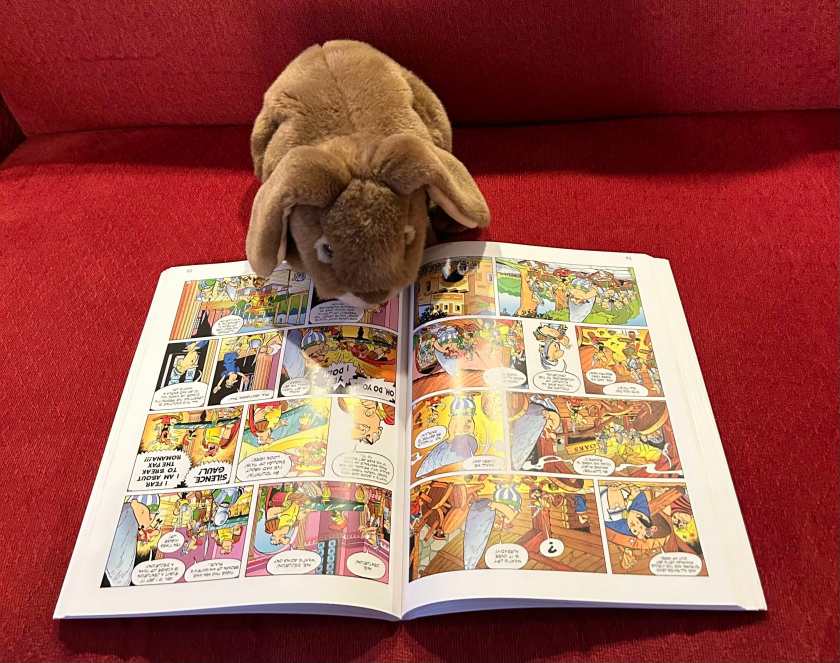
Caramel is reading Asterix Omnibus 1, written by Rene Goscinny and illustrated by Albert Uderzo.

S: So this is an omnibus, which, according to our trusted online dictionary, is “a volume containing several novels or other items previously published separately.” So which stories are in this one volume?

C: There are three. The first is called “Asterix the Gaul”. Then there is “Asterix and the Golden Sickle”. And finally “Asterix and the Goths”.

S: According to Wikipedia, these were first published in 1961, 1962, and 1963, respectively. That is a long time ago. Can you tell?

C: Not really. The stories all happen way back in time. And they are just as funny as they would be if they were written today. But I did read that some Asterix stories have issues with race. The way they represent people of African origin would be racist today, so those stories would probably not even be published.

S: That is a very sensitive issue Caramel. I am impressed that you took the time to learn about it and are sharing it with us.

C: At least those issues do not come up in these three stories. I mean, the Goths are pretty mean and sometimes stupid in the third story, and the Wikipedia article says that was because the authors had strong anti-German feelings because it was so soon after World War II. But that would not be racism even though it is still not a nice thing to do, stereotyping people like that.

S: You are right Caramel. Okay, let us move on to a lighter topic. I know my sister used to laugh out loud when reading these; did you find them funny too?

C: Yes. There is a funny thing on each page, and if you actually look carefully at the individual frames, there is a lot of other hilarious stuff happening, too. The characters are all funny themselves too.

S: They are all very caricaturish, actually. Some characters have huge noses, some are round like a ball, and so on. A lot of them have exaggerated features.

C: Yes, and that makes it funny. And the pictures are all very colorful.

S: I am getting the sense that you really enjoyed reading this book.

C: I did.

S: How would you describe it in three to five words?

C: Hilarious, cartoony, and Roman-ful.

S: Come on, those are not words!

C: Okay. Hilarious cartoons full of Romans. That’s five words!

S: Alright, that works. I think this is a good time to wrap up the review. What do you want to tell our readers?

C: Stay tuned for more book bunny reviews!

Caramel enjoyed reading Asterix Omnibus 1, written by Rene Goscinny and illustrated by Albert Uderzo, and recommends it to other bunnies who might enjoy reading about a stubborn village full of hilarious people standing up against the big Roman Empire.