
Today Marshmallow reviews Water of the Sky: A Dictionary of 2,000 Japanese Rain Words, a unique book by artist Miya Ando, published in 2025.
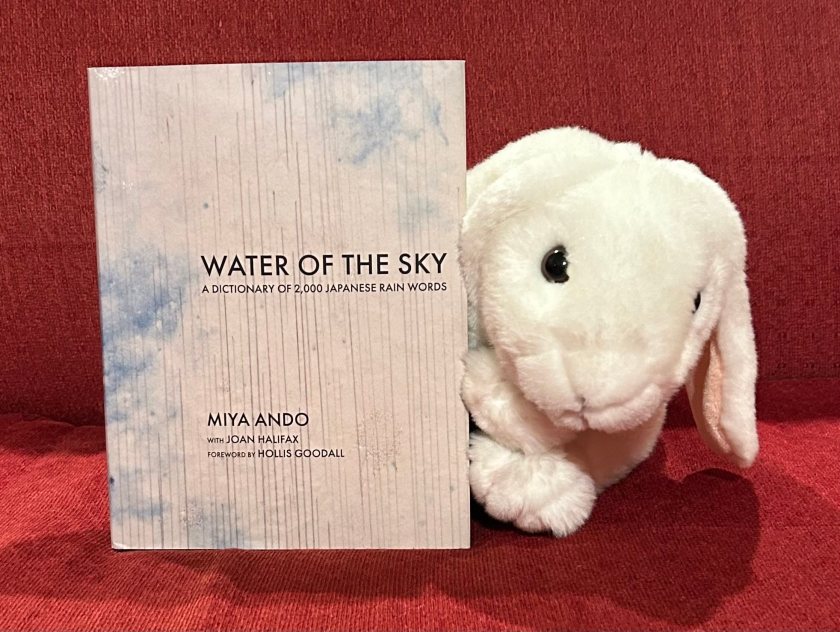
Marshmallow’s Quick Take: If you like nature and taking time to think about things on a deeper level, then this is the book for you!
Marshmallow’s Summary: Miya Ando is a Japanese American artist whose grandfather was a Buddhist monk. Her mother and grandmother practiced tea ceremonies, and this upbringing gave her a deep understanding and appreciation of Japanese culture, poetry, and admiration for nature. This book reflects exactly that.
First off, I should note that pages 104-240 of the book contain the 2o00 words referred to in the book title. These pages list each of the 2000 words in Japanese script (first kanji, basically how the word is actually written, then the hiragana script to tell the Japanese reader how the word is pronounced, I think), and an English pronunciation of the word as well as a poetic translation of the meaning of the word.
There is not much text in Water of the Sky: A Dictionary of 2,000 Japanese Rain Words. except for the Foreword “A Constellation of Frozen Moments: The Language of Rain” by Hollis Goodall, Curator of Japanese Art at the Los Angeles County Museum of Art, the Preface by Miya Ando herself; and a short introductory essay “Perceiving Rain” by Joan Halifax, an American Zen Buddhist teacher. These are each a couple pages long and explain the author’s perspective, methods, and some of the Japanese words that relate to the book. Goodall, Ando, and Halifax all mention words like wabi, sabi, ichigo ichie, “thusness,” and mono no aware. These are not part of the 2,000 Japanese rain words, but are ideas that relate to rain. They are all very meaningful and nuanced and are very difficult to describe. There is no direct translation for the meaning behind those words. For example, wabi is the sad beauty of poverty which forces you to drink tea but to also experience it more gratefully. Sabi is the beauty of loneliness which cultivates beautiful haikus and ink paintings. I find it remarkable how these ideas can conjure soft images in my mind and have such a simple meaning yet leave a profound feeling of wonder and appreciation for life. This is something that continues throughout the book. It is, after all, a book with 2,000 Japanese words that are used for rain.
Shockingly, Japan has that many words (if not more) to describe all the different types of rain. I also learned that Japan, traditionally, has 72 micro-seasons which affect the way one is supposed to dress and conduct tea ceremonies.
The first part of the book has 100 drawings by Miya Ando that represent some of these Japanese words. The drawings are all blue but they are all astoundingly unique. You would figure that there are only so many ways you can represent rain on a canvas. Yet, Japanese culture seems to have infinite ways to characterize rain and—in doing so—appreciate nature, its impermanence, and its existence (its “thusness”) in a way that so many of us today have perhaps never done once in our lives. This book presents this way of thinking to the reader and offers a sense of fulfillment just by being and a sense of wonder at how beautiful our world is.
If you are interested in seeing some of Ando’s work that appears in this book, you can check out: https://www.miyaando.com/rain


Marshmallow is reading Water of the Sky: A Dictionary of 2,000 Japanese Rain Words by Miya Ando with Joan Halifax.
Marshmallow’s Review: I was a bit stressed when I started reading Water of the Sky: A Dictionary of 2,000 Japanese Rain Words; reading it has made me feel so much better. The Japanese ideas of wabi, sabi, “thusness,” and others described in the book are reminiscent of a peaceful past that takes you out of the present and into a state of mind that is more ready to appreciate the world and the nature that silently surrounds us.
I will say that the writers are very verbose and some of their word choice feels overly esoteric. I had to look up a couple of words every paragraph or so. This, for me, was a worthwhile and fulfilling experience and I liked learning and trying to understand the meaning behind the complex sentence structures and SAT-level words. Yet, I do think this might be discouraging to younger bunnies or someone who is not a huge fan of hard words. I would recommend sticking to it though because the sense of calm and comprehension you get at the end is worth it.
Reading Water of the Sky: A Dictionary of 2,000 Japanese Rain Words and looking at Miya Ando’s art truly did make me feel as though I was in a completely different state of mind. Sometimes, I felt as if I was living back in ancient Japan and it was raining outside. This was a very interesting experience. Just like how the best haikus put a brief, impermanent image in your mind, this book does too. The authors discuss how rain is impermanent and how appreciating rain is appreciating nature and how things fades away and change and are created. Thinking about these sorts of things puts you on another level of thinking, a deeper yet higher level of understanding that does make you forget about daily stress for a moment.
Looking at Ando’s art is itself an amazing experience. It is amazing how there are so many different iterations of rain. Every moment truly is unique and never repeated. Japan is probably the first country to catalogue every beautiful, individual rainfall (the only comparable thing I can think of is that unproven claim that there are one hundred words for snow in Inuit).
I really appreciated reading Water of the Sky: A Dictionary of 2,000 Japanese Rain Words and all the hard work that went into making it! I would highly recommend it to anyone who has the time and is willing to push through the harder, more difficult reading at the beginning. The ideas are fascinating and beautiful and the paintings and the definitions themselves are beautiful as well. Or if you like, you can simply peruse Ando’s art work in bits and pieces. But taking your time with the book is the best way to appreciate it I think. Reading Water of the Sky: A Dictionary of 2,000 Japanese Rain Words really gives you the opportunity and duty to appreciate the beauty around you in the simple things of nature and everything in the world. We should all try to be a little more like that every day!
Marshmallow’s Rating: 100%.
 BookBunnies
RG’s Comments:
Japan is truly a wondrous and unique country. I am not surprised that they would have so many different ways to express rain.
True story: I was in Tokyo during a business trip. I was staying at the Shinjuku Hilton while visiting some customers. The time came to check out of the hotel and wait for one of our salesmen to take me to Nara, to visit another customer (Sharp), overnight in Nara and then proceed to Osaka and spend one night at the Osaka Hilton and catch my return flight from Osaka airport.
The plan was to pack an overnight bag and then check my suitcase at the Tokyo train station, to have it delivered to the Hilton in Osaka. So, after checking out of the hotel in Shinjuku, I checked my suitcase with the bell captain and sat in the lobby to wait for our salesman to arrive and then go to the train station. When he finally arrived, I went to the bell captain to retrieve my suitcase.
The bell captain came back empty handed from the luggage storage area and very apologetically told me that they made a terrible mistake and mistakenly had placed my suitcase on the limousine bus going to Narita airport. I was devastated! I had 3 new suits in that suitcase. Our salesman said not to worry, that Japan was a small island and my suitcase could not go too far.
Anyway, I asked the bell captain to have my suitcase (if it was ever found) delivered to the Osaka Hilton, where I would be the day after tomorrow. He replied yes and took down the information.
We rode the train to Nara, visited the customer there spent the night at a local hotel and then parted ways the following morning, he back to Tokyo and me on the train to Osaka. At the Osaka train station, I took a taxi to the Osaka Hilton and proceeded to stand in line at the registration desk, it was quite busy and there were several other guests in front of me. When my turn came, I gave them my name. The hotel registration clerk immediately bowed to me and escorted me to the concierge desk. The Concierge told me I was already registered and that my suitcase was already in my room.
It turns out that I had been upgraded to a suite! My suitcase was there (nothing was missing) and on the desk was a platter full of fresh fruit, along with a handwritten letter of apology from the bell captain of the Shinjuku Hilton.
The experience was amazing, more so when one realizes that the Shinjuku Hilton and the Osaka Hilton were owned by two different companies.
KG’s Comments:
Yes, Japanese culture values nature. This can seem strange to many foreigners, who see Japan as an advance technological society.There are two main religions in Japan, Buddhism which came from China and Shinto. Shinto, (literally meaning “the way of the kami”) is Japan’s indigenous religion and it’s focused on harmony with nature, purity, and the worship of spirits known as kami. Shinto emphasizes rituals, respecting ancestors, and nature-based spirituality.
LikeLiked by 1 person