[We are back! The book bunnies were hit by a mysterious bug in the middle of October so had to take some time off. We are all finally feeling up for some reading and blogging again. Sorry for the disruption!]
Two weeks ago, Caramel reviewed the first book in the Nathan Hale’s Hazardous Tales series, recommended to the book bunnies by one of our friendly readers. This week he is talking to Sprinkles about the second book in the series, Treaties, Trenches, Mud, and Blood, first published in 2014.
[We were hoping to go through these books in order, but Caramel happened to first read a three-book sampler which was made up of the first, fourth, and the fifth books! So the numbering of these posts is mainly about the order Caramel is reading them in. Treaties, Trenches, Mud, and Blood, reviewed in today’s post, is the fourth ever book in the series, originally published in 2014.]
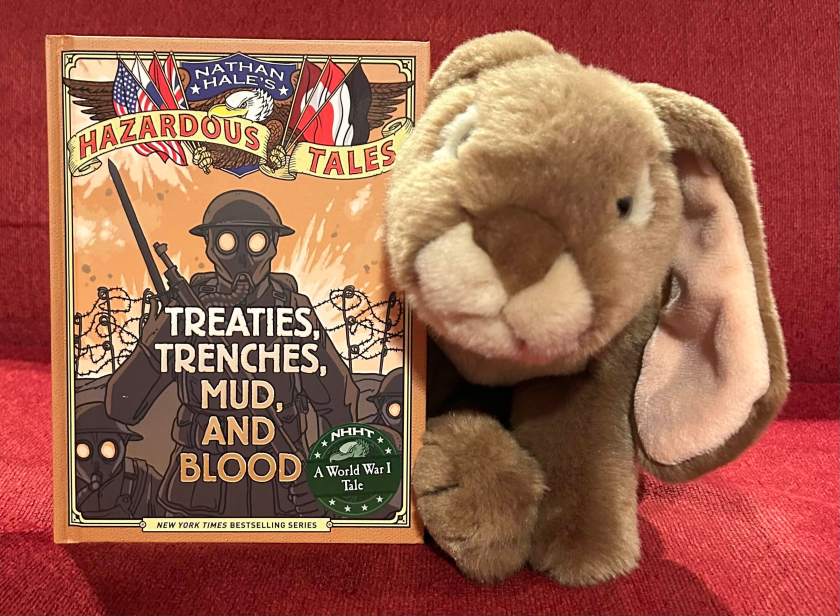
Sprinkles: So here we are, ready to talk about the second Nathan Hale book. So tell us a bit about the book Caramel.
Caramel: This is about World War One. Apparently it is one of the worst wars ever, in terms of how many people died.
S: I agree. It was also a very impactful event, leading to the fall of many powers and rise of others. But then, is the book a basic history of the war?
C: It is a comic book, like the first book. So it is history, but told in a different way. Many of the people are not people. I mean, they use different kinds of animals to represent all sorts of people. Like there are bird-faced soldiers, lion-faced people, and so on. I think it is called “anthropomorphized animals” because they are supposed to represent humans.
S: So it is kind of like Maus, the book Marshmallow reviewed about the Holocaust, where the humans were replaced by cats, mice, and pigs?
C: Yes! But I have to say that book is so much more depressing.
S: But are they consistent with the animal depictions? Like all dogs are some type of people?
C: Well, kind of. The Russians are bears, the British are bulldogs, the Germans are eagles, the Ottomans are otter, and the Americans are bunnies, like us!
S: That is interesting! I guess in a war with so many different groups involved, it kind of makes sense. It would be really hard to distinguish different nationalities by their uniforms for example.
C: I agree. I think it is clever.
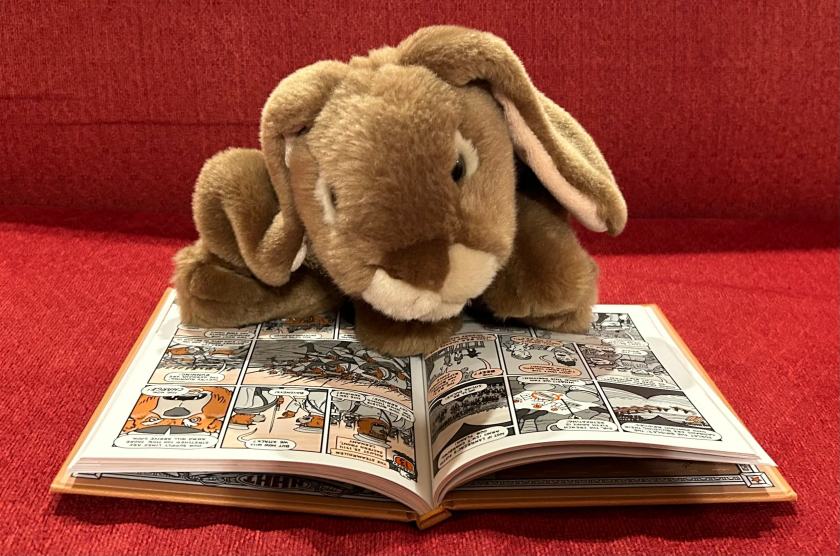
S: I can see how you would like a book like this. You like facts, so you would of course like historical stuff.
C: Yes, and I really am curious about World War One. The book is full of facts! For example, I learned that the U.S. army did not have enough uniforms to go around at the time when the U.S. entered the war.
S: I did not know that! Interesting! So the book is really a story of the war, you say. Does it start at 1914 and end at 1918? Or does it go back and forward a bit so you get some context?
C: It goes from 1914 to 1918, mostly in the time order. It jumps from one battle to another though, and you learn lots of facts here and there, like I learned about the Unkillable Soldier.
S: I know you like your facts!
C: Yep.
S: So it is pure history?
C: Well, they do make up some dialogue. But they also sprinkle in some well-known quotes, like this one.
S: I see. So all in all, this was a good read for you?
C: Yes.
S: Do you want to read another Nathan Hale book or another book about the War?
C: Yes. Maybe I can take some time off from war stuff. The next Nathan Hale book sounds good though.
S: That is settled then. You read that and we talk about it next week.
C: Unless we all get sick again!
S: I hope we won’t. We should be immune by now.
C: Well, there are always other bugs.
S: You are right, but I do hope we will be able to continue with the blog. This was the first time in five years that we missed our scheduled posting times…
C: I know you are really bummed by that…
S: Yes. But I am glad we were able to start again today. So thank you for talking to me about your book!
C: You are welcome! I always like to talk about books!
S: So as we wrap up this review, what would you like to tell our readers?
C: Stay tuned for more book bunny reviews! And it won’t be too long!
S: Hopefully…
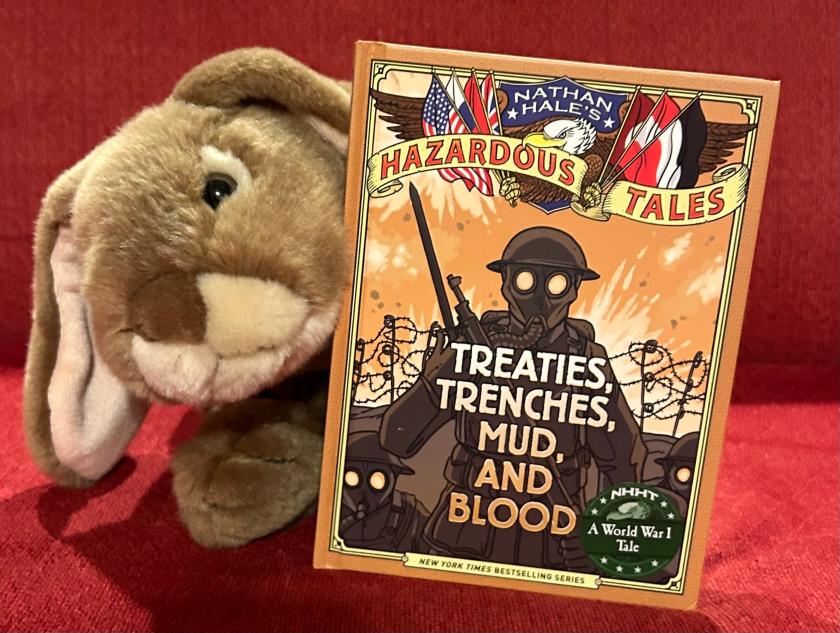
 BookBunnies
RG’s Comments:
__________
I am so happy to read that the Book Bunnies are on the mend.
“Anthropomorphized”. Wow, just wow! Caramel’s erudition is amazing!
WWI was a terribly deadly war. Trench warfare, poison gas and machine guns, took a terrible toll on both sides. British author H.G. Wells (yes, that H.G. Wells), believed that WWI would create a new world order that would prevent future conflict. In a 1914 Times editorial he described it as “The war to end all wars”. Boy, how sadly mistaken he was.
KG’s Comments:
__________
Anthropomorphized, wow, what big words Caramel uses.
Any war is bad and they should never happen. The common people want peace and it is those in power that send them to their death.
LikeLiked by 1 person
Yes, Caramel knows surprising words!
LikeLike