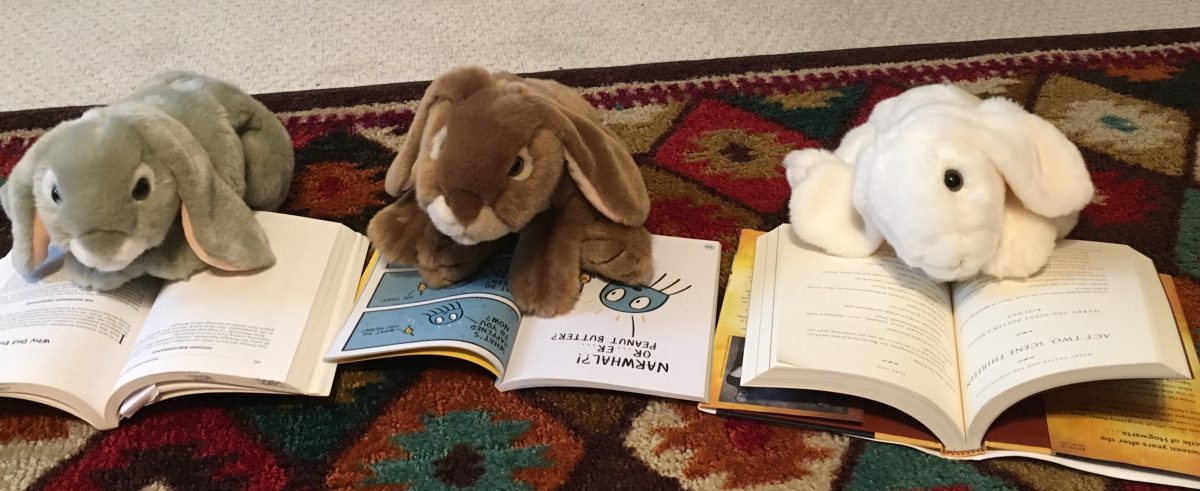
Sprinkles reviews Out Of Wonder: Celebrating Poets and Poetry by Kwame Alexander, Chris Colderley, and Marjory Wentworth

Today Sprinkles reviews Out of Wonder: Celebrating Poets and Poetry by poets Kwame Alexander, Chris Colderley, and Marjory Wentworth. Illustrated beautifully by Ekua Holmes, this poetry collection was first published in 2017.

Sprinkles reviews Out Of Wonder: Celebrating Poets and Poetry by Kwame Alexander, Chris Colderley, and Marjory Wentworth.

I have already reviewed a handful of poetry books through the years for the book bunnies blog. Most of these reviews were about individual books, but earlier this year, I have also reviewed three anthologies. The book I am reviewing today can also be viewed as an anthology of sorts, though it is a very particular type. Out Of Wonder presents twenty poems from three distinct poetic voices: Kwame Alexander, Chris Colderley, and Marjory Wentworth. And each poem is an homage to a specific poet that had a significant impact on the poet writing about them.

The book begins with a preface written by Alexander, where he introduces us to the project: through poems inspired by individual poets, the three authors of this book aim to introduce to the young reader the depths and breadths of poetry. Alexander writes:

“The poems in this book pay tribute to the poets being celebrated by adopting their style, extending their ideas, and offering gratitude to their wisdom and inspiration.”

Following this description then, it should not surprise the reader that the poems in the book are organized into three parts.

Part I, titled “Got Style?”, offers us six poems, written in the styles of Naomi Shihab Nye, Robert Frost, e. e. cummings, Bashō, Nikki Giovanni, and Langston Hughes. It is a great idea indeed to start with a style focus like this; these poets have particularly distinct styles, and the six poems honoring them manage to showcase to the young reader what possibilities exist for poetic form.

Part II, titled “In Your Shoes”, celebrates Walter Dean Myers, Emily Dickinson, Terrance Hayes, Billy Collins, Pablo Neruda, Judith Wright, and Mary Oliver with seven poems that explore themes and contexts that come directly from these poets’ own works.

Part III, titled “Thank You”, includes seven more poems, this time explicitly thanking and celebrating Gwendolyn Brooks, Sandra Cisneros, William Carlos Williams, Okot p’Bitek, Chief Dan George, Rumi, and Maya Angelou.

The book ends with a list of biographies of the twenty poets celebrated in it, so the curious reader can learn a bit more about these poets if desired. But of course the really curious bunnies will also want to check out poems by these poets. To that end, most of the links I provided above to the poets go to the Poetry Foundation page on them where you can find at least a couple sample poems.

Sprinkles is reading Out Of Wonder: Celebrating Poets and Poetry by Kwame Alexander, Chris Colderley, and Marjory Wentworth.

All twenty poems in Out Of Wonder are accessible to young readers, but they do not underestimate them. Each poem stands on its own, with its distinct style and voice. Alexander’s “Jazz Jive Jam” celebrating Langston Hughes dances even!

These are all really appealing poems. For example Marjory Wentworth’s “In Every Season” celebrating Robert Frost leaves resonances in one’s palate which complement the experience of reading his “Stopping by Woods on a Snowy Evening”. Chris Colderley’s “For Our Children’s Children” celebrating Chief Dan George is striking in its simplicity–here is an excerpt:

Let the shadows 
of drifting clouds
warm your cheek
and whisper softly:

Share the earth
with all creatures.
Love them, and they
will love you back.

Kwame Alexander’s “I Like Your” celebrates e. e. cummings in a style that reflects the latter’s very own–here is the beginning of this lovely poem:

I like my shoes when they are with
your shoes. Mostly the comes. Leastly
the goes. I carry your footsteps(onetwothreefour)
in between today(...)tomorrow.

Each and every one of these poems is a joy to read. And each is accompanied by beautiful illustrations by the talented Ekua Jolmes. Most poems thus get a full two-page spread and the illustrations are as distinct and striking as the poems themselves.

This is not a book to read from cover to cover in one sitting. Read one poem, look at the beautiful illustrations accompanying it, check the bio of the poet celebrated by the poem that is provided at the back of the book, and then finally, if you have the time, go find some poems by the same poet to see if you will find a new favorite of your own.

***

If you would like to know a bit more about the book, you should probably know that it has its own Wikipedia page! And you can also view the book trailer on Youtube:

Caramel reviews Voyage to the Bunny Planet by Rosemary Wells

Today Caramel is talking to Sprinkles about Voyage to the Bunny Planet, a little book by Rosemary Wells, first published in 1992.

Caramel reviews Voyage to the Bunny Planet by Rosemary Wells.

Sprinkles: So Caramel, today we are talking about a book about a planet of bunnies!

Caramel: Yep, something we would like!

S: Well, I quite like living on this planet. 

C: Me, too. But it is also cool to think of a planet only for us, you know. 

S: That is true. It might be fun to think about that… Okay so tell me what this book is about.

C: It is about three bunnies named Robert, Claire, and Felix, who are sad, and they dream about a planet called the bunny planet. On the bunny planet, there is a bunny, Janet the Bunny Queen, who helps them feel better about their day.

S: That sounds neat!

C: Yeah, it is a neat idea. 

S: So they get to do a do-over of something that went wrong?

C: No, it is more like she helps them feel better by seeing things in different ways. 

S: That makes sense. So do all three bunnies have a bad day at the same time? Are they friends? Do they know each other?

C: No, I don’t think so. The three bunnies each have their own stories. It looks like each story is independent, and maybe they were even published as separate books first, and they put them in one book here. 

S: Yes, it does seem like it, Caramel. I saw online that there were three little books before this one, and this one brings all three together and adds a little bit to the beginning about Janet the Bunny Queen.

C: That makes total sense. The three bunnies’ stories are all separated, like different chapters. The first story is about Claire and is called “First Tomato”. The second is about Robert and it is called “Moss Pillows”. And the last one is called “The Island Light”, and that one is about Felix. So I can see how they were separate books first. 

Caramel is reading Voyage to the Bunny Planet by Rosemary Wells.

S: I think the author added an introduction about Janet the Bunny Queen for this collection. But it all seems to have worked out fine, right? It worked like a single book for you?

C: Yes. Of course this book is already quite short, so the three individual books must have been even shorter. But then again, it is a little book for little bunnies, so that makes sense, too. 

S: Yes it does! And I think little bunnies can read them with a parent bunny or with an older sibling bunny, and they can read one story at a time. I can imagine how that could work for a nice nighttime reading. 

C: Yeah, it would be a nice calming book to read, or be read to from, after a hard day. And every little bunny has a hard day every now and then. 

S: Of course! Every bunny has a hard day sometimes. Remember Alexander, who had a terrible, horrible, no good, very bad day

C: Yes! But that book went through the whole day, and everything did go bad for Alexander, and he kind of had a bad attitude about it, too, and it ended that way in the end, too. Here the unhappy bunnies end up happy. 

S: I can see how someone who had a bad day can appreciate Alexander’s story, too. When you are really grumpy, you might want to continue to be grumpy and annoyed and feel like all is wrong with the world and sulk. But more generally, it is a good idea to be able to shift perspective and take a different look at things, and try to see them from more positive angles. Voyage to the Bunny Planet seems to be saying that. 

C: Yes. You know, I kind of was angry at Alexander. He did get a bit too whiny when a lot of the time he was just unlucky. And there were no bunnies in that book. So I think I like this book a lot better.

S: I can understand that! Also, Alexander’s story does not end happily, and you like happy endings. 

C: Yes, that is another reason why I like this book a lot more. 

S: I am glad you found yet another book that you like Caramel! So this is a good time to wrap up this review, I think. 

C: Yep, I agree.

S: What do you want to tell our readers?

C: Stay tuned for more book bunny reviews!

Caramel enjoyed reading Voyage to the Bunny Planet by Rosemary Wells and recommends it to all the little bunnies and their adults who had a bad day and want to curl up into a ball and read a bit of happiness into their day.

Marshmallow reviews On Tyranny: Graphic Edition by Timothy Snyder and Nora Krug

Today Marshmallow reviews the graphic edition of Timothy Snyder’s On Tyranny, originally published in 2017. The graphic edition was illustrated by Nora Krug and published in 2021.

Marshmallow reviews On Tyranny: Graphic Edition, written by Timothy Snyder and illustrated by Nora Krug.

Marshmallow’s Quick Take: If you like reading books about current events and deep ideas about nations and history, then this is the book for you! If not, then this book is for you, too!

Marshmallow’s Summary (with Spoilers): This is a nonfiction book about the titular topic of tyranny. The dictionary defines tyranny as “oppressive power, especially oppressive power exerted by a government” and “a government in which absolute power is vested in a single ruler”. So On Tyranny is about oppressive government structures and how they come to be.

More specifically, the book is divided into twenty main lessons we can learn from the history of the twentieth century. Historian Timothy Snyder dives into what happened—in Europe mostly—during the twentieth century, examining the ways in which those past democracies were systematically replaced by tyrannical, manipulative dictators who seized control of their countries using several tactics some leaders are using today. Because I think these lessons are of utmost importance, I’ll put them here on this post for those who don’t plan on purchasing the book:

“Do not obey in advance. Defend institutions. Beware the one-party state. Take responsibility for the face of the world. Remember professional ethics. Be wary of paramilitaries. Be reflective if you must be armed. Stand out. Be kind to our language. Believe in truth. Investigate. Make eye contact and small talk. Practice corporeal politics. Establish a private life. Contribute to good causes. Learn from peers in other countries. Listen for dangerous words. Be calm when the unthinkable arrives. Be a patriot. Be as courageous as you can.”

Now, it’s simple to read these simple-sounding phrases and think, “I just learned everything this book has to offer.” But I cannot think of another book that I believe should be read more than this one. I think this book should be mandatory reading because it is an instruction manual for how to protect democratic governments. Democracy is the best way for peoples to govern themselves, but it can be vulnerable; it needs to be protected from enemies within and outside the borders of any nation that wishes to uphold democratic institutions.

The ideals of democracy, the book’s author conveys, are things that cannot be taken for granted. The people must be able to think for themselves, ask questions, and know when those in power are starting to sound a little too much like the tyrants in the history books. This book uses quotes, stories, facts, and nuanced, yet time-tested ideas to compellingly create the ultimate survival guide for a democratic nation. Telling us exactly what the downfall of a democracy would look like, this book offers its readers ways to prevent such an end. 

Marshmallow is reading On Tyranny: Graphic Edition, written by Timothy Snyder and illustrated by Nora Krug.

Marshmallow’s Review: In case you couldn’t tell from my little sermon above, I should explicitly write out that I think this book needs to be read by any and every person who is a part of a modern society today. The book is a timely warning and a critical manifesto that we all need to read, now more than ever.

As one of the wisest humans I know once said, “Nothing in this world is free. Freedom is not free.” We all have a responsibility to protect the blessings that liberal democracy has given us. Various forces are trying to tear democratic nations apart and rebuild them into their own image, Frankenstein-like and through fear. This book looks at history and pulls from what happened in the past to show us how people were manipulated into submission so today’s people don’t fall for the same tricks.

The book is definitely written with an American perspective, and I expect that there will be some who disagree with the author’s political views on contemporary U.S. politics. However, the history presented is still relevant, to each and every one of us living today. We all need to know what mistakes people like us made when they thought nothing bad could happen in their country. We need to understand their mistakes to recognize when we might be about to make our own. 

As is natural for all young bunnies, I love my country. If you love your country, too, then read this book so you know how to protect it.

Marshmallow’s Rating: 100%.

Marshmallow rates On Tyranny: Graphic Edition, written by Timothy Snyder and illustrated by Nora Krug 100%.

Caramel reviews Wishtree by Katherine Applegate

Both Caramel and Marshmallow have enjoyed reading many books by Katherine Applegate through the years. And they have reviewed them for the book bunnies blog. (Readers might enjoy Marshmallow’s reviews of The One And Only Ivan, Willodeen and Crenshaw, and Caramel’s reviews of The One and Only Bob, The One and Only Ruby, and The One and Only Family.) Today Caramel is talking to Sprinkles about Wishtree, first published in 2017.

Caramel reviews Wishtree by Katherine Applegate.

Sprinkles: So Caramel, today we are talking about a new-to-us book by Katherine Applegate. 

Caramel: Yep. It is named Wishtree and it is about a wishtree. A wishtree is a tree that people tie things to its leaves and branches to make a wish. A tree for making wishes. So It’s kind of like the name of the book.

S: Yes, I suppose it is very descriptive. So this is a book about a tree. How does that work? Wouldn’t that be kind of boring? 

C: No, it is a tree that can talk, so it is interesting. And it is the tree telling its own story so you learn that the inside story of trees is really not boring at all. 

S: Wait, the book is narrated by a tree? I have to read this book; it sounds fascinating!

C: Yes, it really is.

S: Okay, so please tell me more. 

C: Okay, so, in this town there is this oak tree that has been there for two hundred years, and at some point the people who live there have started to think that if they write a wish on a piece of paper and tie it to the branch of the tree, it will grant their wishes. 

S: Does it actually work? 

C: Yes, but not because of magic or anything. The tree is not magical, but it can still help sometimes, because it has animal friends that help it to grant wishes. 

S: So the tree has friends? That is cool. And they are not all other trees. 

C: Oh no. It has many animal friends. There is a crow named Bongo, for example, that is the tree’s best friend.

S: Cool. So is the whole book about the tree and its friends then?

C: Yep, but this person whose garden the tree is in wants to cut it down, and its friends try to save it. 

S: The tree’s animal friends? 

C: Yes. And they do manage to save it in the end. 

S: That’s good.

C: Yes. Then there is a child named Samar in town who is bullied because she is different from the others, because her family is Muslim and some of the other children do not treat her very kindly. So Samar is very lonely and she wishes for a friend. And then things get really tense but the tree and its animal friends find a really kind way to solve all the problems. Samar gets a friend and the person who wanted to cut the tree down remembers her great-great-grandmother’s first wish which came true and made the wishtree become a wishtree. 

S: So all ends well then?

C: Yes, and you know I always like happy stories.

Caramel is reading Wishtree by Katherine Applegate.

S: I do. Did you know that the author wrote this book after The One and Only Ivan, thinking that after writing through the eyes of a gorilla, writing through the eyes of a tree could also be fun? 

C: No, but that is really cool!

S: I agree. Did you also know that some people tried to ban this book? Apparently because the tree says that it is both female and male so it has both genders, so people thought this was inappropriate for young readers. Here is an interview with the author about one such event

C: Oh, well, that is interesting, but I disagree. It is a scientific fact that oak trees have both male and female flowers on them. 

S: Apparently it is called monoecious. Even Wikipedia has an article on monoecy

C: Hmm, I did not know the word, but I knew the concept. Some trees can reproduce just by themselves. 

S: Of course Caramel, you and your facts! I am just happy I at least found a word that you did not know. 

C: No I knew the word monoecious, the tree calls itself that in the book. I just did not know the word “monoecy”. 

S: You continue to amaze me Caramel. 

C: Yep, I am amazing, aren’t I?

S: Yes, but I would not call you very modest. Anyways, do you think this is a good place to end our review?

C: Yep, I think that would be a good idea. 

S: Would you recommend Wishtree to other little bunnies? 

C: Yes. It is a really nice story about friendship and kindness and also trees and how cool they are. And it has a happy ending. What is not to like? So yes, every little bunny should read it!

S: Okay, that is great Caramel. So let us wrap things up. What do you want to tell our readers?

C: Stay tuned for more book bunny reviews!

Caramel enjoyed reading Wishtree by Katherine Applegate and recommends it to all little bunnies who like the quiet of trees and find happiness in friendship.