Caramel reviews Poppy and Rye by Avi

A couple weeks ago Caramel reviewed Poppy, the book that launched Avi’s Dimwood Forest series. This week he is continuing the series, with a review of the next book in line: Poppy and Rye, written by Avi and illustrated by Brian Floca. As usual, Sprinkles is asking questions and taking notes.

Caramel reviews Poppy and Rye, written by Avi and illustrated by Brian Floca.
Caramel reviews Poppy and Rye, written by Avi and illustrated by Brian Floca.

Sprinkles: So Caramel, tell me about Poppy and Rye.

Caramel: Poppy and Rye is a good book if you like mice. Especially if you like battles of mice against bad creatures, like beavers.

S: Well, I never thought about whether I’d like to read about mice battling beavers before. But you are right, this is a book about mice and their fight against a group of mean beavers.

C: And in the lead is a beaver named Caster P. Canad. He is the one who made a dam and it flooded the house that Ragweed’s family used to live.

S: Oh, so Ragweed’s family is in this book? That’s cool.

C: Yes, Rye is his brother, and he is in the title of the book. But this is after Ragweed … oops… I am trying not to give away what happened to Ragweed in Poppy.

S: Yes, but the events in this book happen after all that, right?

C: Yes. Why do you ask?

S: So I am guessing people who are thinking of reading this book should probably have already read Poppy and should already know what happened to Ragweed.

C: Yep, I guess so.

S: So do you think someone could read Poppy and Rye without having read Poppy?

C: They could, but it is probably not a good idea.

S: I agree, I think you would not have a good sense of who Poppy is otherwise. But keep in mind the very first book Ragweed was actually written after Poppy and Rye. So perhaps people do not need to really have read that one just yet.

C: Possibly. But I still think it is a good idea to start with Ragweed. And if you can read Ragweed and Poppy in between, before Poppy, then you can follow these mice all through their adventures in the right way.

S: That is how we are reading through this series, right?

C: Yes.
Caramel is reading Poppy and Rye, written by Avi and illustrated by Brian Floca.
Caramel is reading Poppy and Rye, written by Avi and illustrated by Brian Floca. 

S: Okay, so you already told us that there are some beavers who have basically destroyed the home of Ragweed’s family.

C: Yes, the beavers make a dam on the brook and then they flood the home of Clover and Valerian, who are Ragweed’s mom and dad. And the family has to move out.

S: So where does Poppy come into this story? Doesn’t she live far away from the Brook?

C: Yes, but she wants to tell Ragweed’s family the news about his … oh, sorry.. She wants to meet them, let me say.

S: Okay, yes, she goes through the whole forest to get to them, right? Who is with her?

C: A porcupine, a bad-mannered porcupine, a very annoyed porcupine. And his name is Ereth.

S: Some people really like Ereth. Did you like him, too?

C: Yeah, I especially love his grumpiness. He is funny! He always grumbles and says things to annoy Poppy.

S: Yes, but he also really really likes Poppy, right?

C: Yes.

S: So what three words would you use to describe this book?

C: Funny, descriptive, adventurous.

S: Hmm, you have used two of those words before for the other books from the Dimwood Forest series, but “descriptive” is new. Why do you say that?

C: There is a lot of description in the story. The author describes Ereth and Rye and all the other characters. And the places they are in. The forest, the brook, the area near the dam, and the rock where Clover and Valerian and their litter of billions of mouse babies move into after their first home is flooded.

S: That is true. And so yes, I agree, your descriptive words are good choices for this book. Again. So let us wrap up this review. What would you tell our readers Caramel?

C: Stay tuned for more book bunnies reviews!
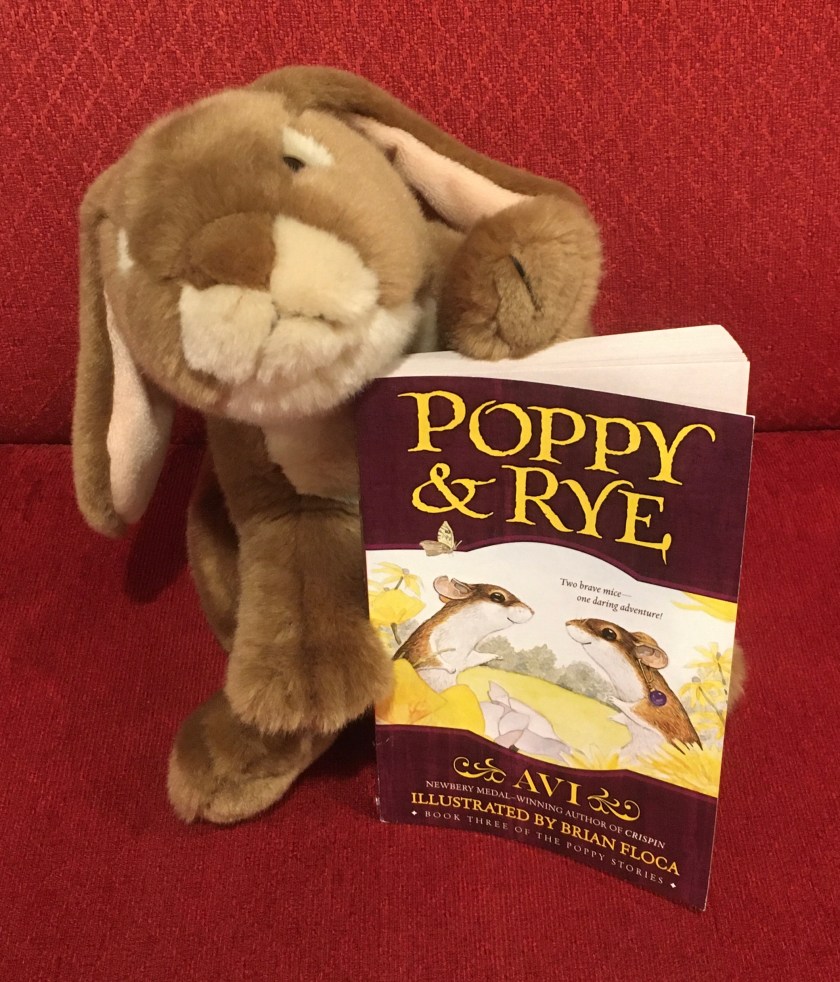
Caramel enjoyed reading Poppy and Rye, written by Avi and illustrated by Brian Floca, and is looking forward to reading more adventures of these lovable animals from Dimwood Forest.
Caramel enjoyed reading Poppy and Rye, written by Avi and illustrated by Brian Floca, and is looking forward to reading more adventures of these lovable animals from Dimwood Forest.

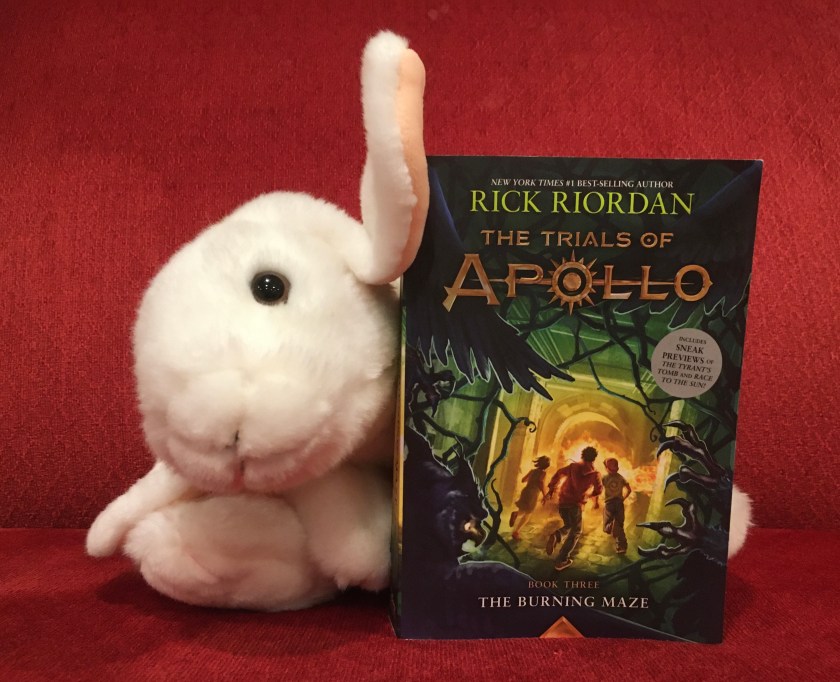
Marshmallow reviews The Burning Maze (Book 3 of the Trials of Apollo Series) by Rick Riordan

This week Marshmallow continues with Rick Riordan’s Trials of Apollo series and reviews the third book: The Burning Maze.

Marshmallow reviews The Burning Maze (Book 3 of the Trials of Apollo Series) by Rick Riordan.

Marshmallow’s Quick Take: If you like books about Greek and Roman mythology, then this might be the book for you. But I will add my usual warning again: if you have not read the earlier books in the Trials of Apollo series, I think you should go back and read those before you dive into this one.

Marshmallow’s Summary (with Spoilers): Zeus has turned Apollo into an average teenager and now he has a twelve-year-old master, a satyr guide, and an assignment to restore all Oracles.  This time he has to help find the Oracle of Erythaea. He reaches California and meets some old friends and makes some new ones. Apollo and his friends learn more about the identity of the third emperor in Triumvirate Holdings, a company who is behind many of the assets that previous enemies used. Apollo and his friends learn that the third emperor is set on trying to become the new Apollo and wants to have an old enemy boil the current Apollo with Helios so then the emperor can eat them and become the new sun god. This will mean that Apollo and Helios will cease to exist. It seems that Zeus will allow this, and Apollo will die. The stakes couldn’t be higher for Apollo (and also for California, because the book has an interesting explanation of what is going on with California wildfires…)

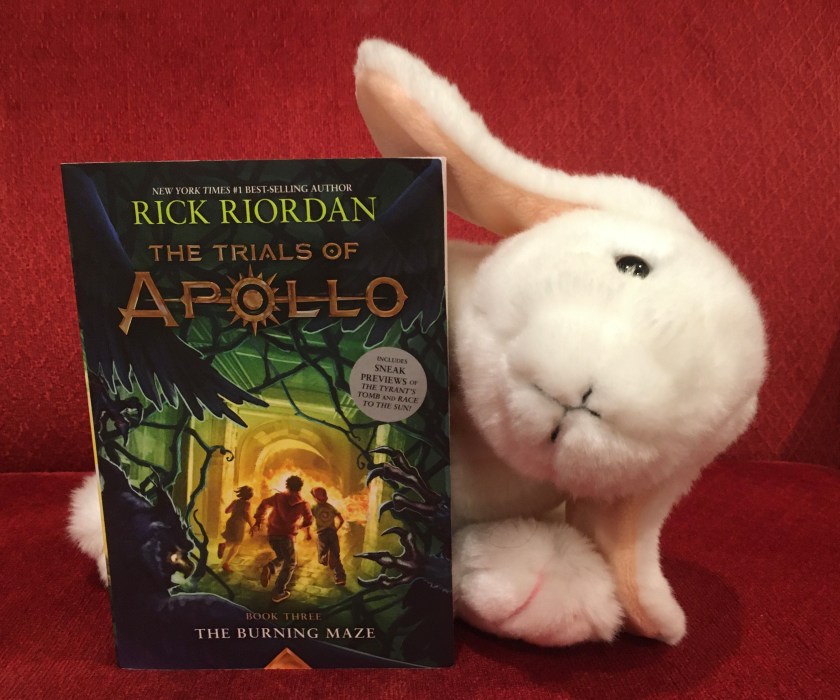
Marshmallow is reading The Burning Maze (Book 3 of the Trials of Apollo Series) by Rick Riordan.

Marshmallow’s Review: I think that The Burning Maze is a great book because the author, Rick Riordan, adds jokes and, basically, comic relief to his books. Of course if you read some of his other books, from his Percy Jackson and the Olympians or Heroes of Olympus series, and more, then you would know that. Also another interesting thing in this book is that as the book and the series progresses, so does the character of Apollo/Lester Papadopoulos. He basically grows, though also quite physically, more down-to-Earth. 

This book does talk somewhat about history, but you don’t really need to know anything about it, though knowing some Roman history would mean that you might be able to find out who the bad guys are faster. At the end of this book the heroes receive a prophecy of a sort, and it links to a character I really like.

Though this is a great book for everyone, I think that people (and bunnies) of age 9 and up might like it especially. 

I really enjoyed reading The Burning Maze. I think that it’s funny, especially Apollo/Lester’s conversations with the Arrow of Dodona are very well-written. The plot is very well thought out and the clues are great. The characters are well developed, too; each character has flaws and skills that make them more realistic and more relatable.

Marshmallow’s Rating: 100%.

Marshmallow rates The Burning Maze (Book 3 of the Trials of Apollo Series) by Rick Riordan 100%.

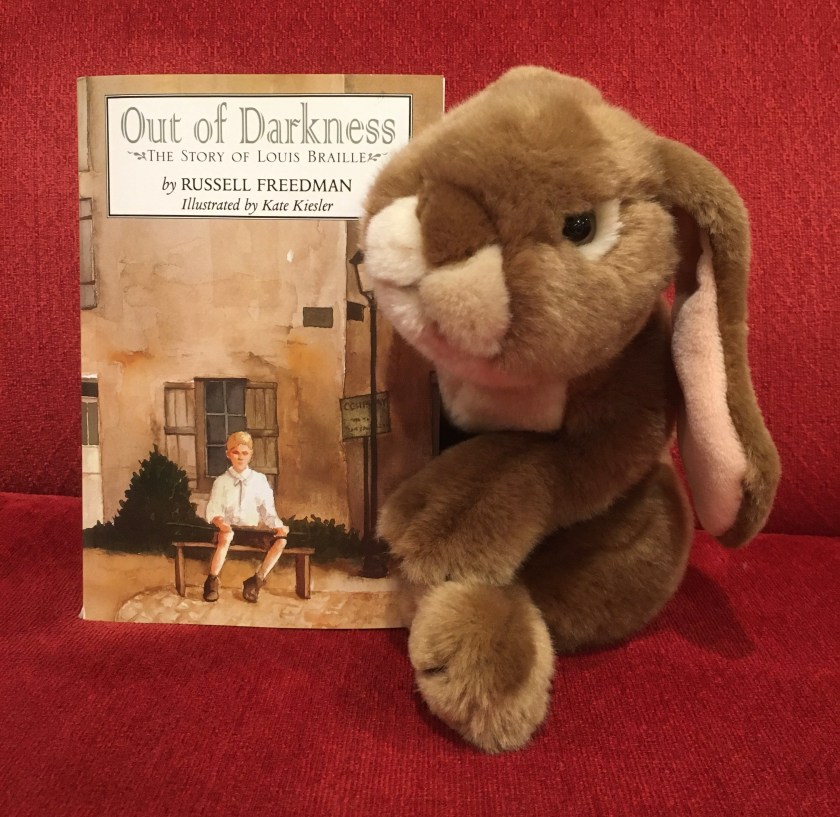
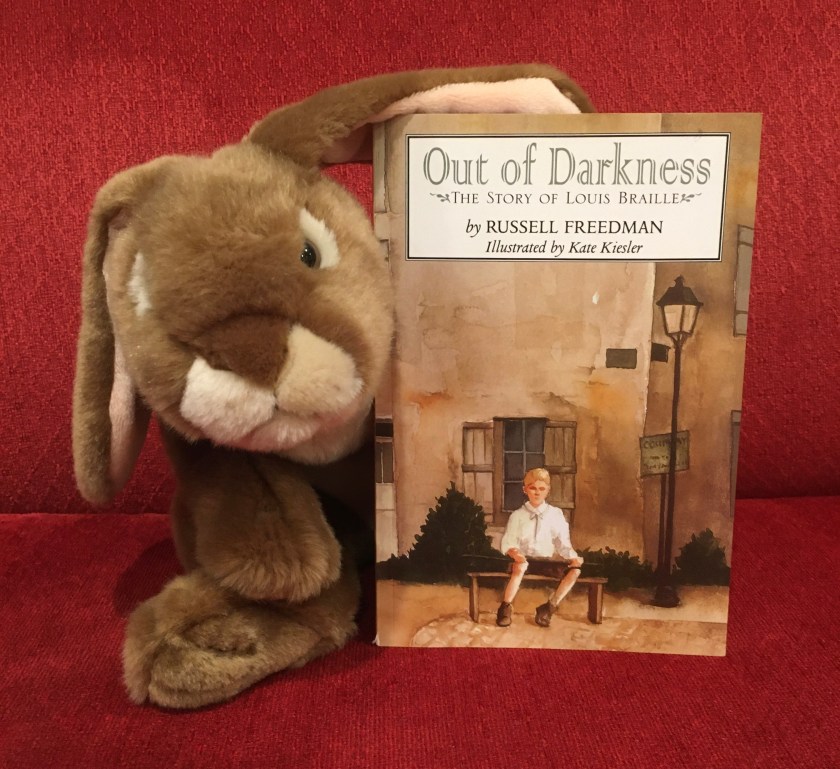
Caramel reviews Out of Darkness: The Story of Louis Braille by Russell Freedman

Today Caramel wanted to talk about Out of Darkness: The Story of Louis Braille, written by Russell Freedman and illustrated by Kate Kiesler. As usual Sprinkles is taking notes and asking questions.

Caramel reviews Out of Darkness: The Story of Louis Braille, written by Russell Freedman and illustrated by Kate Kiesler.

Sprinkles: Caramel, tell me a bit about this book.

Caramel: This book is about the life of Louis Braille. Braille is the person who invented the Braille alphabet. The Braille alphabet is used by people who cannot see to read and write.

S: Did you know about him before reading the book?

C: No. I had heard of the Braille alphabet, and I thought it was probably invented by someone named Braille, but I did not know anything else about Braille.

S: So you learned about his life from this book. Tell us about him a bit.

C: Louis Braille was not born blind. He could see at some point but when he was four, one of his eyes got poked out and his other eye got infected and he lost both.

S: Yes, I read that part too. It is a sad accident that leads to the loss of one eye and the infection on the other eye. It is really sad.

C: Yes very sad. And also because the infection could probably be cured today.

S: Yes. It is possible. But he was living in the first half of the nineteenth century, and they did not have antibiotics or anything else to fight infections with.

C: Yes. They did use leeches for some medical purposes, which is weird.

S: Yes, I think so too. But apparently they still use leeches for some medical purposes!

C: I did not know that! That is so strange. I learn something new every day!

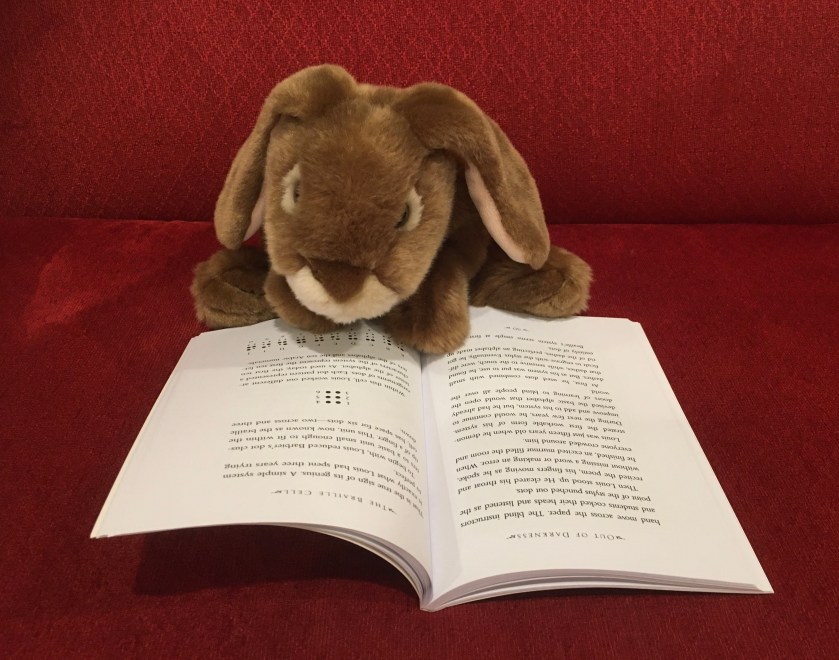
Caramel is reading Out of Darkness: The Story of Louis Braille, written by Russell Freedman and illustrated by Kate Kiesler He is on the page where the Braille alphabet is being described. .

S: Tell me more about the book.

C: If you like biographies, you would probably like this book. It is about a young person doing some really big and important things. Like inventing an entirely new alphabet! And he was also blind!

S: Yes, but maybe being blind, he knew what would help him better than seeing people who assumed that everybody should use the same alphabet. In the book we learn that Louis as a student learns about a writing system devised by an army captain and then modifies it in novel ways that would make it practical and easy to learn and use.

C: Yes. The government and the school do not want to use his system at first.

S: Yes, first his school has a headmaster who likes his ideas but once he is replaced, the new director bans its use.

C: The students already had been using it, but the new headmaster bans it. So they still use it, but in secret.

S: Yes, it is a very interesting story, isn’t it?

C: Yes, it definitely is. But it is also very sad.

S: Why do you say that?

C: Because he works so hard to develop this alphabet, he works when everybody is sleeping. But then people do not want to use it.

S: But in the end things work out, don’t they?

C: Yes. But he also dies.

S: Yes, people do die, but you are right that his death is sad too.

C: He dies from tuberculosis, and we can cure it today, right?

S: Yes, that is true and it is indeed sad. But at least he knew his alphabet was being used and was much appreciated by then. So what three words would you use to describe this book?

C: Fascinating, biography, black-and-white illustrations.

S: Hmm, that is a few more words than three, but I’ll let it be. What do you want to tell our readers as we wrap up this review?

C: Stay tuned for more book bunny reviews!

Caramel has appreciated reading Out of Darkness: The Story of Louis Braille, written by Russell Freedman and illustrated by Kate Kiesler, and recommends it to other little bunnies who might like to learn about a young person who overcame big obstacles and achieved great things.

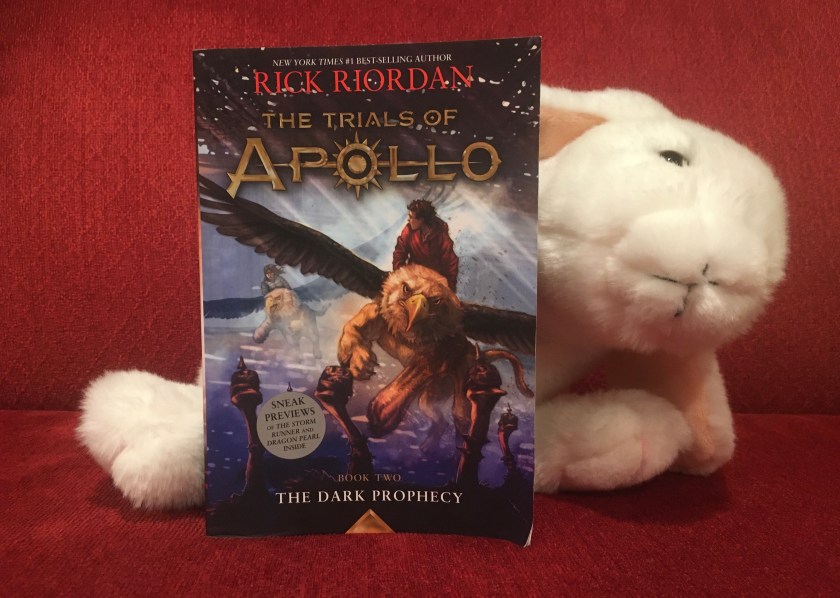
Marshmallow reviews The Dark Prophecy (Book 2 of the Trials of Apollo Series) by Rick Riordan

Marshmallow wrapped up 2020 with a review of The Hidden Oracle, the first book in Rick Riordan’s Trials of Apollo series. She begins 2021 with a review of The Dark Prophecy, the second book in the series.

Marshmallow reviews The Dark Prophecy (Book 2 of the Trials of Apollo Series) by Rick Riordan.

Marshmallow’s Quick Take: If you have enjoyed reading some of Rick Riordan’s books or if you just like reading about Greek mythology, then this might be the book for you.

Marshmallow’s Summary (with Spoilers): Apollo has been transformed into a teenager with flab, acne, and no “eight-pack abs”. His demigod master has left him and now he has been flying with two other heroes (whom we have met before in the Heroes of Olympus series). Finally they land in Indiana, only to find that a lot of the people there are not human, they are blemmyae, monsters that are pretending to be humans, waiting for Apollo. Apollo and his two friends are captured by these blemmyae, but luckily for our heroes, the blemmyae are obsessed with being “polite” so when they are going to try to kill Apollo, they are still obsessed with making sure that they say thank you. So when they are trying to kill him, they are sure to make sure that they listen to his “last words”, which turns out to be a hilarious summary of the first book

Eventually Apollo and his friends are rescued and brought to a magical building. There is much to learn about this building. In this book, the reader will uncover some of those as well as some other secrets that Apollo keeps buried deep inside.  

Marshmallow is reading The Dark Prophecy (Book 2 of the Trials of Apollo Series) by Rick Riordan

Marshmallow’s Review: I think that all of Rick Riordan’s book in general, at least the ones I have read, are all really well thought-out and really well-written. This one, especially, is very well thought out as the author takes mythology and adds it to his own earlier stories to make a very well designed and intricate plot. If you know a thing or two about Roman history, then that might help you because at the beginning you don’t exactly know everything about who the bad guys are. There are clues of course: the clues are stuff like someone whose name means “Little Booties” and someone who likes to think of himself as “The New Hercules” and more.

But if you are going to read this series, like always, I will recommend that you start by reading the first two series, Percy Jackson and the Olympians and Heroes of Olympus. The characters’ background stories from earlier series add a lot to the current series.

This is a great book for all readers, but it may confuse younger readers, as the story gets a bit convoluted (in a good way!), so maybe it is better for ages 7 and up.   

Marshmallow’s Rating: 100%.

Marshmallow rates The Dark Prophecy (Book 2 of the Trials of Apollo Series) by Rick Riordan 100%.